. 2021 Feb 24;288(1945):20203169.
doi: 10.1098/rspb.2020.3169. Epub 2021 Feb 24.

Conservation and turnover of miRNAs and their highly complementary targets in early branching animals

Affiliations

Conservation and turnover of miRNAs and their highly complementary targets in early branching animals

Daniela Praher et al. Proc Biol Sci. .

Erratum in

Abstract

MicroRNAs (miRNAs) are crucial post-transcriptional regulators that have been extensively studied in Bilateria, a group comprising the majority of extant animals, where more than 30 conserved miRNA families have been identified. By contrast, bilaterian miRNA targets are largely not conserved. Cnidaria is the sister group to Bilateria and thus provides a unique opportunity for comparative studies. Strikingly, like their plant counterparts, cnidarian miRNAs have been shown to predominantly have highly complementary targets leading to transcript cleavage by Argonaute proteins. Here, we assess the conservation of miRNAs and their targets by small RNA sequencing followed by miRNA target prediction in eight species of Anthozoa (sea anemones and corals), the earliest-branching cnidarian class. We uncover dozens of novel miRNAs but only a few conserved ones. Further, given their high complementarity, we were able to computationally identify miRNA targets in each species. Besides evidence for conservation of specific miRNA target sites, which are maintained between sea anemones and stony corals across 500 Myr of evolution, we also find indications for convergent evolution of target regulation by different miRNAs. Our data indicate that cnidarians have only few conserved miRNAs and corresponding targets, despite their high complementarity, suggesting a high evolutionary turnover.

Keywords: cnidaria; conservation; miRNAs; microRNA targets; microRNAs; turnover.


Figures
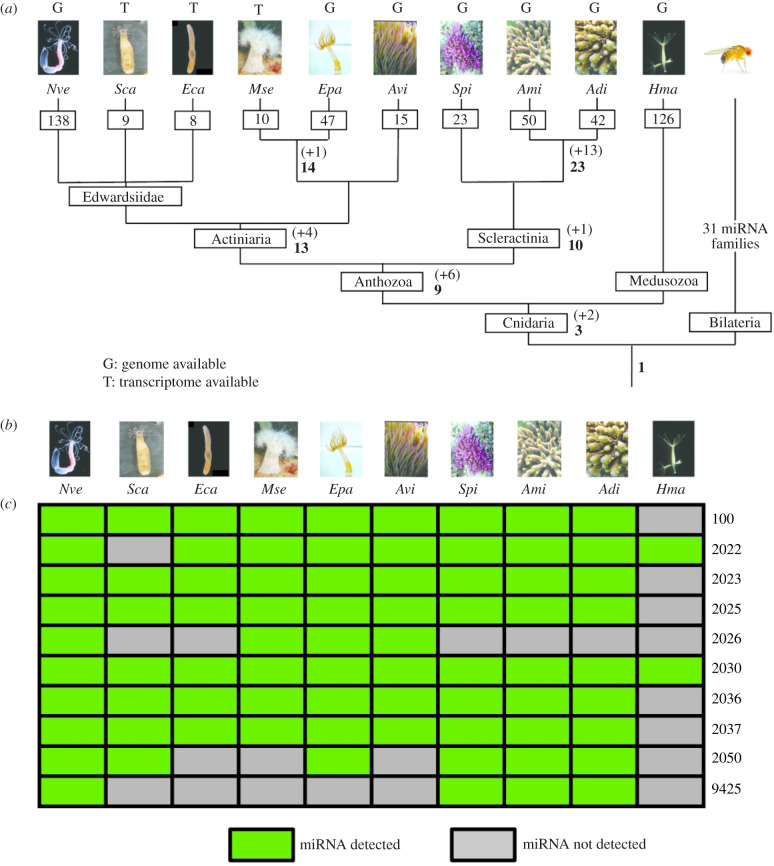
Figure 1.
Figure 1.
Anthozoan miRNAs. (a) Evolutionary gains of miRNAs within Cnidaria. Numbers in bold at nodes of the phylogenetic tree represent the total number of shared miRNAs, while numbers in brackets with a+sign indicate gains. Numbers in squares on top of the branches describe total numbers of identified miRNAs in each species. Letter above each species indicates the availability of a published genome (‘G’ for Nve, Epa, Avi, Spi, Ami, Adi and Hma) or a transcriptome (‘T’ for Sca, Ecal, Mse) for the respective species. Data from Hma were taken from [8]. Abbreviations: Nve, Nematostella vectensis, Eca, Edwardsiella carnea; Epa, Exaiptasia pallida, Sca, Scolanthus callimorphus; Mse, Metridium senile; Avi, Anemonia viridis; Spi, Stylophora pistillata; Ami, Acropora millepora; Adi, Acropora digitifera; Hma, Hydra magnipapillata; Dre, Danio rerio. (b) Conservation of the core set of anthozoan miRNAs shared between at least four species. Green squares indicate presence of miRNAs whereas grey squares reflect that the miRNA is not expressed [21].
Figure 2.
Figure 2.
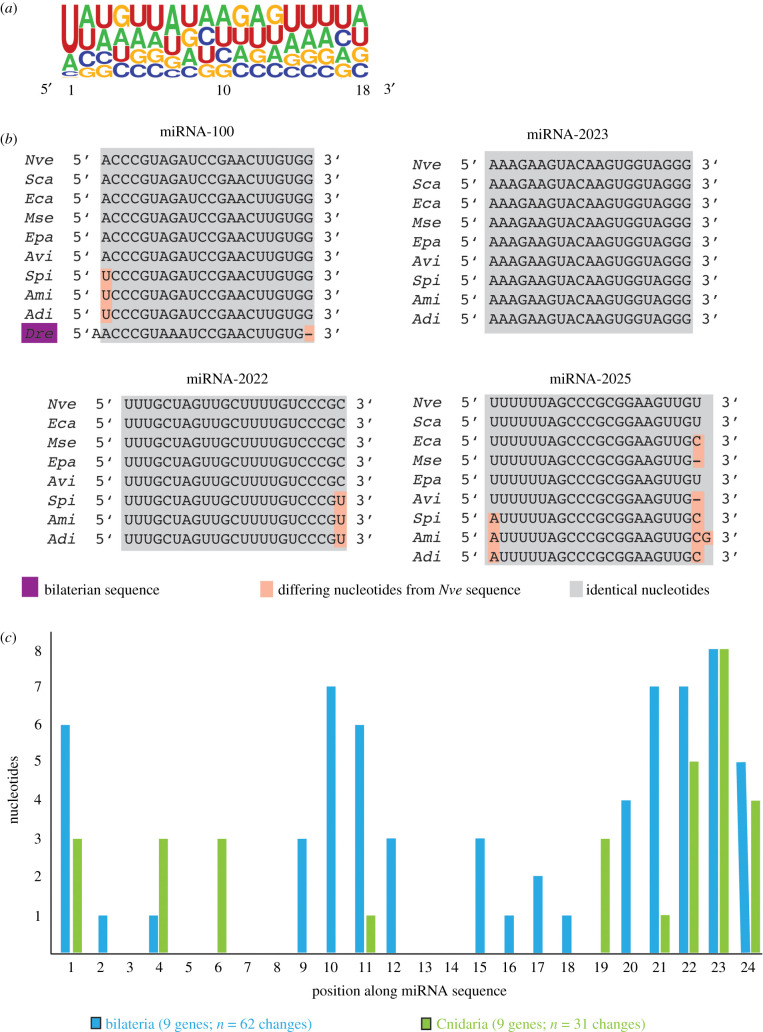
Features of anthozoan miRNA sequences. (a) Sequence logo of nucleotides bias of anthozoan miRNAs. Despite overall low bias of nucleotides along the miRNA sequences, a notable U bias at position 1 can be detected, which is a known characteristic of miRNAs in bilaterian species. (b) Conservation of the mature miRNA sequence exemplified by miRNA-100, miRNA-2022, miRNA-2023 and miRNA-2025 within investigated cnidarian species. Note the low number of nucleotide changes, especially for miRNA-2025 whose sequence does not experience any substitution. (c) Comparison of the evolutionary dynamics of miRNA sequences in Bilateria (blue) and Cnidaria (green). For each phylum, nine conserved miRNA genes were analysed. In Bilateria, the sequences gained 62 changes in total, whereas cnidarian sequences only had 31.
Figure 3.
Figure 3.
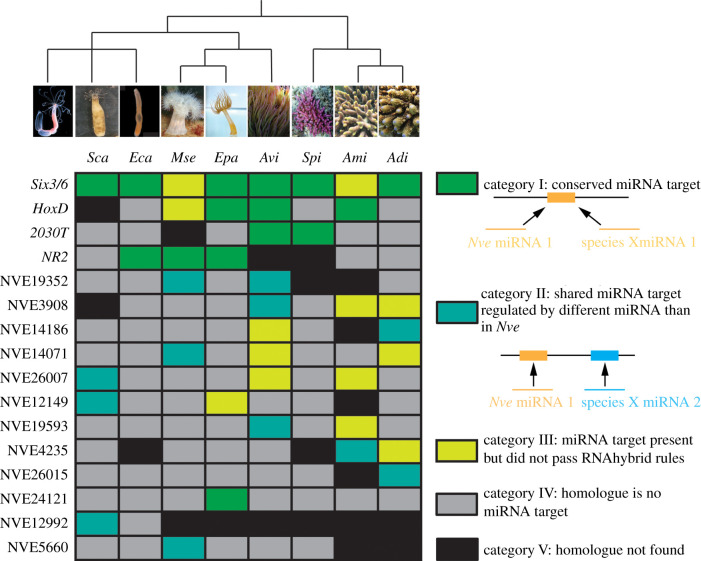
miRNA targets in Cnidaria. (a) Conserved and shared miRNA targets between Nve and at least one other investigated species. miRNA targets are labelled with their gene model annotation of the Nve homologues. Blast hits for the gene models are: NVE12346: Six3/6, NVE21156: HoxD, NVE19315: uncharacterized protein (previously described as 2030T [10], NVE18870: uncharacterized protein (previously described as Nematogalectin related 2 (NR2; [10]), NVE19352: fer1l3 protein, NVE3908: serine/threonine-protein kinase PRP4, NVE14186: F-actin-capping protein subunit beta, NVE14071: f-box wd repeat-containing protein 4, NVE26007: centrosomal protein of 290 kDa-like, NVE12149: eukaryotic translation initiation factor 3 subunit j, NVE19593: E3 ubiquitin-protein ligase IRF2BPL, NVE 4235: delta alicitoxin-Pse2b, NVE26015: uncharacterized protein, NVE24121: cAMP-dependent protein kinase type I-alpha regulatory subunit, NVE12992: titin-like, NVE5660: heterogeneous nuclear ribonucleoprotein A0.
Figure 4.
Figure 4.
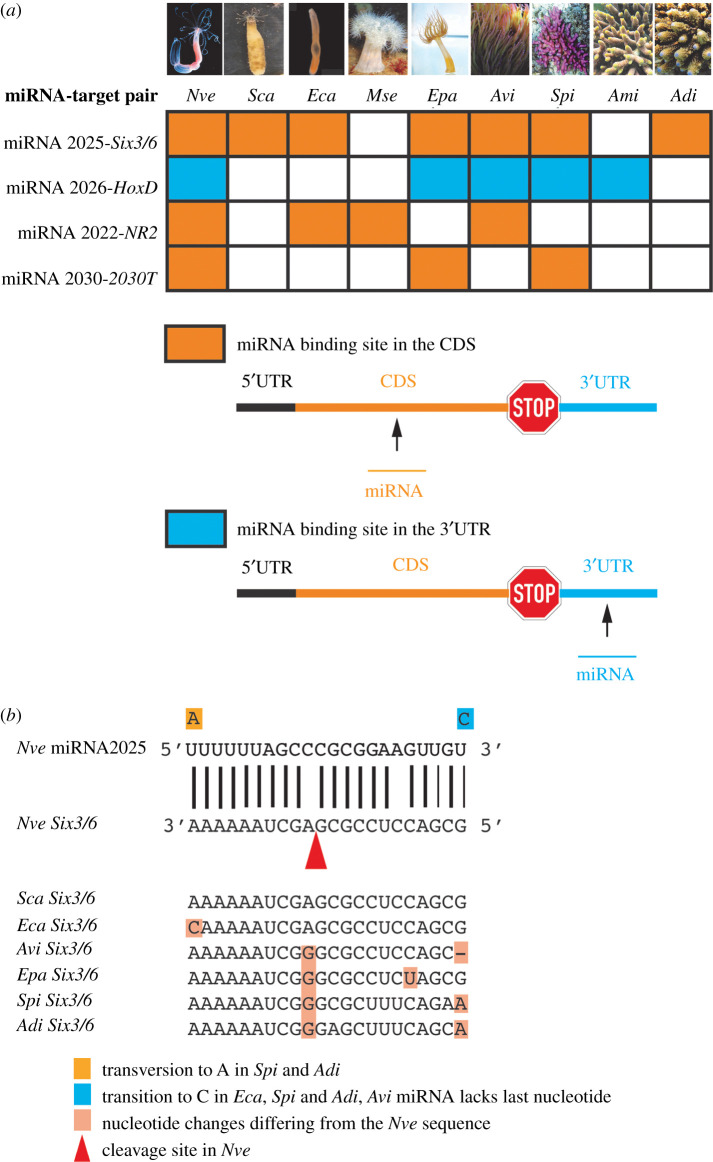
Conservation of miRNA binding sites in Cnidaria. (a) The conserved miRNA targets are regulated by the same miRNA in Nve and other investigated species and keep their genomic location of the miRNA binding site. Abbreviations: UTR, untranslated region. (b) Conservation of the miRNA binding site in Six3/6, target of miRNA-2025, in investigated species. Six3/6 is cleaved in Nve (position indicated by the arrowhead). This represents the most ancient miRNA target interaction known to date. Abbreviations: Nve, Nematostella vectensis, Eca, Edwardsiella carnea; Epa, Exaiptasia pallida; Sca, Scolanthus callimorphus; Mse, Metridium senile; Avi, Anemonia viridis; Spi, Stylophora pistillata; Ami, Acropora millepora; Adi, Acropora digitifera.

References

    1. Rhoades MW, Reinhart BJ, Lim LP, Burge CB, Bartel B, Bartel DP. 2002. Prediction of plant microRNA targets. Cell 110, 513-520. - PubMed
    1. Hutvagner G, Simard MJ. 2008. Argonaute proteins: key players in RNA silencing. Nat. Rev. Mol. Cell Biol. 9, 22-32. ( 10.1038/nrm2321) - DOI - PubMed
    1. Bartel DP. 2009. MicroRNAs: target recognition and regulatory functions. Cell 136, 215-233. ( 10.1016/j.cell.2009.01.002) - DOI - PMC - PubMed
    1. Voinnet O. 2009. Origin, biogenesis, and activity of plant microRNAs. Cell 136, 669-687. ( 10.1016/j.cell.2009.01.046) - DOI - PubMed
    1. Hejnol A, et al. 2009. Assessing the root of bilaterian animals with scalable phylogenomic methods. Proc. R. Soc. B 276, 4261-4270. ( 10.1098/rspb.2009.0896) - DOI - PMC - PubMed

Publication types

LinkOut - more resources