


Multi-Night Validation of a Sleep Tracking Ring in Adolescents Compared with a Research Actigraph and Polysomnography
- PMID: 33623459
- PMCID: PMC7894804
- DOI: 10.2147/NSS.S286070
Multi-Night Validation of a Sleep Tracking Ring in Adolescents Compared with a Research Actigraph and Polysomnography
Abstract
Background: Wearable devices have tremendous potential for large-scale longitudinal measurement of sleep, but their accuracy needs to be validated. We compared the performance of the multisensor Oura ring (Oura Health Oy, Oulu, Finland) to polysomnography (PSG) and a research actigraph in healthy adolescents.
Methods: Fifty-three adolescents (28 females; aged 15-19 years) underwent overnight PSG monitoring while wearing both an Oura ring and Actiwatch 2 (Philips Respironics, USA). Measurements were made over multiple nights and across three levels of sleep opportunity (5 nights with either 6.5 or 8h, and 3 nights with 9h). Actiwatch data at two sensitivity settings were analyzed. Discrepancies in estimated sleep measures as well as sleep-wake, and sleep stage agreements were evaluated using Bland-Altman plots and epoch-by-epoch (EBE) analyses.
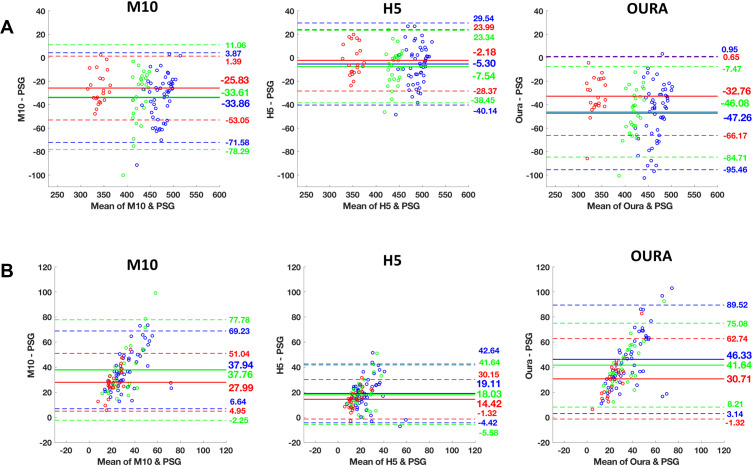
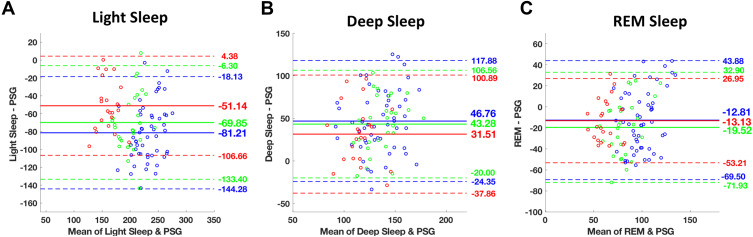
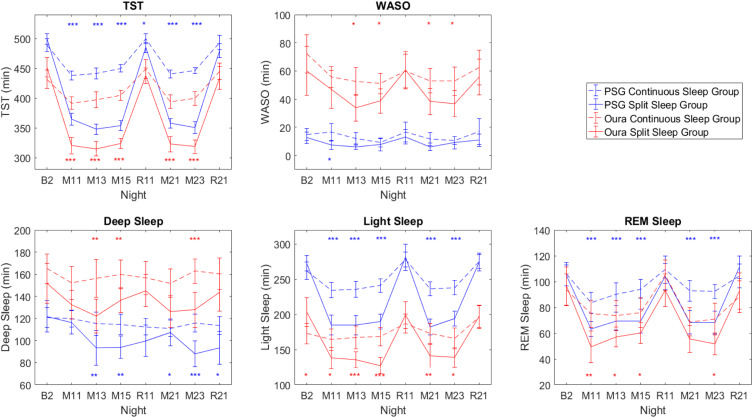
Results: Compared with PSG, Oura consistently underestimated TST by an average of 32.8 to 47.3 minutes (Ps < 0.001) across the different TIB conditions; Actiwatch 2 at its default setting underestimated TST by 25.8 to 33.9 minutes. Oura significantly overestimated WASO by an average of 30.7 to 46.3 minutes. It was comparable to Actiwatch 2 at default sensitivity in the 6.5, and 8h TIB conditions. Relative to PSG, Oura significantly underestimated REM sleep (12.8 to 19.5 minutes) and light sleep (51.1 to 81.2 minutes) but overestimated N3 by 31.5 to 46.8 minutes (Ps < 0.01). EBE analyses demonstrated excellent sleep-wake accuracies, specificities, and sensitivities - between 0.88 and 0.89 across all TIBs.
Conclusion: The Oura ring yielded comparable sleep measurement to research grade actigraphy at the latter's default settings. Sleep staging needs improvement. However, the device appears adequate for characterizing the effect of sleep duration manipulation on adolescent sleep macro-architecture.
Keywords: actigraphy; adolescents; polysomnography; validation; wearable.
© 2021 Chee et al.
Conflict of interest statement
The Oura rings used in this study were supplied by Oura Health Oy for the collection of PSG data for the company’s internal use. The contents of this report were independently generated. The authors report no financial or other conflicts of interest in this work.
Figures
References
-
- Ancoli-Israel S. Actigraphy In: Kryger M, Roth T, Dement W, editors. Principles and Practice of Sleep Medicine. Philadelphia: W.B. Saunders; 2000:1295–1301.
-
- Colburn TR, Smith BM, Guarini JJ, Simmons NN. An ambulatory activity monitor with solid state memory. ISA Trans. 1976;15(2):149–154. - PubMed
LinkOut - more resources
Full Text Sources
Other Literature Sources
