


Suggestions on cleavage embryo and blastocyst vitrification/transfer based on expression profile of ACE2 and TMPRSS2 in current COVID-19 pandemic
- PMID: 33624358
- PMCID: PMC8014618
- DOI: 10.1002/mrd.23456
Suggestions on cleavage embryo and blastocyst vitrification/transfer based on expression profile of ACE2 and TMPRSS2 in current COVID-19 pandemic
Abstract
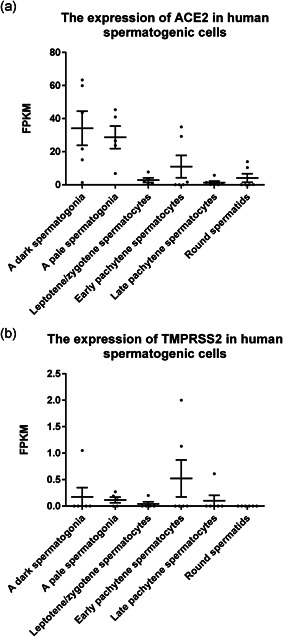
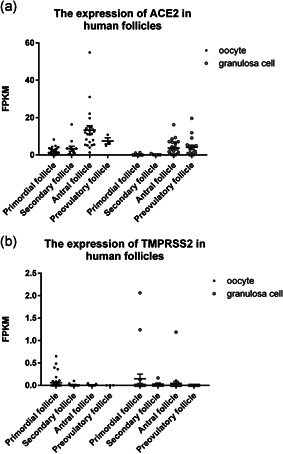
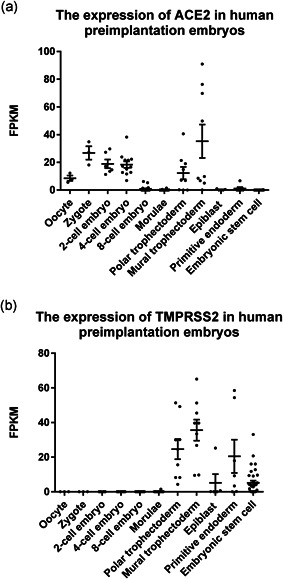
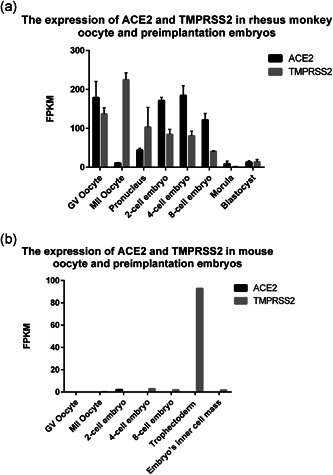
An outbreak of severe acute respiratory syndrome coronavirus 2 (SARS-CoV-2) is leading to an unprecedented worldwide health crisis. SARS-CoV-2 cell entry depends on ACE2 and TMPRSS2. Our objectives are to analysis the expression profile of ACE2 and TMPRSS2 in human spermatogenic cells, follicle cells, and preimplantation embryos, thereby providing mechanistic insights into viral entry and viral impact on reproduction. We found that ACE2 is mainly expressed during gametogenesis in spermatogonia and oocytes of antral follicles, granulosa cells of antral follicles and pre-ovulatory follicles, while TMPRSS2 almost has no expression in spermatogenic cells, oocytes or granulosa cells. In preimplantation embryos, ACE2 is expressed in early embryos before eight-cell stage, and trophectoderm of late blastocysts, while TMPRSS2 initiates its robust expression in late blastocyst stage. ACE2 and TMPRSS2 only show significant co-expression in trophectoderm of late blastocysts in all above cell types. We speculate that trophectoderm of late blastocysts is susceptible to SARS-CoV-2, and that the chance of SARS-CoV-2 being passed on to offspring through gametes is very low. Therefore, we propose that fertility preservation for COVID-19 patients is relatively safe and rational. We also recommend embryo cryopreservation and embryo transfer into healthy recipient mother at cleavage stage instead of blastocyst stage. Moreover, we unexpectedly found that co-expression pattern of ACE2 and TMPRSS2 in oocytes and preimplantation embryos in human, rhesus monkey and mouse are totally different, so animal models have significant limitations for evaluating transmission risk of SARS-CoV-2 in reproduction.
Keywords: ACE2; SARS-CoV-2; TMPRSS2; assisted reproductive technology; reproduction.
© 2021 Wiley Periodicals LLC.
Conflict of interest statement
The authors declare that there are no conflict of interests.
Figures
References
-
- Adrian, M. , Dubochet, J. , & Lepault, J. (1984). Cryo‐electron microscopy of viruses. Nature, 308, 32–36. - PubMed
Publication types
MeSH terms
Substances
Associated data
- Actions
- Actions
- Actions
- Actions
- Actions
- Actions
Grants and funding
LinkOut - more resources
Full Text Sources
Other Literature Sources
Miscellaneous
