


A Machine Learning Approach to Predict Deep Venous Thrombosis Among Hospitalized Patients
- PMID: 33625875
- PMCID: PMC7907939
- DOI: 10.1177/1076029621991185
A Machine Learning Approach to Predict Deep Venous Thrombosis Among Hospitalized Patients
Abstract
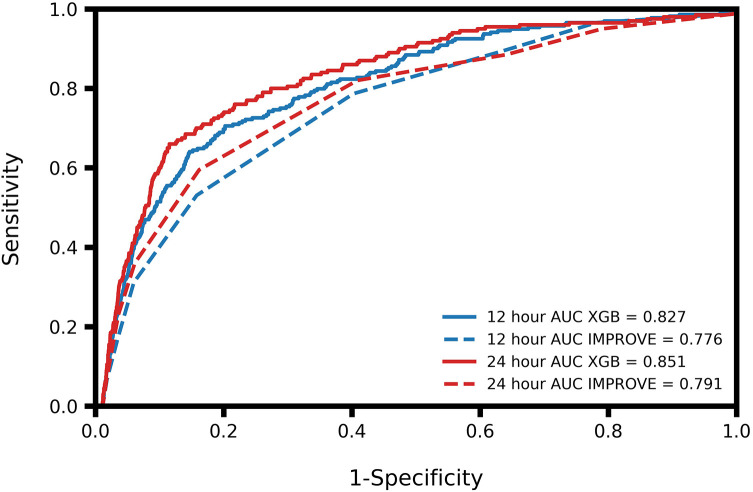
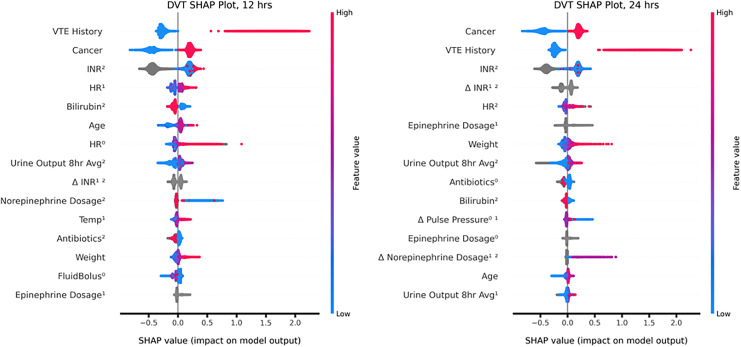
Deep venous thrombosis (DVT) is associated with significant morbidity, mortality, and increased healthcare costs. Standard scoring systems for DVT risk stratification often provide insufficient stratification of hospitalized patients and are unable to accurately predict which inpatients are most likely to present with DVT. There is a continued need for tools which can predict DVT in hospitalized patients. We performed a retrospective study on a database collected from a large academic hospital, comprised of 99,237 total general ward or ICU patients, 2,378 of whom experienced a DVT during their hospital stay. Gradient boosted machine learning algorithms were developed to predict a patient's risk of developing DVT at 12- and 24-hour windows prior to onset. The primary outcome of interest was diagnosis of in-hospital DVT. The machine learning predictors obtained AUROCs of 0.83 and 0.85 for DVT risk prediction on hospitalized patients at 12- and 24-hour windows, respectively. At both 12 and 24 hours before DVT onset, the most important features for prediction of DVT were cancer history, VTE history, and internal normalized ratio (INR). Improved risk stratification may prevent unnecessary invasive testing in patients for whom DVT cannot be ruled out using existing methods. Improved risk stratification may also allow for more targeted use of prophylactic anticoagulants, as well as earlier diagnosis and treatment, preventing the development of pulmonary emboli and other sequelae of DVT.
Keywords: algorithms; deep venous thrombosis; machine learning; risk assessment; venous thromboembolism.
Conflict of interest statement
Figures
References
-
- White R H. The epidemiology of venous thromboembolism. Circulation. 2003;107(23_suppl_1):I–4. - PubMed
-
- Mahan CE, Holdsworth MT, Welch SM, Borrego M, Spyropoulos AC. Deep-vein thrombosis: a United States cost model for a preventable and costly adverse event. Thromb Haemost. 2011;106(3):405–415. - PubMed
-
- Kafeza M, Shalhoub J, Salooja N, Bingham L, Spagou K, Davies AH. A systematic review of clinical prediction scores for deep vein thrombosis. Phlebology. 2017;32(8):516–531. - PubMed
-
- Heit JA, Melton LJ, Lohse CM. et al. Incidence of venous thromboembolism in hospitalized patients vs community residents. Mayo Clin Proc. 2001;76(11):1102–1110. - PubMed
MeSH terms
LinkOut - more resources
Full Text Sources
Other Literature Sources
Medical
