


Relationship Between Coronavirus-Related eHealth Literacy and COVID-19 Knowledge, Attitudes, and Practices among US Adults: Web-Based Survey Study
- PMID: 33626015
- PMCID: PMC8006897
- DOI: 10.2196/25042
Relationship Between Coronavirus-Related eHealth Literacy and COVID-19 Knowledge, Attitudes, and Practices among US Adults: Web-Based Survey Study
Abstract
Background: During a global pandemic, it is critical that the public is able to rapidly acquire new and accurate health information. The internet is a major source of health information. eHealth literacy is the ability of individuals to find, assess, and use health information available on the internet.
Objective: The goals of this study were to assess coronavirus-related eHealth literacy and examine the relationship between eHealth literacy and COVID-19-related knowledge, attitudes, and practices (KAPs).
Methods: We conducted a web-based survey of a representative sample of 1074 US adults. We adapted the 8-item eHealth Literacy Scale to develop the Coronavirus-Related eHealth Literacy Scale (CoV-eHEALS) to measure COVID-19-related knowledge, conspiracy beliefs, and adherence to protective behaviors (eg, wearing facial masks and social distancing). Our analyses identified sociodemographic associations with the participants' CoV-eHEALS scores and an association between the CoV-eHEALS measure and COVID-19 KAPs.
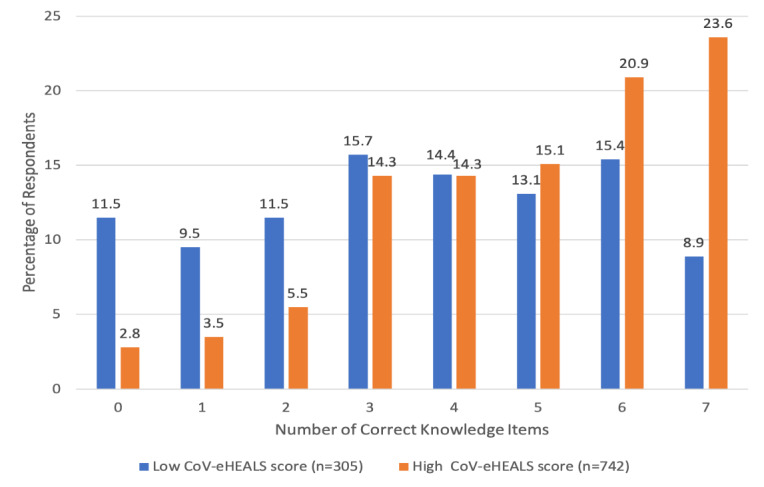
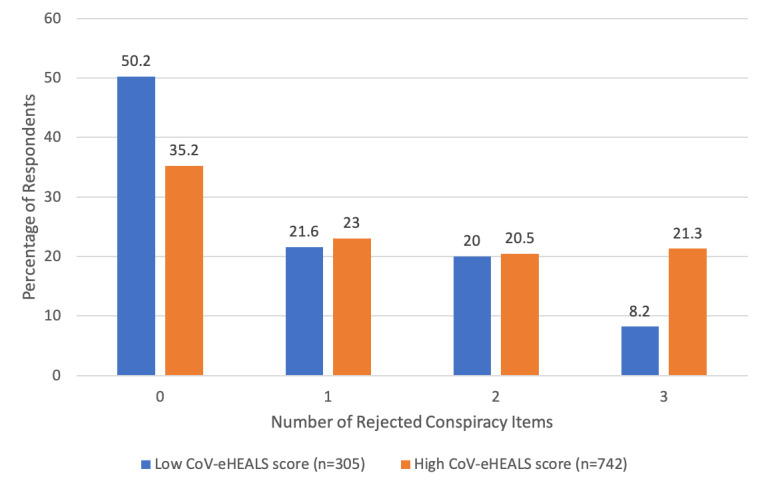
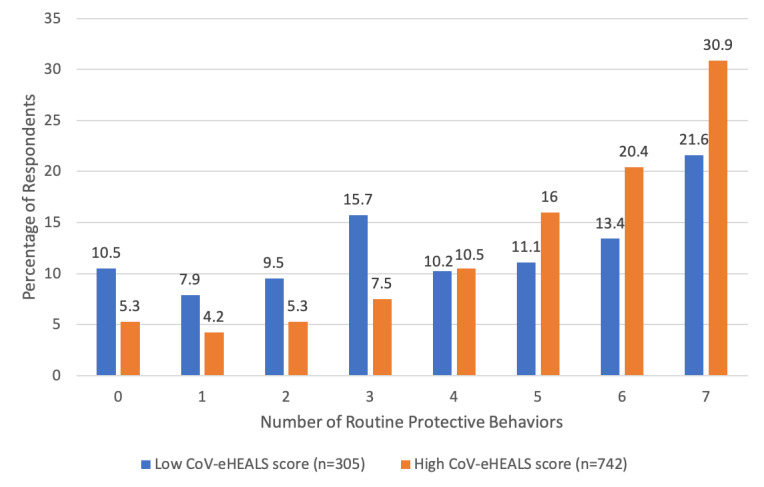
Results: The internal consistency of the adapted CoV-eHEALS measure was high (Cronbach α=.92). The mean score for the CoV-eHEALS was 29.0 (SD 6.1). A total of 29% (306/1074) of the survey participants were classified as having low coronavirus-related eHealth literacy (CoV-eHEALS score <26). Independent associations were found between CoV-eHEALS scores and ethnicity (standardized β=-.083, P=.016 for Black participants) and education level (standardized β=-.151, P=.001 for participants with high-school education or lower). Controlling for demographic characteristics, CoV-eHEALS scores demonstrated positive independent associations with knowledge (standardized β=.168, P<.001) and adherence to protective behaviors (standardized β=.241, P<.001) and a negative association with conspiracy beliefs (standardized β=-.082, P=.009).
Conclusions: This study provides an estimate of coronavirus-related eHealth literacy among US adults. Our findings suggest that a substantial proportion of US adults have low coronavirus-related eHealth literacy and are thus at a greater risk of lower and less-protective COVID-19 KAPs. These findings highlight the need to assess and address eHealth literacy as part of COVID-19 control efforts. Potential strategies include improving the quality of health information about COVID-19 available on the internet, assisting or simplifying web-based search for information about COVID-19, and training to improve general or coronavirus-specific search skills.
Keywords: COVID-19; attitude; behavior; conspiracy beliefs; coronavirus; digital health; eHealth; eHealth literacy; health communication; internet; knowledge; protective behaviors; social distancing; survey.
©Lawrence An, Elizabeth Bacon, Sarah Hawley, Penny Yang, Daniel Russell, Scott Huffman, Ken Resnicow. Originally published in the Journal of Medical Internet Research (http://www.jmir.org), 29.03.2021.
Conflict of interest statement
Conflicts of Interest: None declared.
Figures
References
-
- Brørs G, Norman C, Norekvål TM. Accelerated importance of eHealth literacy in the COVID-19 outbreak and beyond. Eur J Cardiovasc Nurs. 2020 Aug;19(6):458–461. doi: 10.1177/1474515120941307. https://journals.sagepub.com/doi/10.1177/1474515120941307?url_ver=Z39.88... - DOI - PMC - PubMed
-
- Chong Y, Cheng H, Chan H, Chien W, Wong S. COVID-19 pandemic, infodemic and the role of eHealth literacy. Int J Nurs Stud. 2020 Aug;108:103644. doi: 10.1016/j.ijnurstu.2020.103644. http://europepmc.org/abstract/MED/32447127 - DOI - PMC - PubMed
-
- Sentell T, Vamos S, Okan O. Interdisciplinary perspectives on health literacy research around the world: more important than ever in a time of COVID-19. Int J Environ Res Public Health. 2020 Apr 26;17(9):3010. doi: 10.3390/ijerph17093010. https://www.mdpi.com/resolver?pii=ijerph17093010 - DOI - PMC - PubMed
-
- Eysenbach G. How to fight an infodemic: the four pillars of infodemic management. J Med Internet Res. 2020 Jun 29;22(6):e21820. doi: 10.2196/21820. https://www.jmir.org/2020/6/e21820/ - DOI - PMC - PubMed
-
- Coronavirus disease (COVID-19) pandemic. World Health Organization. [2020-10-06]. https://www.who.int/emergencies/diseases/novel-coronavirus-2019.
MeSH terms
Grants and funding
LinkOut - more resources
Full Text Sources
Other Literature Sources
Medical
