


Distinct and dementia-related synaptopathy in the hippocampus after military blast exposures
- PMID: 33629462
- PMCID: PMC8412116
- DOI: 10.1111/bpa.12936
Distinct and dementia-related synaptopathy in the hippocampus after military blast exposures
Abstract
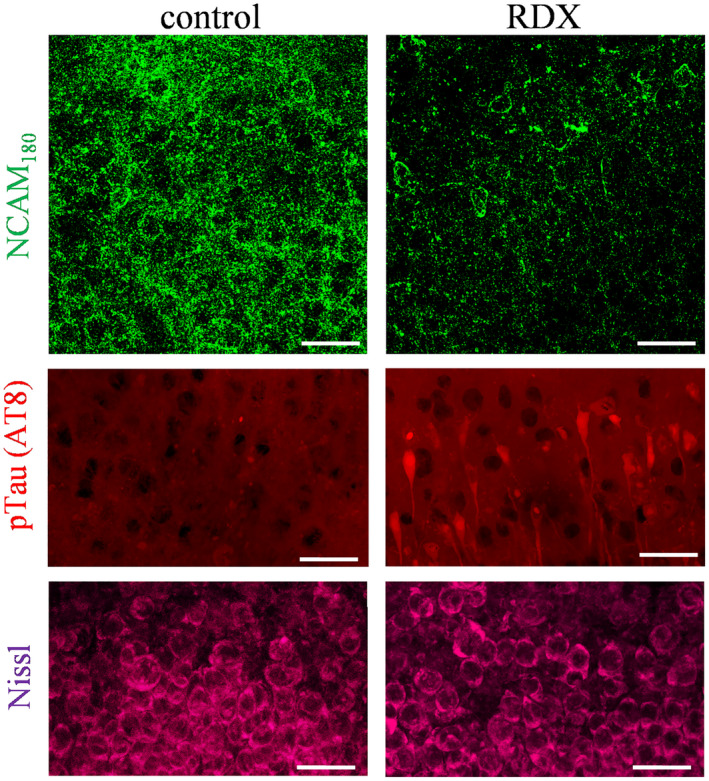
Explosive shockwaves, and other types of blast exposures, are linked to injuries commonly associated with military service and to an increased risk for the onset of dementia. Neurological complications following a blast injury, including depression, anxiety, and memory problems, often persist even when brain damage is undetectable. Here, hippocampal explants were exposed to the explosive 1,3,5-trinitro-1,3,5-triazinane (RDX) to identify indicators of blast-induced changes within important neuronal circuitries. Highly controlled detonations of small, 1.7-gram RDX spherical charges reduced synaptic markers known to be downregulated in cognitive disorders, but without causing overt neuronal loss or astroglial responses. In the absence of neuromorphological alterations, levels of synaptophysin, GluA1, and synapsin IIb were significantly diminished within 24 hr, and these synaptic components exhibited progressive reductions following blast exposure as compared to their stable maintenance in control explants. In contrast, labeling of the synapsin IIa isoform remained unaltered, while neuropilar staining of other markers decreased, including synapsin IIb and neural cell adhesion molecule (NCAM) isoforms, along with evidence of NCAM proteolytic breakdown. NCAM180 displayed a distinct decline after the RDX blasts, whereas NCAM140 and NCAM120 exhibited smaller or no deterioration, respectively. Interestingly, the extent of synaptic marker reduction correlated with AT8-positive tau levels, with tau pathology stochastically found in CA1 neurons and their dendrites. The decline in synaptic components was also reflected in the size of evoked postsynaptic currents recorded from CA1 pyramidals, which exhibited a severe and selective reduction. The identified indicators of blast-mediated synaptopathy point to the need for early biomarkers of explosives altering synaptic integrity with links to dementia risk, to advance strategies for both cognitive health and therapeutic monitoring.
Keywords: Alzheimer-type synaptopathogenesis; NBDP; NCAM breakdown products; mild traumatic brain injury; neurotrauma; synaptic decline.
© 2021 The Authors. Brain Pathology published by John Wiley & Sons Ltd on behalf of International Society of Neuropathology.
Conflict of interest statement
The authors declare that they have no competing interests. The funding agencies had no role in study design, data collection and analysis, or decision to publish.
Figures



References
-
- Brix KA, Brody DL, Grimes JB, Yitzhak A. Working Group Members . Military blast exposure and chronic neurodegeneration: summary of working groups and expert panel findings and recommendations. J Neurotrauma 2017;34(S1):S18–25.
-
- Department of Defense (DoD) . Data from “Worldwide numbers for traumatic brain injury”. https://dvbic.dcoe.mil/dod‐worldwide‐numbers‐tbi. Accessed May 15, 2020.
-
- Williamson V, Mulhall E. Invisible wounds: psychological and neurological injuries confront a new generation of veterans. Iraq and Afghanistan Veterans of America, Issue Report; 2009.
-
- Sawyer TW, Ritzel DV, Wang Y, Josey T, Villanueva M, Nelson P, et al. Primary blast causes delayed effects without cell death in shell‐encased brain cell aggregates. J Neurotrauma. 2018;35:174–86. - PubMed
Publication types
MeSH terms
Substances
Grants and funding
LinkOut - more resources
Full Text Sources
Other Literature Sources
Medical
Research Materials
Miscellaneous
