


Stronger Together: Results from a Randomized Controlled Efficacy Trial of a Dyadic Intervention to Improve Engagement in HIV Care Among Serodiscordant Male Couples in Three US Cities
- PMID: 33630199
- PMCID: PMC8247634
- DOI: 10.1007/s10461-021-03199-8
Stronger Together: Results from a Randomized Controlled Efficacy Trial of a Dyadic Intervention to Improve Engagement in HIV Care Among Serodiscordant Male Couples in Three US Cities
Abstract
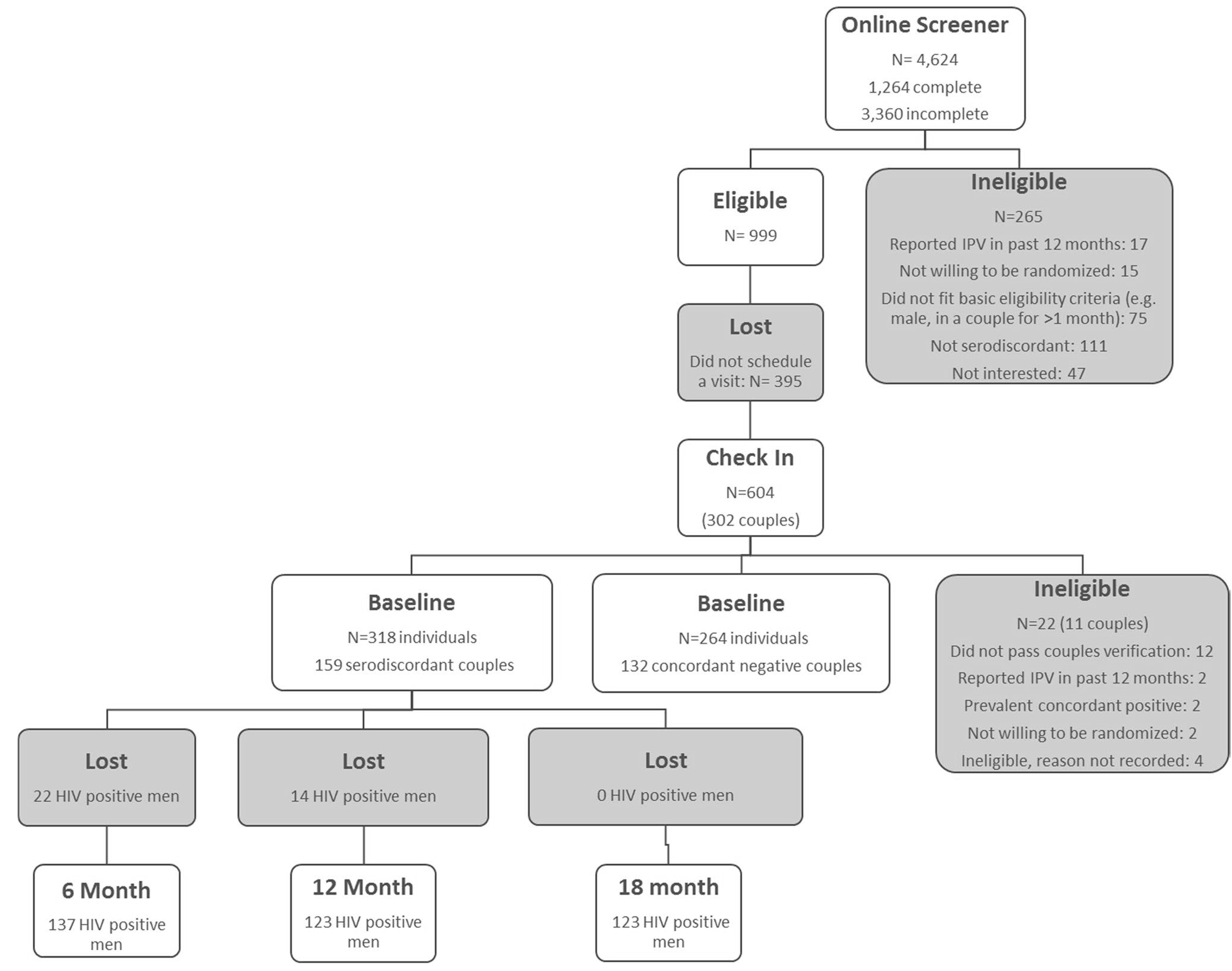
Engagement in HIV care and a high level of antiretroviral therapy (ART) adherence for people living with HIV is crucial to treatment success and can minimize the population burden of the disease. Despite this, there is a critical gap in HIV prevention science around the development of interventions for serodiscordant male couples. This paper reports on the results of a randomized controlled trial to assess the efficacy of Stronger Together, a dyadic counseling intervention aimed at increasing engagement in and optimizing HIV care among serodiscordant male couples in Atlanta, GA, Boston, MA, and Chicago, IL. Between 2014 and 2017, 159 male serodiscordant couples (total N = 318) in Atlanta, GA, Boston, MA, and Chicago, IL were enrolled and equally randomized to either the Stronger Together intervention arm (a three-session dyadic intervention involving HIV testing and adherence counseling) or a standard of care (SOC) control arm. Couples completed individual study assessments via an audio computer assisted self-interviewing (ACASI) system at baseline, 6, 12 and 18 months. Primary outcomes included being prescribed and currently taking ART, and fewer missed doses of ART in the past 30 days; because the trial was not powered to examine viral suppression, we examined this as an exploratory outcome. Longitudinal data analysis was by an intention-to-treat approach. Participants ages ranged from 18 to 69 (mean = 35.9), and are predominantly white (77.5%), and college educated (68.4% earned a college degree or higher). Participants randomized to the Stronger Together arm had a significantly greater odds of being prescribed and currently taking ART over time than those in the SOC arm (at 12 months OR 2.75, 95%CI 1.35-4.67, p-value 0.020, and at 18 months OR 2.91, 95%CI 1.61-4.88, p-value 0.013). Similarly, those in the Stronger Together arm had a significantly lower odds of missing a dose of ART in the past 30 days over time compared to those in the SOC arm (at 12 months OR 0.28, 95%CI 0.09-0.81, p-value 0.019, and at 18 months OR 0.25, 95%CI 0.07-0.82, p-value 0.023). Among male couples in serodiscordant relationships, the Stronger Together intervention resulted in significantly improved HIV treatment outcomes at both 12 and 18 months of follow-up. This trial is the first to date to demonstrate evidence of efficacy for a dyadic counseling intervention and has the potential to fill a critical gap in secondary HIV prevention interventions for serodiscordant male couples.
Keywords: Adherence; Behavioral interventions; Couples; Testing.
Figures
References
-
- Goldenberg T, Finneran C, Andes KL, Stephenson R. ‘Some-times people let love conquer them’: how love, intimacy, and trust in relationships between men who have sex with men influence perceptions of sexual risk and sexual decision-making. Cult Health Sex. 2015;17(5):607–22. 10.1080/13691058.2014.979884. - DOI - PMC - PubMed
Publication types
MeSH terms
Grants and funding
LinkOut - more resources
Full Text Sources
Other Literature Sources
Medical
Miscellaneous
