. 2021 Apr 3;9(2):1883965.
doi: 10.1080/21688370.2021.1883965. Epub 2021 Feb 26.

Airway tight junctions as targets of viral infections

Affiliations

Airway tight junctions as targets of viral infections

Debra T Linfield et al. Tissue Barriers. .

Abstract

The apical junctional complexes (AJCs) of airway epithelial cells are a key component of the innate immune system by creating barriers to pathogens, inhaled allergens, and environmental particles. AJCs form between adjacent cells and consist of tight junctions (TJs) and adherens junctions (AJs). Respiratory viruses have been shown to target various components of the AJCs, leading to airway epithelial barrier dysfunction by different mechanisms. Virus-induced epithelial permeability may allow for allergens and bacterial pathogens to subsequently invade. In this review, we discuss the pathophysiologic mechanisms leading to disruption of AJCs and the potential ensuing ramifications. We focus on the following viruses that affect the pulmonary system: respiratory syncytial virus, rhinovirus, influenza viruses, immunodeficiency virus, and other viruses such as coxsackievirus, adenovirus, coronaviruses, measles, parainfluenza virus, bocavirus, and vaccinia virus. Understanding the mechanisms by which viruses target the AJC and impair barrier function may help design therapeutic innovations to treat these infections.

Keywords: Respiratory Syncytial Virus (RSV); actin cytoskeleton; adherens junction; apical junctional complex; barrier dysfunction; epithelial barrier; epithelial cells; permeability; tight junction; trans-epithelial electrical resistance; viral infection.


Figures
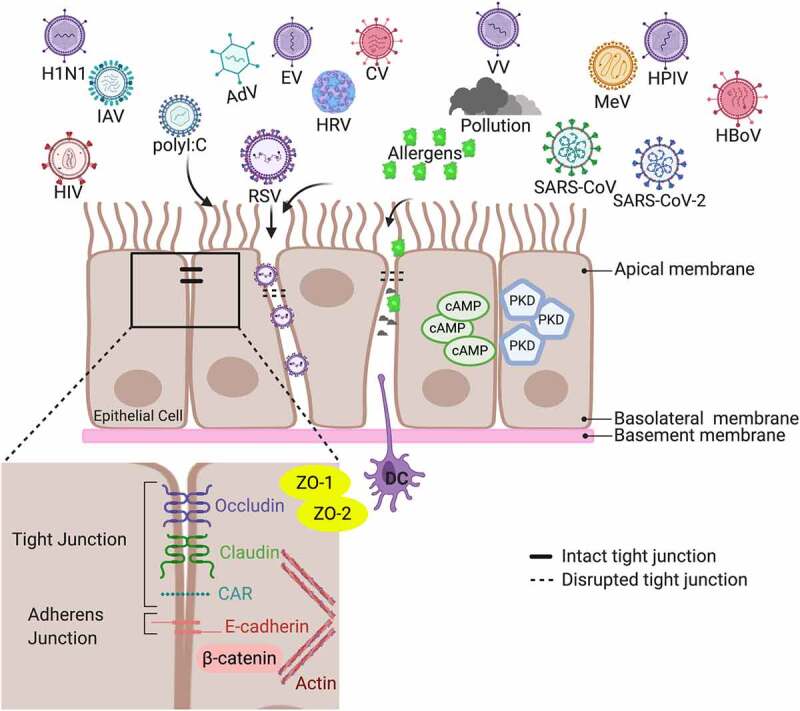
Figure 1.
Figure 1.
Structure of the airway epithelial cell apical junction complexes. The human airway comprises epithelium, surface mucus layers, and underlying immune cells, such as dendritic cells (DC). AJC form between neighboring cells and comprise TJ and AJ, which are associated with an underlying perijunctional actin cytoskeleton. Respiratory viruses can lead to AJC disassembly and disruption. Subsequently, virus-induced epithelial permeability may allow for allergens, environmental insults, like pollution and cigarette smoke, and bacterial pathogens to invade. An immune response, represented here with DC, is activated to combat the viral infection and reestablish the AJC and eliminate the bacterial pathogens and allergens that gained access to the internal system. Multiple pathways have been implicated in restoring the AJC barrier. Following RSV infection, cyclic adenosine cAMP and PKD-inhibitors have reduced viral replication and attenuated AJC disruption to restore the epithelial barrier. This image was created with BioRender.com

References

    1. Rezaee F, Georas SN.. Breaking barriers. New insights into airway epithelial barrier function in health and disease. Am J Respir Cell Mol Biol. 2014;50(5):1–19. doi:10.1165/rcmb.2013-0541RT. PubMed PMID: 24467704 - DOI - PMC - PubMed
    1. Georas SN, Rezaee F. Epithelial barrier function: at the front line of asthma immunology and allergic airway inflammation. J Allergy Clin Immunol. 2014;134(3):509–520. doi:10.1016/j.jaci.2014.05.049. PubMed PMID: 25085341; PMCID: PMC4170838 - DOI - PMC - PubMed
    1. Dong D, Xie W, Liu M. Alteration of cell junctions during viral infection. Thorac Cancer. 2020;11(3):519–525. Epub 2020/02/06. doi:10.1111/1759-7714.13344. PubMed PMID: 32017415; PMCID: PMC7049484. - DOI - PMC - PubMed
    1. Mineta K, Yamamoto Y, Yamazaki Y, Tanaka H, Tada Y, Saito K, Tamura A, Igarashi M, Endo T, Takeuchi K, et al. Predicted expansion of the claudin multigene family. FEBS Lett. 2011;585(4):606–612. Epub 2011/02/01. doi:10.1016/j.febslet.2011.01.028. PubMed PMID: 21276448. - DOI - PubMed
    1. Schneeberger EE, Lynch RD. The tight junction: a multifunctional complex. Am J Physiol Cell Physiol. 2004;286(6):C1213–28. Epub 2004/05/21. doi:10.1152/ajpcell.00558.2003. PubMed PMID: 15151915. - DOI - PubMed

Publication types
