


A qualitative inquiry of access to and quality of primary healthcare in seven communities in East and West Africa (SevenCEWA): perspectives of stakeholders, healthcare providers and users
- PMID: 33632135
- PMCID: PMC7908656
- DOI: 10.1186/s12875-021-01394-z
A qualitative inquiry of access to and quality of primary healthcare in seven communities in East and West Africa (SevenCEWA): perspectives of stakeholders, healthcare providers and users
Abstract
Background: Universal health coverage is one of the Sustainable Development Goal targets known to improve population health and reduce financial burden. There is little qualitative data on access to and quality of primary healthcare in East and West Africa. The aim of this study was to describe the viewpoints of healthcare users, healthcare providers and other stakeholders on health-seeking behaviour, access to and quality of healthcare in seven communities in East and West Africa.
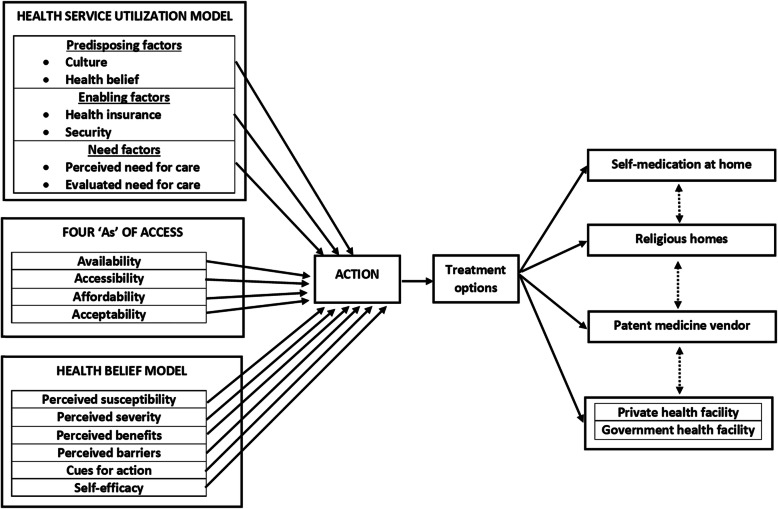
Methods: A qualitative study was conducted in four communities in Nigeria and one community each in Kenya, Uganda and Tanzania in 2018. Purposive sampling was used to recruit: 155 respondents (mostly healthcare users) for 24 focus group discussions, 25 healthcare users, healthcare providers and stakeholders for in-depth interviews and 11 healthcare providers and stakeholders for key informant interviews. The conceptual framework in this study combined elements of the Health Belief Model, Health Care Utilisation Model, four 'As' of access to care, and pathway model to better understand the a priori themes on access to and quality of primary healthcare as well as health-seeking behaviours of the study respondents. A content analysis of the data was done using MAXQDA 2018 qualitative software to identify these a priori themes and emerging themes.
Results: Access to primary healthcare in the seven communities was limited, especially use of health insurance. Quality of care was perceived to be unacceptable in public facilities whereas cost of care was unaffordable in private facilities. Health providers and users as well as stakeholders highlighted shortage of equipment, frequent drug stock-outs and long waiting times as major issues, but had varying opinions on satisfaction with care. Use of herbal medicines and other traditional treatments delayed or deterred seeking modern healthcare in the Nigerian sites.
Conclusions: There was a substantial gap in primary healthcare coverage and quality in the selected communities in rural and urban East and West Africa. Alternative models of healthcare delivery that address social and health inequities, through affordable health insurance, can be used to fill this gap and facilitate achieving universal health coverage.
Keywords: Access; Health-seeking behaviour; Kenya; Nigeria; Primary healthcare; Quality; Social entrepreneurship; Tanzania; Uganda; Universal health coverage.
Conflict of interest statement
The authors declare that they have no competing interests.
References
-
- World Health Organization (2008). The world health report. Primary Healthcare - Now More Than Ever http://www1pahoorg/hq/dmdocuments/2010/PHC_The_World_Health_Report-2008pdf Cited Dec 29 2018.
-
- World Health Organization (2017). Tracking Universal Health Coverage - Global Monitoring Report. World Health Organization and International Bank for Reconstruction and Development/The World Bank; 2017. Licence: CC BY-NC-SA 3.0 IGO. http://pubdocs.worldbank.org/en/193371513169798347/2017-global-monitorin.... Cited Apr 13 2019.
-
- World Health Organization . World health statistics. 2015.
-
- Ponsar F, Tayler-Smith K, Philips M, Gerard S, Van Herp M, Reid T, et al. No cash, no care: how user fees endanger health--lessons learnt regarding financial barriers to healthcare services in Burundi, Sierra Leone, Democratic Republic of Congo, Chad, Haiti and Mali. Int Health. 2011;3(Suppl 2):91–100. doi: 10.1016/j.inhe.2011.01.002. - DOI - PubMed
Publication types
MeSH terms
Grants and funding
LinkOut - more resources
Full Text Sources
Other Literature Sources
Research Materials
Miscellaneous
