


Performance of a fully-automated system on a WHO malaria microscopy evaluation slide set
- PMID: 33632222
- PMCID: PMC7905596
- DOI: 10.1186/s12936-021-03631-3
Performance of a fully-automated system on a WHO malaria microscopy evaluation slide set
Abstract
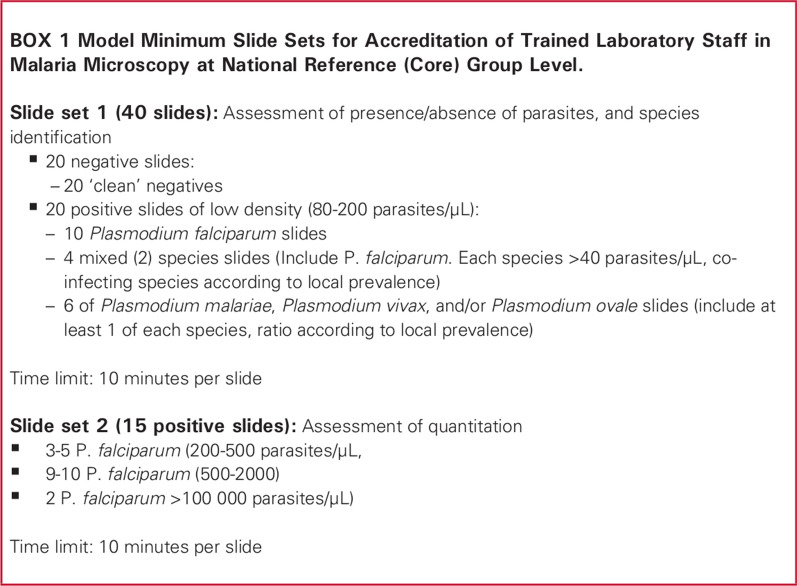
Background: Manual microscopy remains a widely-used tool for malaria diagnosis and clinical studies, but it has inconsistent quality in the field due to variability in training and field practices. Automated diagnostic systems based on machine learning hold promise to improve quality and reproducibility of field microscopy. The World Health Organization (WHO) has designed a 55-slide set (WHO 55) for their External Competence Assessment of Malaria Microscopists (ECAMM) programme, which can also serve as a valuable benchmark for automated systems. The performance of a fully-automated malaria diagnostic system, EasyScan GO, on a WHO 55 slide set was evaluated.
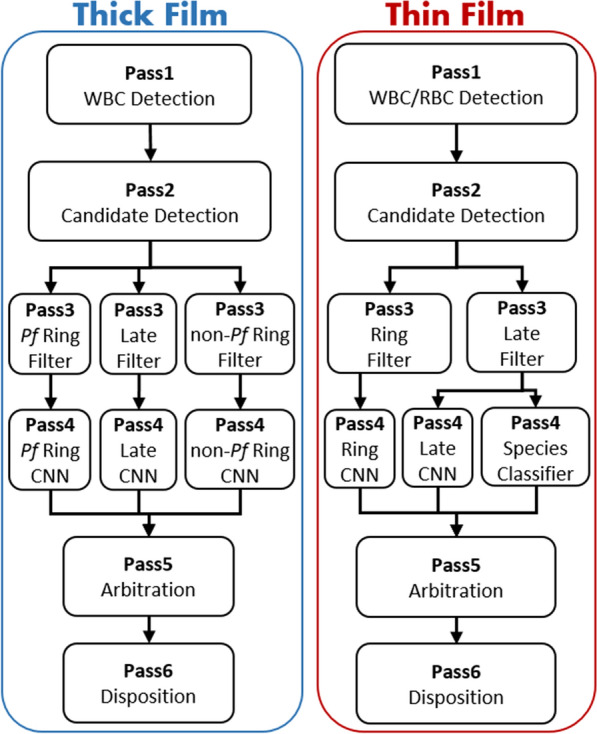
Methods: The WHO 55 slide set is designed to evaluate microscopist competence in three areas of malaria diagnosis using Giemsa-stained blood films, focused on crucial field needs: malaria parasite detection, malaria parasite species identification (ID), and malaria parasite quantitation. The EasyScan GO is a fully-automated system that combines scanning of Giemsa-stained blood films with assessment algorithms to deliver malaria diagnoses. This system was tested on a WHO 55 slide set.
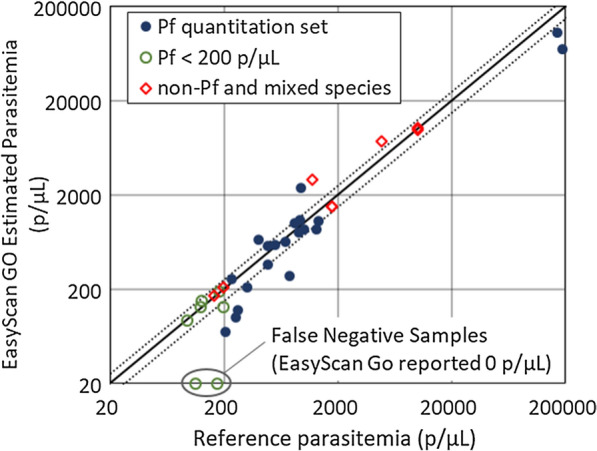
Results: The EasyScan GO achieved 94.3 % detection accuracy, 82.9 % species ID accuracy, and 50 % quantitation accuracy, corresponding to WHO microscopy competence Levels 1, 2, and 1, respectively. This is, to our knowledge, the best performance of a fully-automated system on a WHO 55 set.
Conclusions: EasyScan GO's expert ratings in detection and quantitation on the WHO 55 slide set point towards its potential value in drug efficacy use-cases, as well as in some case management situations with less stringent species ID needs. Improved runtime may enable use in general case management settings.
Keywords: Automated diagnosis; Machine learning; Malaria; Microscopy; WHO.
Conflict of interest statement
The authors declare that they have no competing interests.
Figures
References
-
- WHO. World Malaria Report 2019. Geneva, World Health Organization, 2019.
-
- Nazare-Pembele G, Rojas L, Nunez FA. Lack of knowledge regarding the microscopic diagnosis of malaria by technicians of the laboratory network in Luanda, Angola. Biomedica. 2016;36:149–55. - PubMed
-
- Delahunt CB, Jaiswal MS, Horning MP, Janko S, Thompson CM, Kulhare S, et al. Fully-automated patient-level malaria assessment on field-prepared thin blood film microscopy images. In: Proc Global Humanitarian Technologies Conf. 2019;1–8.
MeSH terms
LinkOut - more resources
Full Text Sources
Other Literature Sources
Medical
