


Examination of the Prefrontal Cortex Hemodynamic Responses to the Fist-Edge-Palm Task in Naïve Subjects Using Functional Near-Infrared Spectroscopy
- PMID: 33633554
- PMCID: PMC7901956
- DOI: 10.3389/fnhum.2021.617626
Examination of the Prefrontal Cortex Hemodynamic Responses to the Fist-Edge-Palm Task in Naïve Subjects Using Functional Near-Infrared Spectroscopy
Abstract
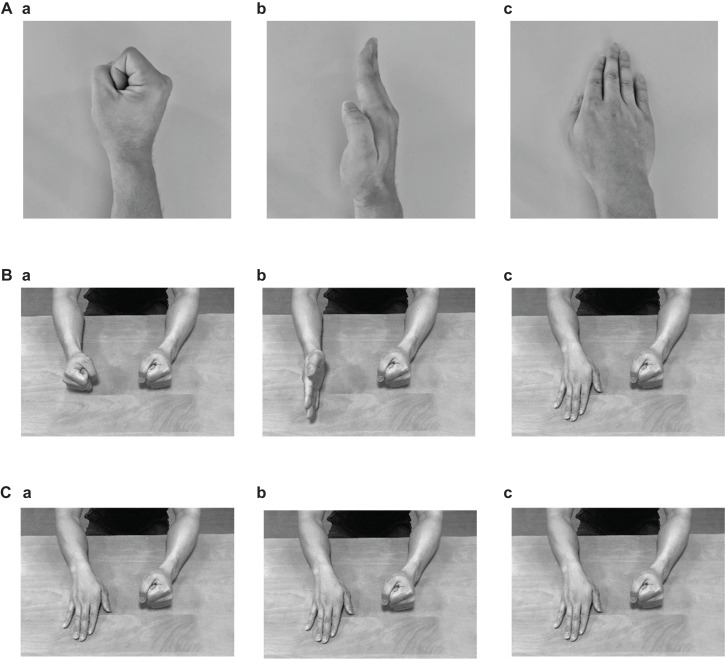
The Fist-Edge-Palm (FEP) task, a manual hand task, has been used to detect frontal dysfunctions in clinical situations: its performance failures are observed in various prefrontal cortex (PFC)-related disorders, including schizophrenia. However, previous imaging studies reported that the performance of the FEP task activated motor-related areas, but not the PFC. Here, we aimed to investigate the relationships between the performance of the FEP task and PFC functions. Hemodynamic activity in the PFC, including the dorsolateral PFC (area 46) and frontal pole (area 10), was recorded. Healthy young subjects performed the FEP task as well as a palm tapping (PT) task (control task) three times. The subjects also completed a Wisconsin Card Sorting Test (WCST) and Schizotypal Personality Scale (STA) questionnaire. We found that hemodynamic activity (Oxy-Hb) in the PFC increased in the first trial of the FEP task but decreased considerably in the second and third trials compared to the PT task. The number of performance errors in the FEP task also decreased in the second and third trials. Error reduction (i.e., learning) in the FEP task between the first and second trials was negatively correlated with schizotypal trait and the number of perseveration errors in the WCST. Furthermore, changes in the PFC hemodynamic activity between the first and second trials were positively correlated with error reduction in the FEP task between the first and second trials, and negatively correlated with the number of perseveration errors in the WCST. These results suggest that learning in the FEP task requires PFC activation, which is negatively associated with perseveration errors in the WCST. The results further suggest that the FEP task, in conjunction with near-infrared spectroscopy, may be useful as a diagnostic method for various disorders with PFC dysfunction.
Keywords: FEP task; WCST; fNIRS; prefrontal cortex; schizophrenia.
Copyright © 2021 Kobayashi, Iwama, Nishimaru, Matsumoto, Setogawa, Ono and Nishijo.
Conflict of interest statement
The authors declare that the research was conducted in the absence of any commercial or financial relationships that could be construed as a potential conflict of interest.
Figures


References
-
- Badoud S., Borgognon S., Cottet J., Chatagny P., Moret V., Fregosi M., et al. (2017). Effects of dorsolateral prefrontal cortex lesion on motor habit and performance assessed with manual grasping and control of force in macaque monkeys. Brain Struct. Funct. 222 1193–1206. 10.1007/s00429-016-1268-z - DOI - PMC - PubMed
LinkOut - more resources
Full Text Sources
Other Literature Sources
Miscellaneous
