An official website of the United States government
The .gov means it’s official.
Federal government websites often end in .gov or .mil. Before
sharing sensitive information, make sure you’re on a federal
government site.
The site is secure.
The https:// ensures that you are connecting to the
official website and that any information you provide is encrypted
and transmitted securely.
1 Department of Brain and Behavioural Sciences, University of Pavia, Pavia, Italy.
2 Center of Research in Medical Pharmacology University of Insubria, Varese, Italy.
3 Institute for Biomedical Research "Alberto Sols" (IIBM), Spanish National Research Council-Autonomous University of Madrid (CSIC-UAM), Madrid, Spain.
4 Rare Diseases Networking Biomedical Research Centre, Centro de Investigación Biomédica en Red, Carlos III Institute of Health, Madrid, Spain.
5 La Paz Hospital Institute for Health Research (IdiPAZ), Madrid, Spain.
6 Department of Otorhinolaryngology, Head and Neck Surgery, Charité-Universitätsmedizin Berlin, Corporate Member of Freie Universität Berlin, Humboldt-Universität zu Berlin, and Berlin Institute of Health, Berlin, Germany.
7 Faculty of Medicine and Health Sciences, University of Zielona Gora, Zielona Gora, Poland.
1 Department of Brain and Behavioural Sciences, University of Pavia, Pavia, Italy.
2 Center of Research in Medical Pharmacology University of Insubria, Varese, Italy.
3 Institute for Biomedical Research "Alberto Sols" (IIBM), Spanish National Research Council-Autonomous University of Madrid (CSIC-UAM), Madrid, Spain.
4 Rare Diseases Networking Biomedical Research Centre, Centro de Investigación Biomédica en Red, Carlos III Institute of Health, Madrid, Spain.
5 La Paz Hospital Institute for Health Research (IdiPAZ), Madrid, Spain.
6 Department of Otorhinolaryngology, Head and Neck Surgery, Charité-Universitätsmedizin Berlin, Corporate Member of Freie Universität Berlin, Humboldt-Universität zu Berlin, and Berlin Institute of Health, Berlin, Germany.
7 Faculty of Medicine and Health Sciences, University of Zielona Gora, Zielona Gora, Poland.
The authors declare that the research was conducted in the absence of any commercial or financial relationships that could be construed as a potential conflict of interest.
Figures
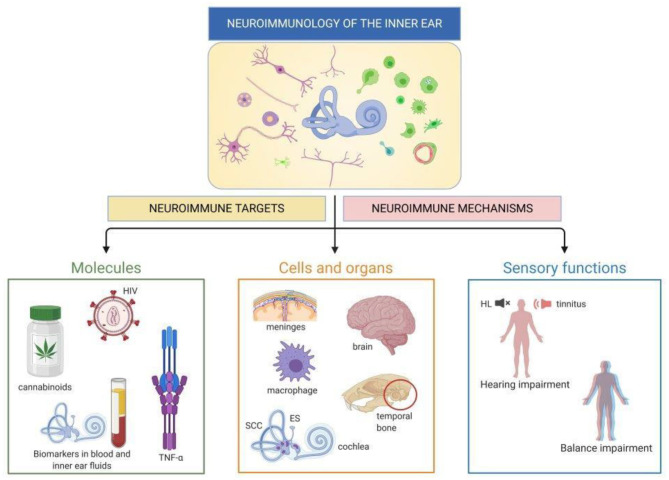
Figure 1
Neuroimmunology of the inner ear.…
Figure 1
Neuroimmunology of the inner ear. Visual abstract of this Research Topic: each paper…
Figure 1
Neuroimmunology of the inner ear. Visual abstract of this Research Topic: each paper within this Topic explores molecules, cells and/or functions related to inner ear neuroimmune interactions. HL, hearing loss; ES, endolymphatic sac; SCC, semicircular canals. Created with Biorender.com.
Editorial on the Research Topic Neuroimmunology of the Inner Ear
References
Nutma E, Willison H, Martino G, Amor S. Neuroimmunology - the past, present and future. Clin Exp Immunol. (2019) 197:278–93. 10.1111/cei.13279
-
DOI
-
PMC
-
PubMed
Jahnke K. The blood-perilymph barrier. Arch Otorhinolaryngol. (1980) 228:29–34. 10.1007/BF00455891
-
DOI
-
PubMed
Juhn SK, Rybak LP, Fowlks WL. Transport characteristics of the blood–perilymph barrier. Am J Otolaryngol. (1982) 3:392–6. 10.1016/S0196-0709(82)80016-1
-
DOI
-
PubMed
Cohen-Salmon M, Regnault B, Cayet N, Caille D, Demuth K, Hardelin JP, et al. . Connexin30 deficiency causes instrastrial fluid-blood barrier disruption within the cochlear stria vascularis. Proc Natl Acad Sci USA. (2007) 104:6229–34. 10.1073/pnas.0605108104
-
DOI
-
PMC
-
PubMed
Shi X. Pathophysiology of the cochlear intrastrial fluid-blood barrier (review). Hear Res. (2016) 338:52–63. 10.1016/j.heares.2016.01.010
-
DOI
-
PMC
-
PubMed
