


Time course of attentional bias to painful facial expressions and the moderating role of attentional control: an eye-tracking study
- PMID: 33633849
- PMCID: PMC7882769
- DOI: 10.1177/2049463719866877
Time course of attentional bias to painful facial expressions and the moderating role of attentional control: an eye-tracking study
Abstract
Introduction: This study investigated the time course of attention to pain and examined the moderating effect of attentional control in the relationship between pain catastrophizing and attentional bias in chronic pain patients.
Methods: A total of 28 patients with chronic pain and 29 pain-free individuals observed pictures of pain, happy and neutral facial expressions while their gaze behaviour was recorded. Pain intensity and duration, anxiety, depression, stress, attentional control and pain catastrophizing were assessed by questionnaires.
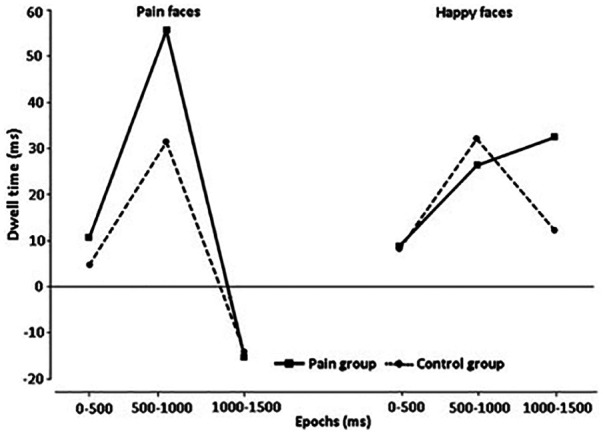
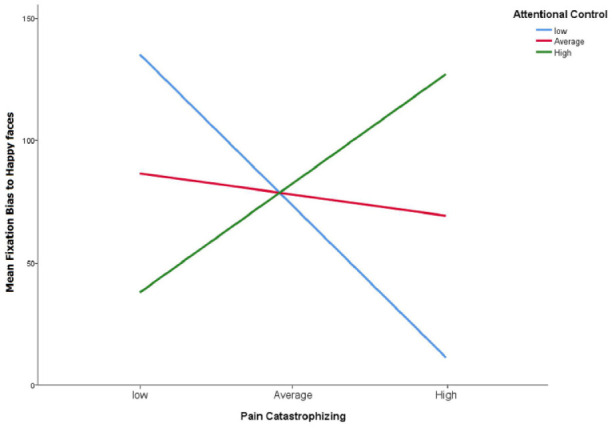
Results: In all subjects, the pattern of attention for pain faces was characterized by initial vigilance, followed by avoidance. No significant difference was found between the two groups in terms of orientation towards the stimuli, the duration of first fixation, the average duration of fixation or number of fixations on the pain stimuli. Attentional control moderated the relationship between catastrophizing and overall dwell time for happy faces in pain patients, indicating that those with high attentional control and high catastrophizing focused more on happy faces, whereas the reverse was true for those with low attentional control.
Conclusion: This study supported the vigilance-avoidance pattern of attention to painful facial expressions and a moderation effect of attentional control in the association between pain catastrophizing and attentional bias to happy faces among pain patients.
Keywords: Attentional bias; attentional control; chronic pain; eye tracking; time course.
© The British Pain Society 2019.
Conflict of interest statement
Conflict of interest: The author(s) declared no potential conflicts of interest with respect to the research, authorship and/or publication of this article.
Figures
References
-
- Todd J, Sharpe L, Johnson A, et al. Towards a new model of attentional biases in the development, maintenance, and management of pain. Pain 2015; 156(9): 1589–1600. - PubMed
-
- Khatibi A, Dehghani M, Sharpe L, et al. Selective attention towards painful faces among chronic pain patients: evidence from a modified version of the dot-probe. Pain 2009; 142(1–2): 42–47. - PubMed
-
- Crombez G, Van Ryckeghem DML, Eccleston C, et al. Attentional bias to pain-related information: a meta-analysis. Pain 2013; 154(4): 497–510. - PubMed
-
- Todd J, van Ryckeghem DML, Sharpe L, et al. Attentional bias to pain-related information: a meta-analysis of dot-probe studies. Health Psychol Rev 2018; 12(4): 419–436. - PubMed
-
- Sharpe L. Attentional biases in pain: more complex than originally thought? Pain 2014; 155(3): 439–440. - PubMed
LinkOut - more resources
Full Text Sources