


Overcoming Chemoresistance: Altering pH of Cellular Compartments by Chloroquine and Hydroxychloroquine
- PMID: 33634129
- PMCID: PMC7900406
- DOI: 10.3389/fcell.2021.627639
Overcoming Chemoresistance: Altering pH of Cellular Compartments by Chloroquine and Hydroxychloroquine
Abstract
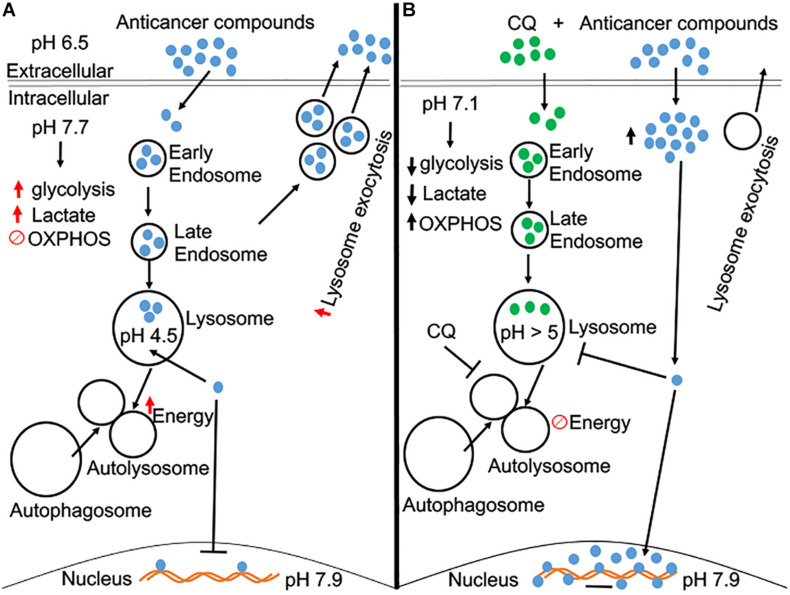
Resistance to the anti-cancer effects of chemotherapeutic agents (chemoresistance) is a major issue for people living with cancer and their providers. A diverse set of cellular and inter-organellar signaling changes have been implicated in chemoresistance, but it is still unclear what processes lead to chemoresistance and effective strategies to overcome chemoresistance are lacking. The anti-malaria drugs, chloroquine (CQ) and its derivative hydroxychloroquine (HCQ) are being used for the treatment of various cancers and CQ and HCQ are used in combination with chemotherapeutic drugs to enhance their anti-cancer effects. The widely accepted anti-cancer effect of CQ and HCQ is their ability to inhibit autophagic flux. As diprotic weak bases, CQ and HCQ preferentially accumulate in acidic organelles and neutralize their luminal pH. In addition, CQ and HCQ acidify the cytosolic and extracellular environments; processes implicated in tumorigenesis and cancer. Thus, the anti-cancer effects of CQ and HCQ extend beyond autophagy inhibition. The present review summarizes effects of CQ, HCQ and proton pump inhibitors on pH of various cellular compartments and discuss potential mechanisms underlying their pH-dependent anti-cancer effects. The mechanisms considered here include their ability to de-acidify lysosomes and inhibit autophagosome lysosome fusion, to de-acidify Golgi apparatus and secretory vesicles thus affecting secretion, and to acidify cytoplasm thus disturbing aerobic metabolism. Further, we review the ability of these agents to prevent chemotherapeutic drugs from accumulating in acidic organelles and altering their cytosolic concentrations.
Keywords: Golgi pH; chemoresistance; chloroquine; cytosolic pH; endolysosome pH; hydroxychloroquine.
Copyright © 2021 Halcrow, Geiger and Chen.
Conflict of interest statement
The authors declare that the research was conducted in the absence of any commercial or financial relationships that could be construed as a potential conflict of interest.
Figures
References
-
- Adar Y., Stark M., Bram E. E., Nowak-Sliwinska P., Van Den Bergh H., Szewczyk G., et al. (2012). Imidazoacridinone-dependent lysosomal photodestruction: a pharmacological Trojan horse approach to eradicate multidrug-resistant cancers. Cell Death Dis. 3:e293. 10.1038/cddis.2012.30 - DOI - PMC - PubMed
-
- Al-Akra L., Bae D. H., Leck L. Y. W., Richardson D. R., Jansson P. J. (2019). The biochemical and molecular mechanisms involved in the role of tumor micro-environment stress in development of drug resistance. Biochim. Biophys. Acta Gen. Subj. 1863 1390–1397. 10.1016/j.bbagen.2019.06.007 - DOI - PubMed
-
- Al-Akra L., Bae D. H., Sahni S., Huang M. L. H., Park K. C., Lane D. J. R., et al. (2018). Tumor stressors induce two mechanisms of intracellular P-glycoprotein-mediated resistance that are overcome by lysosomal-targeted thiosemicarbazones. J. Biol. Chem. 293 3562–3587. 10.1074/jbc.m116.772699 - DOI - PMC - PubMed
-
- Alfarouk K. O., Verduzco D., Rauch C., Muddathir A. K., Adil H. H. B., Elhassan G. O., et al. (2014). Glycolysis, tumor metabolism, cancer growth and dissemination. A new pH-based etiopathogenic perspective and therapeutic approach to an old cancer question. Oncoscience 1 777–802. 10.18632/oncoscience.109 - DOI - PMC - PubMed
Publication types
Grants and funding
LinkOut - more resources
Full Text Sources
Other Literature Sources
Research Materials
