Review
. 2020 Jul 16;10(1):22-30.
doi: 10.1097/XCE.0000000000000223. eCollection 2021 Mar.

Coronary microvascular disease: current concepts of pathophysiology, diagnosis and management

Affiliations
Review

Coronary microvascular disease: current concepts of pathophysiology, diagnosis and management

Aish Sinha et al. Cardiovasc Endocrinol Metab. .

Abstract

Coronary microvascular disease (CMD) is present in 30% of patients with angina and is associated with increased morbidity and mortality. We now have an improved understanding of the pathophysiology of CMD and the invasive and noninvasive tests that can be used to make the diagnosis. Recent studies have shown that management of CMD guided by physiological testing yields better results than empirical treatment. Despite major advances in diagnosing and stratifying this condition, therapeutic strategies remain limited and poorly defined. This review article discusses recent advances in understanding the pathophysiology of CMD, the modalities that are available to diagnose it clinically, current management options and a look at what is in store for the future.

Keywords: coronary blood flow; coronary flow reserve; coronary microvascular disease; microvascular resistance; nitric oxide; physiology-stratified disease endotypes.


Figures

Fig. 1
Fig. 1
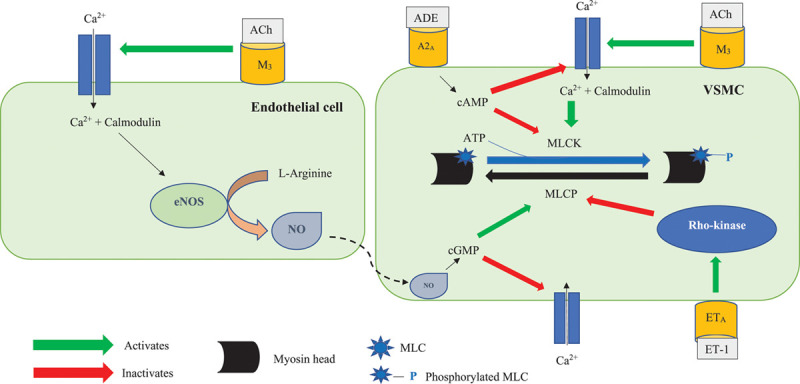
The endothelial and vascular smooth muscle cellular pathways (adapted from Lanza et al. [14]). Acetylcholine has dual effects on coronary microvasculature. It binds to the muscarinic 3 (M3) receptor on endothelial cells and leads to an influx of intracellular calcium (Ca2+) via the L-type calcium channels. Intracellular Ca2+ binds to the protein calmodulin, and the calcium-calmodulin complex activates the endothelial nitric oxide synthase (eNOS) enzyme, which catalyses the conversion of L-arginine into nitric oxide (NO). NO then diffuses into the neighbouring vascular smooth muscle cell (VSMC) and activates guanylate cyclase (GC) enzyme to catalyse the conversion of guanosine triphosphate (GTP) into cyclic GMP (cGMP). cGMP activates the protein kinase G (PKG), which, via a series of intracellular events, inactivates the calcium channels on the VSMC. This reduces the intracellular influx of Ca2+ into the VSMC, therefore leading to vasodilation. Acetylcholine also binds to the M3 receptor on the surface of VSMCs and, in the presence of endothelial dysfunction, leads to unopposed vasoconstriction. Adenosine (ADE) binds to its receptor (A2a) on the surface of VSMCs; this activates adenylate cyclase (AC) enzyme, which catalyses the conversion of ATP (ATP) to cyclic AMP (cAMP). cAMP activates the protein kinase A (PKA). PKA inactivates the calcium channels and prevents influx of Ca2+, therefore preventing vasoconstriction. Ca2+ enters VSMCs via the L-type calcium channels and binds to the protein calmodulin. The calcium-calmodulin complex activates myosin light chain kinase (MLCK), which phosphorylates myosin light chains (MLCs). MLCs are found on the myosin heads. MLC phosphorylation leads to cross-bridge formation between the myosin heads and the actin filaments, leading to vascular smooth muscle (VSM) contraction. cAMP inhibits MLCK, therefore promoting vasodilation. MLC phosphatase (MLCP) dephosphorylates MLC and promotes unbinding of the myosin-actin filaments, therefore leading to vasodilation. cGMP promotes MLCP activity. Endothelin-1 (ET-1) binds to its receptor (ETA) and activates Rho-kinase, which inhibits MLCP and leads to vasoconstriction. VSM relaxation, and therefore vasodilation, occurs when there is reduced phosphorylation of MLC. This can result from reduced intracellular Ca2+ concentration, inhibition of MLCK by increased intracellular concentration of cAMP and MLCP-activated MLC dephosphorylation.

References

    1. National Institute for Health and Clinical Excellence. NICE CG 126. Management of Stable Angina. 2011. www.nice.org.uk/guidance/CG126. - PubMed
    1. Jespersen L, Hvelplund A, Abildstrøm SZ, Pedersen F, Galatius S, Madsen JK, et al. Stable angina pectoris with no obstructive coronary artery disease is associated with increased risks of major adverse cardiovascular events. Eur Heart J. 2012; 33:734–744. - PubMed
    1. Sara JD, Widmer RJ, Matsuzawa Y, Lennon RJ, Lerman LO, Lerman A. Prevalence of coronary microvascular dysfunction among patients with chest pain and nonobstructive coronary artery disease. JACC Cardiovasc Interv. 2015; 8:1445–1453. - PubMed
    1. Cannon RO, III, Epstein SE. “Microvascular angina” as a cause of chest pain with angiographically normal coronary arteries. Am J Cardiol. 1988; 61:1338–1343. - PubMed
    1. Rahman H, Ryan M, Lumley M, Modi B, McConkey H, Ellis H, et al. Coronary microvascular dysfunction is associated with myocardial ischemia and abnormal coronary perfusion during exercise. Circulation. 2019; 140:1805–1816. - PMC - PubMed