Randomized Controlled Trial
. 2021 Jun;238(6):1671-1686.
doi: 10.1007/s00213-021-05802-1. Epub 2021 Feb 26.

The acute effects of alcohol on state rumination in the laboratory

Affiliations
Randomized Controlled Trial

The acute effects of alcohol on state rumination in the laboratory

O Merve Mollaahmetoglu et al. Psychopharmacology (Berl). 2021 Jun.

Abstract

Rationale: Rumination is a repetitive, negative, self-focused thinking style associated with various forms of psychopathology. Recent studies suggest that rumination increases craving for alcohol and predicts harmful drinking and alcohol-related problems. However, the acute effects of alcohol on rumination have not been previously studied. It is proposed that alcohol may reduce ruminative thinking through decreasing negative mood.

Objectives: In the present study, we aimed to test the previously unexplored effects of acute alcohol consumption on rumination in a hazardous drinking population.

Methods: We conducted a randomised placebo-controlled laboratory study to examine the effect of low (0.4 g kg-1) and high doses (0.8 g kg-1) of alcohol on state rumination compared to placebo. Participants completed a rumination induction task prior to receiving drinks. We then measured state rumination and mood at repeated time points; 30 min, 60 min and 90 min post-drinks consumption.

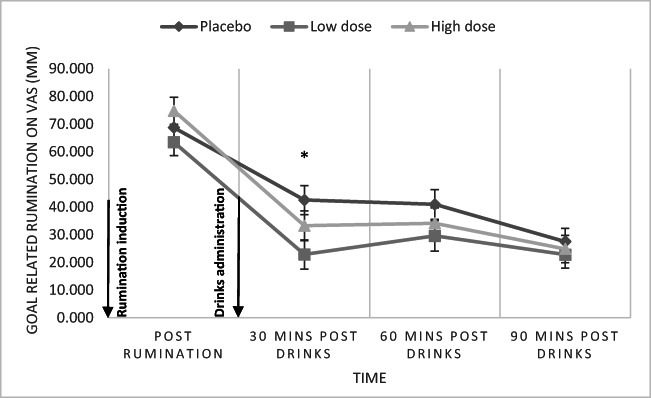
Results: We found a significant decrease in state rumination in the low-dose alcohol group compared to placebo at 30 min post-alcohol consumption, but no difference was observed between the high-dose alcohol and placebo groups. Mediation analysis provided evidence for an indirect effect of alcohol on state rumination through concurrent changes in negative mood.

Conclusions: These findings suggest that acute alcohol consumption can regulate negative mood and concurrently rumination, providing preliminary evidence for the role of rumination in alcohol use disorders. Rumination may be a treatment target in alcohol use disorders.

Keywords: Alcohol use disorders; Depression; Negative affect; Rumination.


Conflict of interest statement

The authors declare no conflict of interest.

Figures
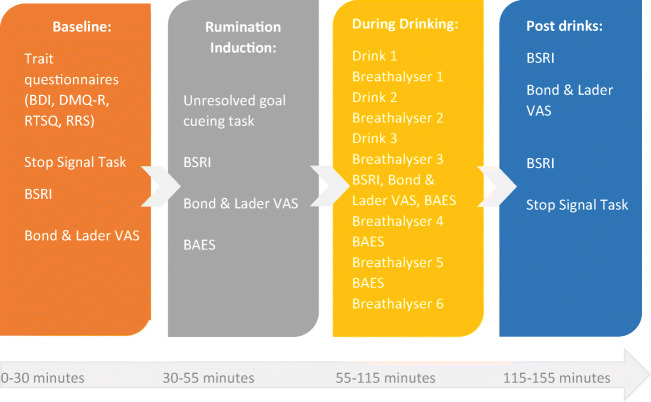
Fig. 1
Fig. 1
Study procedures with approximate timings
Fig. 2
Fig. 2
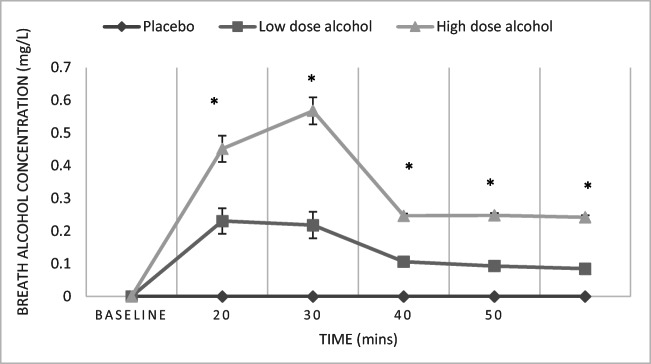
Mean BRAC (mg l−1) across time of testing and alcohol administration group. There were significant (*p < 0.05) group differences in BRAC at all time points except at baseline. Error bars represent standard error of the mean. Thirty-one participants contributed to placebo group, 30 to low-dose alcohol group and 29 to high-dose alcohol group
Fig. 3
Fig. 3
Mean state rumination about an unresolved problem over time and groups (low- and high-dose alcohol conditions collapsed together). There was a significant difference in state rumination between the placebo and the low-dose alcohol group at 30 min post-alcohol administration (*p < 0.05). Error bars represent standard error of the mean. 31 participants contributed to placebo group, 30 to low-dose alcohol group and 29 to high-dose alcohol group
Fig. 4
Fig. 4
Mean state rumination measured using BSRI total scores over time and groups. Time*Condition interaction was not statistically significant. Error bars represent standard error of the mean. Respectively, 30 and 29 participants contributed data to low-dose and high-dose alcohol groups, and 31 contributed data to placebo group
Fig. 5
Fig. 5
Mediation model demonstrating the indirect effect of alcohol dose on rumination by change in negative affect ratings. Significant effects are denoted by an asterisk

References

    1. Abrams K, Kushner MG, Medina KL, Voight A. Self-administration of alcohol before and after a public speaking challenge by individuals with social phobia. Psychol Addict Behav. 2002;16:121–128. doi: 10.1037/0893-164X.16.2.121. - DOI - PubMed
    1. Adrian M, McCarty C, King K, McCauley E, Stoep AV. The internalizing pathway to adolescent substance use disorders: Mediation by ruminative reflection and ruminative brooding. J Adolesc. 2014;37:983–991. doi: 10.1016/j.adolescence.2014.07.010. - DOI - PMC - PubMed
    1. Aldridge-Gerry AA, Roesch SC, Villodas F, McCabe C, Leung QK, Da Costa M. Daily stress and alcohol consumption: modeling between-person and within-person ethnic variation in coping behavior. J Stud Alcohol Drugs. 2011;72:125–134. doi: 10.15288/jsad.2011.72.125. - DOI - PMC - PubMed
    1. Armeli S, Tennen H, Todd M, Carney MA, Mohr C, Affleck G, Hromi A. A daily process examination of the stress-response dampening effects of alcohol consumption. Psychol Addict Behav. 2003;17:266–276. doi: 10.1037/0893-164X.17.4.266. - DOI - PubMed
    1. Beck AT, Epstein N, Brown G, Steer RA. An inventory for measuring clinical anxiety: psychometric properties. J Consult Clin Psychol. 1988;56:893–897. doi: 10.1037/0022-006X.56.6.893. - DOI - PubMed

Publication types

LinkOut - more resources