. 2021 Jun;67(3):487-499.
doi: 10.1007/s00294-021-01158-3. Epub 2021 Feb 26.

Forkhead transcription factor Fkh1: insights into functional regulatory domains crucial for recruitment of Sin3 histone deacetylase complex

Affiliations

Forkhead transcription factor Fkh1: insights into functional regulatory domains crucial for recruitment of Sin3 histone deacetylase complex

Rasha Aref et al. Curr Genet. 2021 Jun.

Abstract

Transcription factors are inextricably linked with histone deacetylases leading to compact chromatin. The Forkhead transcription factor Fkh1 is mainly a negative transcriptional regulator which affects cell cycle control, silencing of mating-type cassettes and induction of pseudohyphal growth in the yeast Saccharomyces cerevisiae. Markedly, Fkh1 impinges chromatin architecture by recruiting large regulatory complexes. Implication of Fkh1 with transcriptional corepressor complexes remains largely unexplored. In this work we show that Fkh1 directly recruits corepressors Sin3 and Tup1 (but not Cyc8), providing evidence for its influence on epigenetic regulation. We also identified the specific domain of Fkh1 mediating Sin3 recruitment and substantiated that amino acids 51-125 of Fkh1 bind PAH2 of Sin3. Importantly, this part of Fkh1 overlaps with its Forkhead-associated domain (FHA). To analyse this domain in more detail, selected amino acids were replaced by alanine, revealing that hydrophobic amino acids L74 and I78 are important for Fkh1-Sin3 binding. In addition, we could prove Fkh1 recruitment to promoters of cell cycle genes CLB2 and SWI5. Notably, Sin3 is also recruited to these promoters but only in the presence of functional Fkh1. Our results disclose that recruitment of Sin3 to Fkh1 requires precisely positioned Fkh1/Sin3 binding sites which provide an extended view on the genetic control of cell cycle genes CLB2 and SWI5 and the mechanism of transcriptional repression by modulation of chromatin architecture at the G2/M transition.

Keywords: Cell cycle genes; Fkh1; Histone deacetylases (HDACs); Sin3; Tup1.


Conflict of interest statement

The authors have no conflict of interest to declare.

Figures
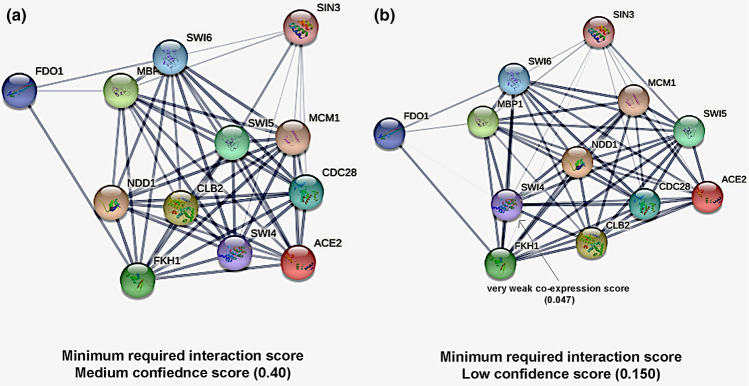
Fig. 1
Fig. 1
The known full interaction network of Fkh1 in addition to Sin3 protein. According to the current status in STRING database, Fkh1/Sin3 interaction is uncharacterized (green line) in S. cerevisiae or other organisms on the medium confidence level of 0.4 (a). At a low confidence score of 0.150 no interaction in S. cerevisiae and very weak co-expression score (0.047) and a low combined score (0.37) was detected in putative homologs in other organisms (b)
Fig. 2
Fig. 2
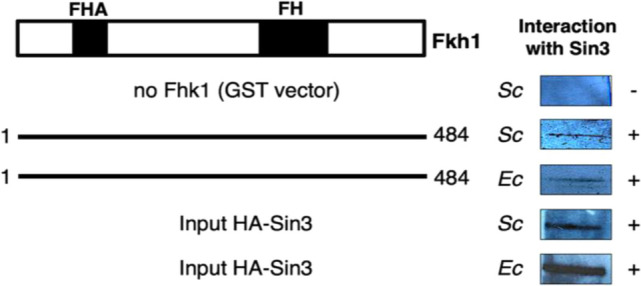
In vitro interaction of Fkh1 and Sin3 shown by affinity chromatography. GST-Fkh1 (full-length fusion protein, 1–484) bound to glutathione (GSH) sepharose was incubated with protein extract containing epitope-tagged Sin3 (full-length) expressed in S. cerevisiae (Sc; plasmid pCW117) and in E. coli (Ec; pSW11) separately. GST-Fkh1 fusion protein was released from the affinity matrix together with its partner by free GSH and subsequently separated by SDS-PAGE, followed by immunodetection using an anti-HA antibody. GST vector was used as a negative control. Input controls are shown at the bottom of Fig. (20% of protein used for the interaction assay). FH forkhead domain, FHA forkhead associated
Fig. 3
Fig. 3
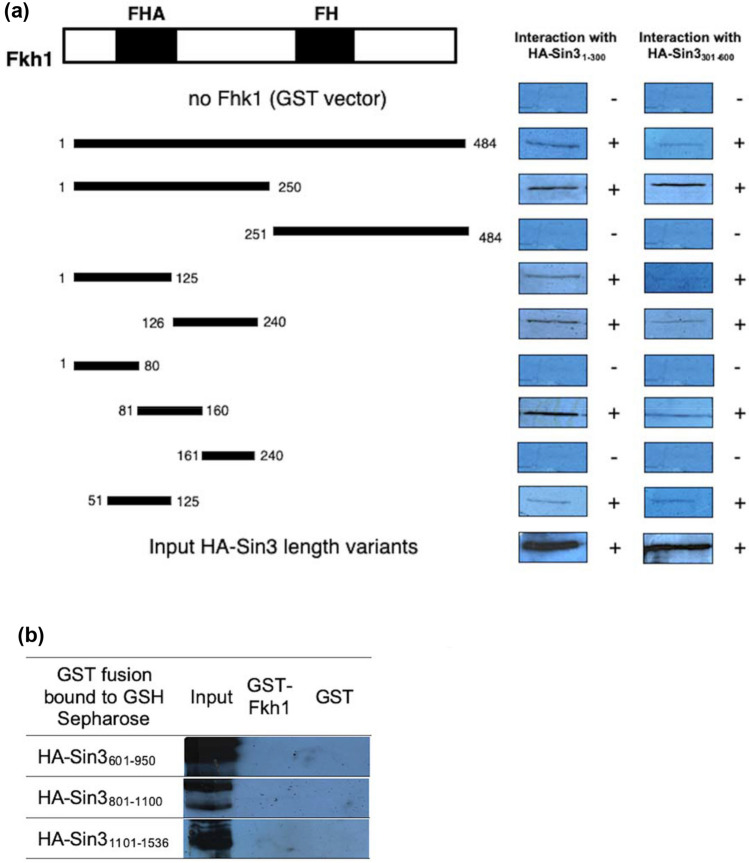
Physical map of Fkh1 domains interacting with Sin3. a Mapping of Fkh1 domains binding to PAH1 and PAH2 of Sin3. Length variants of Fkh1 were fused with GST, immobilized on GSH Sepharose and incubated with protein extracts from yeast. The following GST-FKH1 E. coli expression plasmids were used: pRAR2 (aa 1–484 of Fkh1), pRAR8 (aa 1–250), pRAR9 (aa 201–484), pRAR16 (aa 1–125), pRAR17 (aa 126–240), pRAR32 (aa 1–80), pRAR33 (aa 81–160), pRAR34 (aa 161–240) and pRAR73 (aa 51–125). HA-tagged Sin3 length variants were synthesized in S. cerevisiae using pCW83 (aa 1–300) and pYJ91 (aa 301–600). Input controls for both Sin3 length variants are shown at the bottom of Fig. (20% of protein used for the interaction assay). FH, forkhead domain; FHA, forkhead associated. b Full-length Fkh1 does not interact with the C-terminus of Sin3. Full-length Fkh1 was bacterially synthesized using pRAR2. C-terminal length variants of Sin3 (comprising PAH3 and PAH4) were synthesized in S. cerevisiae by use of pYJ90 (aa 601–950), pYJ89 (aa 801–1100) and pMP20 (aa 1101–1536). For input controls (shown in the left panel), 20% of protein used for the interaction assay was analyzed
Fig. 4
Fig. 4
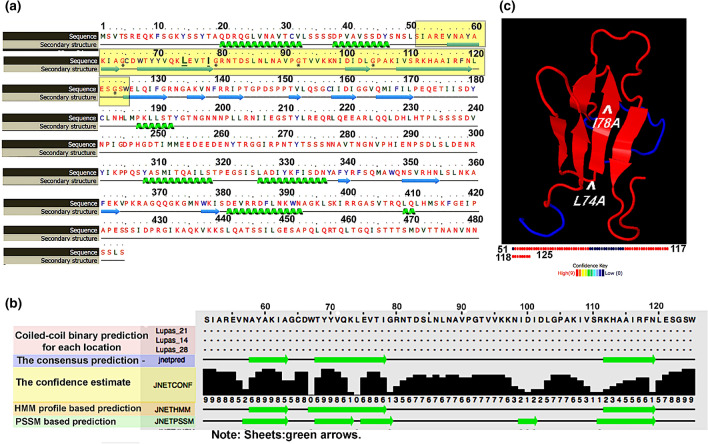
Prediction of the secondary and tertiary structure of Fkh1 core domain recruiting Sin3. a Prediction of the secondary structure of Fkh1 protein and the 75 aa sequence of Fkh1 subdomain recruiting Sin3 is highlighted in yellow that consists of five β-sheets. Within the Fkh1 core domain, the glycine (G) amino acid is denoted by an asterisk (*) to define the turns. Through the sequence, the amino acids that are substituted in the site-directed mutagenesis experiment are underlined (L74A, I78A). The prediction was done using Phyre2 software. b The Fkh1 core domain (aa 51–125) recruiting Sin3 was reanalyzed via various neural networks using Jpred 4 software (Cole et al. 2008). c The tertiary (3D) structure of the Fkh1 core domain (aa 51–125) was predicted by phyre 2 software and displayed using JSmol software (Hanson et al. 2013). The white arrows pointed to the positions L74A and I78A referred to as mutated amino acids (mentioned in the site-directed mutagenesis experiment). The 3D structure prediction scored 79% confidence represented in 59 out of 74 residues. Five antiparallel β-sheets were visualized by the JSmol model
Fig. 5
Fig. 5
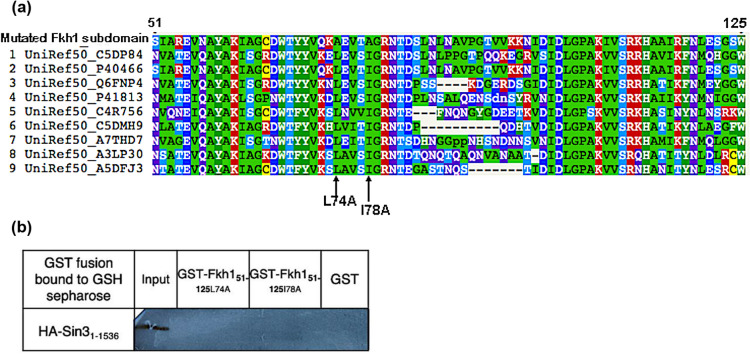
a The Mview of the multiple sequence alignment between a cluster of nine amino acid sequences from the UniRef knowledgebase that aligned with the mutated Fkh1 subdomain. The hydrophobic residues, leucine and isoleucine in positions 74 and 78 were found conserved. b In vitro interaction of GST-Fkh1 mutant variants and HA3-Sin3. GST-Fkh151–125 comprising missense variants (plasmids pRAR89 and pRAR90) were comparatively analyzed for interaction with HA-tagged Sin3 expressed in S. cerevisiae (plasmid pCW117). GST-Fkh1 fusion proteins were released from GSH sepharose together with its partner by free GSH and subsequently separated by SDS-PAGE, followed by immunodetection using an anti-HA antibody. GST vector was used as a negative control. (20% of protein used for the interaction assay)
Fig. 6
Fig. 6
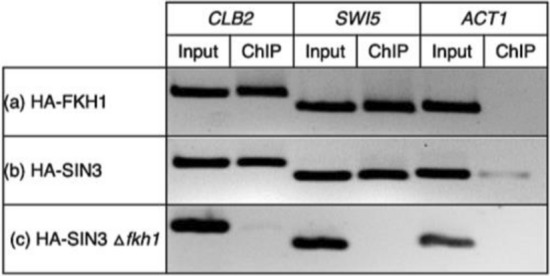
Fkh1-dependent Sin3 recruitment to promoters of cell cycle-regulated genes shown by chromatin immunoprecipitation. Strains RAY4 (contains a His-tagged variant of FKH1 at its natural chromosomal position), FKH11 (contains a His-tagged variant of SIN3 at its natural chromosomal position) and RAY5 (isogenic fkh1 deletion mutant of FKH11) were grown to the exponential growth phase (non-synchronized cells). After shearing of chromatin, binding to His-Tag Dynabeads® and elution, promoter fragments were analyzed by end-point PCR. a Recruitment of Fkh1 to CLB2 and SWI5 promoters. b Recruitment of Sin3 to CLB2 and SWI5 promoters. c Loss of Sin3 recruitment in the absence of Fkh1. DNA amplification was performed using specific primers for CLB2 (− 880/− 580), SWI5 (− 420/− 170) and ACT1 (+ 841/ + 1165; negative control). PCR products were obtained after 29 amplification cycles and then separated by electrophoresis on a 2% agarose gel
Fig. 7
Fig. 7
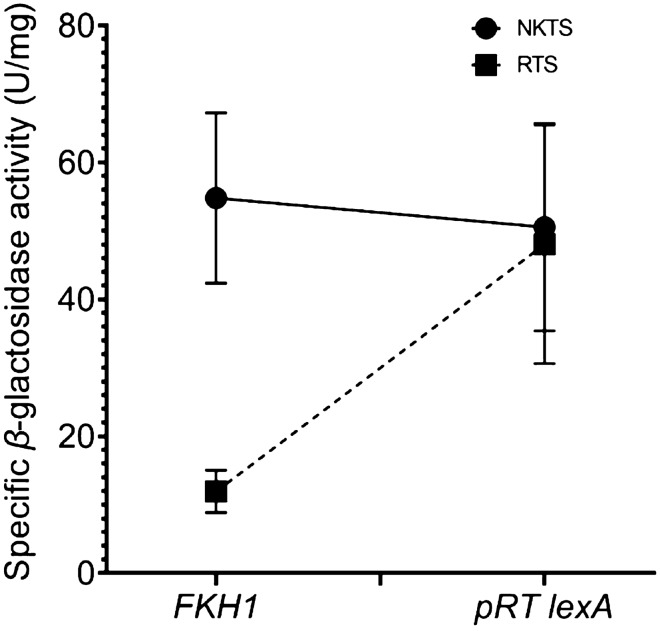
In vivo functional repression by Fkh1 recruited to a lexAOp-containing reporter gene. S. cerevisiae reporter strains RTS + lexA (integrated reporter gene [lexAop]4-CYC1-lacZ) and NKTS (reporter gene CYC1-lacZ without lexAOp) were transformed with effector plasmid pRAR28 (lexABD-FKH1) and grown in SCD -Ura -Leu liquid medium to mid-log growth phase. Empty vector pRT-lexA served as a negative control. After cell harvesting, the specific β-galactosidase activity [µ/mg] was determined in crude extracts of the transformants
Fig. 8
Fig. 8
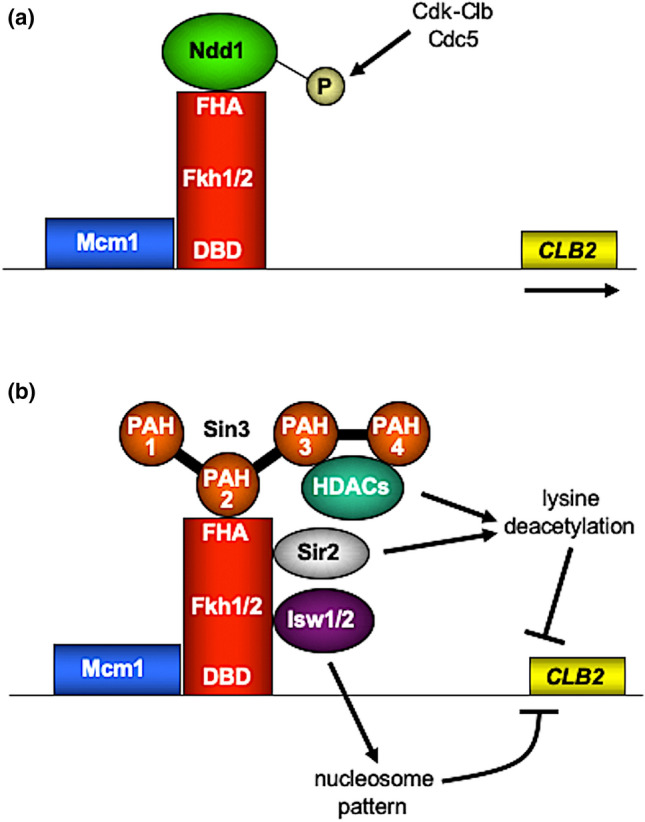
Schematic representation of Fkh-dependent regulation of CLB2 cluster genes. CLB2 is a cell cycle-regulated gene active from late S phase until G2/M transition. a Mcm1 and Fkh proteins bind to UAS elements upstream of genes of the CLB2 cluster. Activation is triggered by phosphorylation of the essential coactivator Ndd1, requiring protein kinases Cdk-Clb and Cdc5 (Reynolds et al. ; Darieva et al. 2006). b Repression of the CLB2 cluster in the G1 phase (no activity of Cdk-Clb) depends on Fkh proteins which recruit Sin3 corepressor (and possibly Tup1, not shown) through the interaction between FHA and PAH2. Sin3 then brings HDACs into action and thus prevents transcription of the respective genes. Repression is further supported by Fkh1-dependent recruitment of Sir2 histone deacetylase (Linke et al. 2013). In addition, Isw1 and Isw2 occupy CLB2 promoter through Fkh1 and Fkh2 recruitment, respectively (Sherriff et al. 2007), initiating a repressive organization of chromatin. FHA, Forkhead-associated domain; PAH1-PAH4: paired amphipathic helices

References

    1. Aref R, Schüller HJ. Functional analysis of Cti6 core domain responsible for recruitment of epigenetic regulators Sin3, Cyc8 and Tup1. Curr Genet. 2020;66:1191–1203. doi: 10.1007/s00294-020-01109-4. - DOI - PMC - PubMed
    1. Bähler J. Cell-cycle control of gene expression in budding and fission yeast. Annu Rev Genet. 2005;39:69–94. doi: 10.1146/annurev.genet.39.110304.095808. - DOI - PubMed
    1. Burke LJ, Baniahmad A. Co-repressors 2000. FASEB J. 2000;14:1876–1888. doi: 10.1096/fj.99-0943rev. - DOI - PubMed
    1. Caudron B, Jestin JL. Sequence criteria for the anti-parallel character of protein beta-strands. J Theor Biol. 2012;315:146–149. doi: 10.1016/j.jtbi.2012.09.011. - DOI - PubMed
    1. Cobb J, van Attikum H. Mapping genomic targets of DNA helicases by chromatin immunoprecipitation in S. cerevisiae. Methods Mol Biol. 2010;587:113–126. doi: 10.1007/978-1-60327-355-8_8. - DOI - PubMed

MeSH terms

LinkOut - more resources