


Classes of lifetime adversity in emerging adult women and men and their associations with weight status
- PMID: 33636192
- PMCID: PMC8149137
- DOI: 10.1016/j.ypmed.2021.106455
Classes of lifetime adversity in emerging adult women and men and their associations with weight status
Abstract
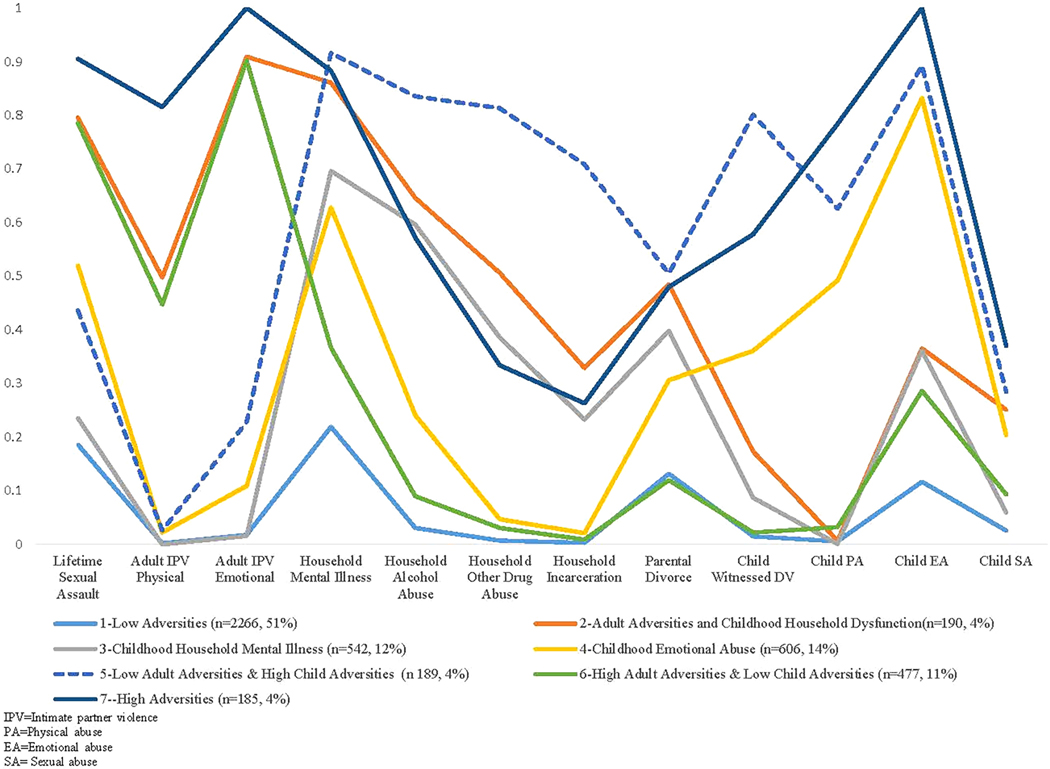
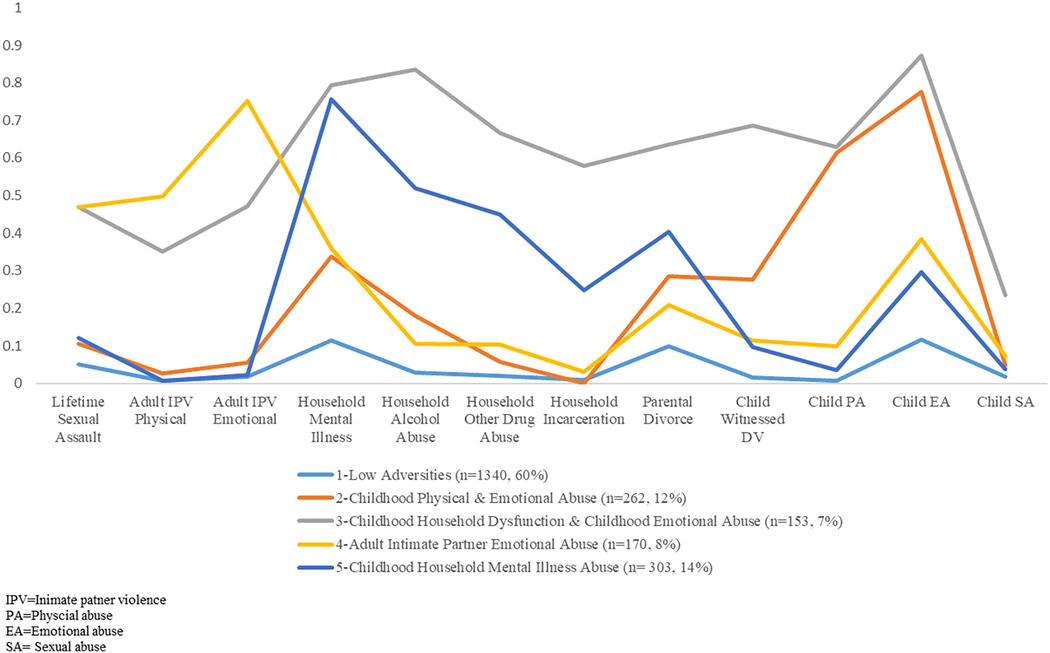
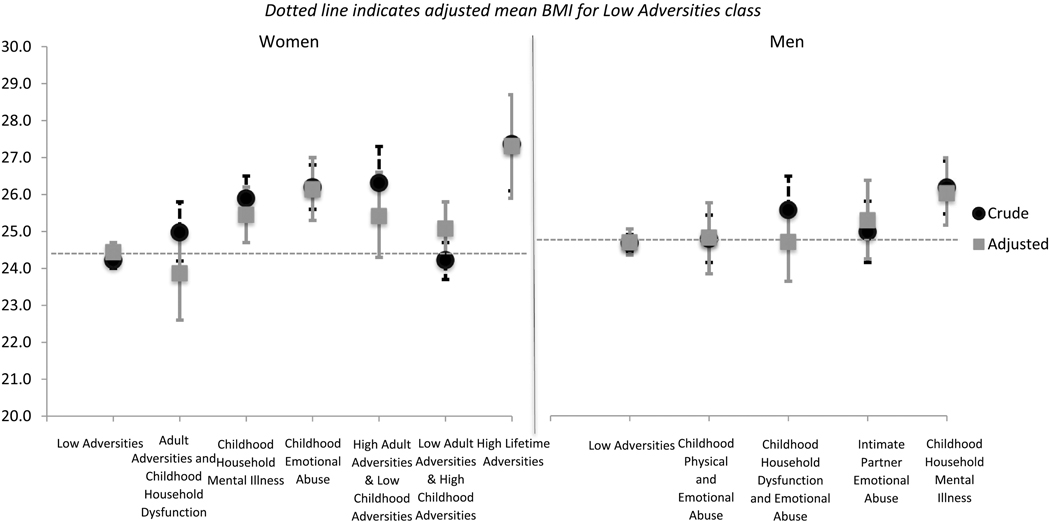
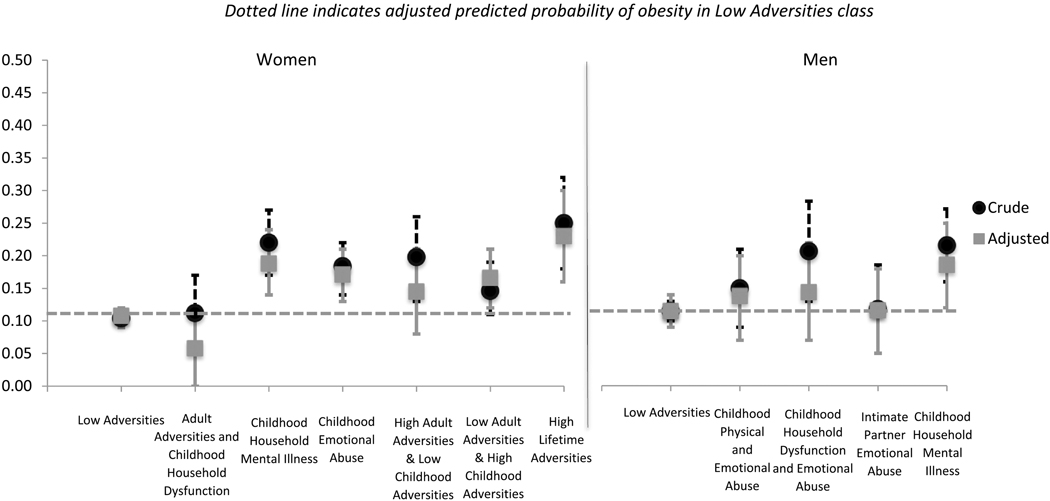
The aim of this paper was to better understand how child and adult adversities cluster together into classes, and how these classes relate to body weight and obesity. Analyses included 2015 and 2018 data from emerging adults (18-25 years old) who participated in a state surveillance system of 2- and 4-year college students in Minnesota (N = 7475 in 2015 and N = 6683 in 2018). Latent Class Analyses (LCA) of 12 child and adult adversities were run stratified by gender and replicated between 2015 and 2018. The distal outcome procedure and three-step Bolck-Croon-Hagenaars approach were used to estimate predicted BMI means and predicted probabilities of obesity for each class, adjusted for covariates. The LCA identified seven classes in women and 5 in men. In women, BMI ranged from 23.9 kg/m2 in the lowest-BMI class ("Adult Adversities and Childhood Household Dysfunction"; 95% CI: 22.6-25.1) to 27.3 kg/m2 in the highest-BMI class ("High Lifetime Adversities"; 95% CI: 25.9-28.7), a statistically significant difference of 3.4 kg/m2. In men, the adjusted BMIs ranged from 24.6 kg/m2 ("Low Adversities"; 95% CI: 24.3-25.0) to 26.0 kg/m2 ("Childhood Household Mental Illness"; 95% CI: 25.1-26.9), a statistically significant difference of 1.4 kg/m2. The pattern was similar for obesity. These results indicate that specific classes of child and adult adversities are strongly associated with BMI and obesity, particularly in women. A key contribution of LCA appeared to be identification of small classes at high risk for excess weight.
Keywords: Adverse childhood experiences; Latent class analysis; Obesity.
Copyright © 2021 Elsevier Inc. All rights reserved.
Figures
References
-
- American College Health Association-National College Health Assessment II: Reference Group Executive Summary Spring 2015, 2015. . Hanover, MD.
-
- Asparouhov T, Muthén B, 2015. Residual Associations in Latent Class and Latent Transition Analysis, Structural Equation Modeling. 10.1080/10705511.2014.935844 - DOI
-
- Asparouhov T, Muthén BO, 2014. Auxiliary variables in mixture modeling: Using the BCH method in Mplus to estimate a distal outcome model and an arbitrary second model. Mplus Web Notes 1–22.
Publication types
MeSH terms
Grants and funding
LinkOut - more resources
Full Text Sources
Other Literature Sources
Medical
Research Materials
