


Factors associated with infrainguinal bypass graft patency at 1-year; a retrospective analysis of a single centre experience
- PMID: 33637022
- PMCID: PMC9019425
- DOI: 10.1177/0267659121995760
Factors associated with infrainguinal bypass graft patency at 1-year; a retrospective analysis of a single centre experience
Abstract
Introduction: The aim of this study was to identify factors associated with primary graft patency 1 year following open lower limb revascularisation (LLR) at a tertiary referral vascular service.
Methods: A retrospective analysis of patients undergoing infra-inguinal bypass surgery between January 2016 and May 2017 at a tertiary vascular centre (St Mary's Hospital, London) was performed. Data regarding patient demographics, comorbidities, type of operation and post-operative anti-thrombotic strategy were collected. Quality of run-off score was assessed from pre-operative imaging.
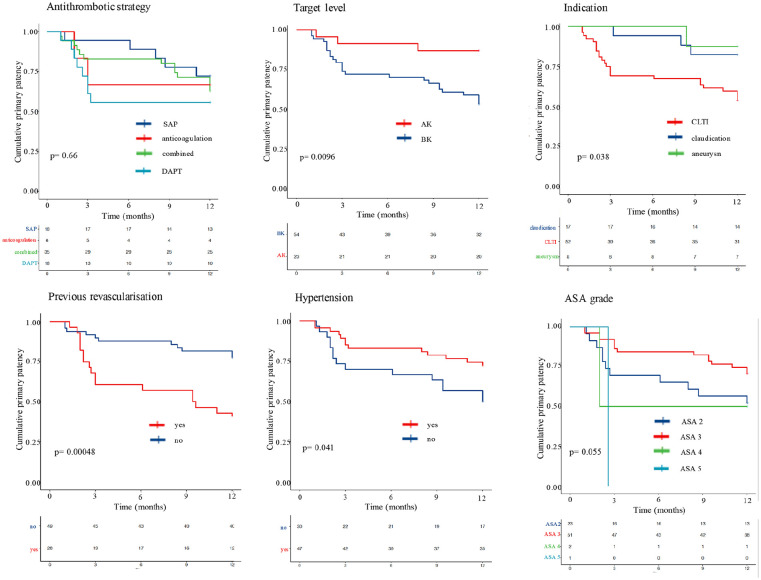
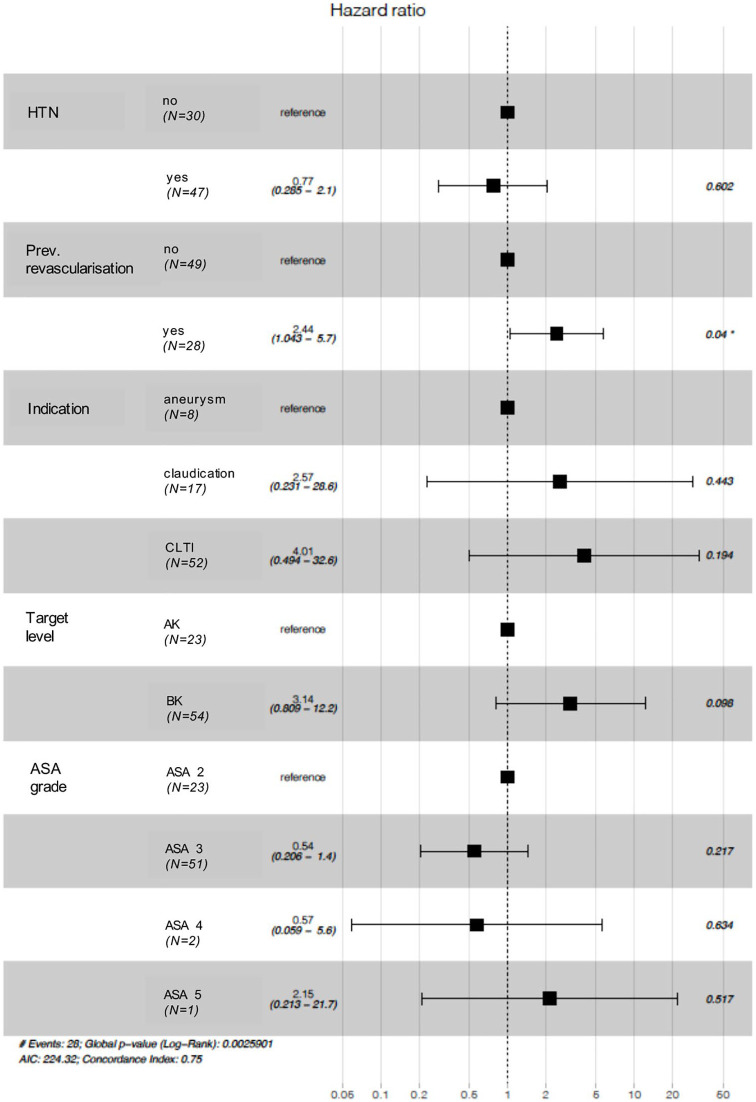
Results: Seventy-seven cases were included in the analysis. Overall, the primary patency rate at 1-year was 63.6% (n = 49/77) and the secondary patency rate was 67.5% (n = 52/77). Independent variables with statistically significant inferior patency rates at 1-year were (1) bypasses with below knee targets (p = 0.0096), (2) chronic limb threatening ischaemia indication (p = 0.038), (3) previous ipsilateral revascularisation (p < 0.001) and (4) absence of hypertension history (p = 0.041). There was also a trend towards significance for American Society of Anesthesiologists (ASA) grade (p = 0.06). Independent variables with log-rank test p values of <0.1 were included in a Cox proportional hazards model. The only variable with a statistically significant impact on primary patency rates was previous open or endovascular ipsilateral revascularisation (HR 2.44 (1.04-5.7), p = 0.04).
Conclusion: At 1-year follow-up, previous ipsilateral revascularisation was the most significant factor in affecting patency rates. Patients in this subgroup should therefore be deemed high-risk, which should be reflected in the informed consent and peri-operative management.
Keywords: anti-thrombotic; bypass revascularization; lower limb; patency.
Conflict of interest statement
Figures
References
-
- Bradbury AW, Adam DJ, Bell J, et al.. Bypass versus Angioplasty in Severe Ischaemia of the Leg (BASIL) trial: an intention-to-treat analysis of amputation-free and overall survival in patients randomized to a bypass surgery-first or a balloon angioplasty-first revascularization strategy. J Vasc Surg 2010;51:5S–17S. - PubMed
-
- Health Quality Improvement Partnership. National vascular registry 2017. annual report. 2017. https://www.hqip.org.uk/resource/national-vascular-registry-annual-repor...
-
- Schanzer A, Hevelone N, Owens CD, et al.. Technical factors affecting autogenous vein graft failure: observations from a large multicenter trial. J Vasc Surg 2007; 46: 1180–1190. - PubMed
-
- Bradbury AW, Adam DJ, Bell J, et al.. Bypass versus Angioplasty in Severe Ischaemia of the Leg (BASIL) trial: analysis of amputation free and overall survival by treatment received. J Vasc Surg 2010; 51: 18S–31S. - PubMed
-
- Lindblad B, Wakefield TW, Stanley TJ, et al.. Pharmacological prophylaxis against postoperative graft occlusion after peripheral vascular surgery: a world-wide survey. Eur J Vasc Endovasc Surg 1995; 9: 267–271. - PubMed
MeSH terms
LinkOut - more resources
Full Text Sources
Other Literature Sources
