


The prevalence of psychological distress during pregnancy in Miyagi Prefecture for 3 years after the Great Eas t Japan Earthquake
- PMID: 33637036
- PMCID: PMC7913250
- DOI: 10.1186/s12199-021-00944-2
The prevalence of psychological distress during pregnancy in Miyagi Prefecture for 3 years after the Great Eas t Japan Earthquake
Abstract
Background: To examine changes in psychological distress prevalence among pregnant women in Miyagi Prefecture, which was directly affected by the Great East Japan Earthquake and tsunami, and compare it with the other, less damaged areas of Japan.
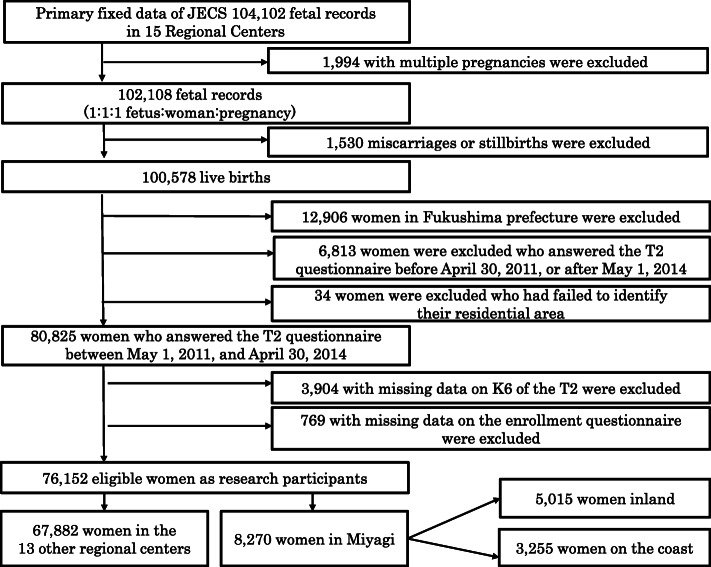
Methods: This study was conducted in conjunction with the Japan Environment and Children`s Study. We examined 76,152 pregnant women including 8270 in Miyagi Regional Center and 67,882 in 13 other regional centers from the all-birth fixed data of the Japan Environment and Children's Study. We then compared the prevalence and risk of distress in women in Miyagi Regional Center and women in the 13 regional centers for 3 years after the disaster.
Results: Women in the Miyagi Regional Center suffered more psychological distress than those in the 13 regional centers: OR 1.38 (95% CI, 1.03-1.87) to 1.92 (95% CI, 1.42-2.60). Additionally, women in the inland area had a consistently higher prevalence of psychological distress compared to those from the 13 regional centers: OR 1.67 (95% CI, 1.18-2.38) to 2.19 (95% CI, 1.60-2.99).
Conclusions: The lack of pre-disaster data in the Japan Environment and Children's Study made it impossible to compare the incidence of psychological distress before and after the March 2011 Great East Japan Earthquake. However, 3 years after the Great East Japan Earthquake, the prevalence of pregnant women with psychological distress did not improve in Miyagi Regional Center. Further, the prevalence of mental illness in inland areas was consistently higher than that in the 13 regional centers after the disaster.
Keywords: Earthquake; Negative life events; Pregnant women; Psychological distress; Tsunami.
Conflict of interest statement
The authors have no conflicts of interest directly relevant to the content of this study.
Figures
References
-
- Fire and Disaster Management Agency of the Ministry of Internal Affairs and Communications, 2019. https://www.fdma.go.jp/disaster/higashinihon/items/159.pdf. (in Japanese), Accessed 30 Dec 2020.
-
- Miyagi Prefectural Government. About the situation such as earthquake damage and evacuation situation of the Great East Japan Earthquake, 2019.https://www.pref.miyagi.jp/uploaded/attachment/742194.pdf. (in Japanese). Accessed 10 Feb 2021.
-
- Hayes GP, Myers EK, Dewey JW, Briggs RW, Earle PS, Benz HM, et al. Tectonic summaries of magnitude 7 and greater earthquakes from 2000 to 2015: U.S. Geological Survey Open-File Report 2016–1192, 148. 2017. 10.3133/ofr20161192.
MeSH terms
LinkOut - more resources
Full Text Sources
Other Literature Sources
Medical