


Sodium-glucose co-transporter 2 inhibitor therapy: mechanisms of action in heart failure
- PMID: 33637556
- PMCID: PMC8223636
- DOI: 10.1136/heartjnl-2020-318060
Sodium-glucose co-transporter 2 inhibitor therapy: mechanisms of action in heart failure
Erratum in
-
Correction: Sodium-glucose co-transporter 2 inhibitor therapy: mechanisms of action in heart failure.Heart. 2021 Nov;107(22):e15. doi: 10.1136/heartjnl-2020-318060corr1. Heart. 2021. PMID: 34706895 Free PMC article. No abstract available.
Abstract
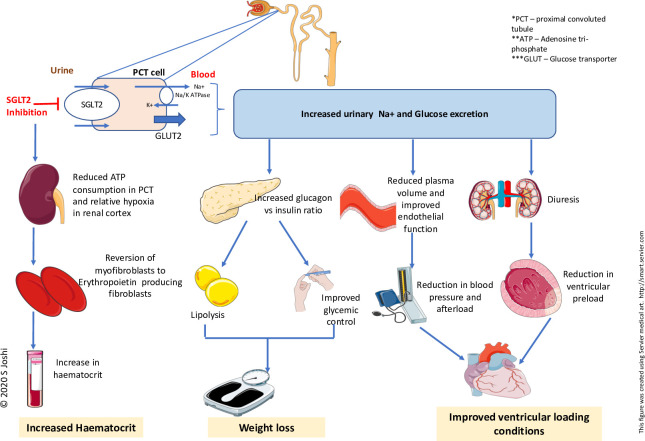
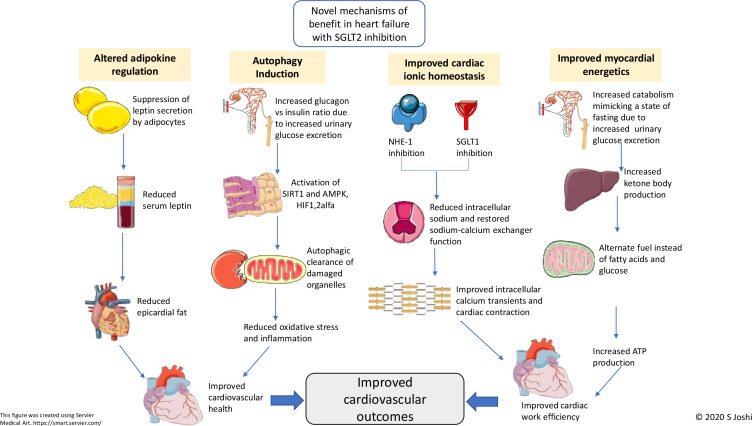
Patients with type 2 diabetes mellitus are at a higher risk of developing heart failure compared with the healthy population. In recent landmark clinical trials, sodium-glucose co-transporter 2 (SGLT2) inhibitor therapies improve blood glucose control and also reduce cardiovascular events and heart failure hospitalisations in patients with type 2 diabetes. Intriguingly, such clinical benefits have also been seen in patients with heart failure in the absence of type 2 diabetes although the underlying mechanisms are not clearly understood. Potential pathways include improved glycaemic control, diuresis, weight reduction and reduction in blood pressure, but none fully explain the observed improvements in clinical outcomes. More recently, novel mechanisms have been proposed to explain these benefits that include improved cardiomyocyte calcium handling, enhanced myocardial energetics, induced autophagy and reduced epicardial fat. We provide an up-to-date review of cardiac-specific SGLT2 inhibitor-mediated mechanisms and highlight studies currently underway investigating some of the proposed mechanisms of action in cardiovascular health and disease.
Keywords: heart failure; heart failure with reduced ejection fraction; pharmacology; systemic review.
© Author(s) (or their employer(s)) 2021. Re-use permitted under CC BY. Published by BMJ.
Conflict of interest statement
Competing interests: The authors have received an investigator initiated award from AstraZeneca to conduct the ‘DAPA-MEMRI’ study.
Figures
Comment in
-
Response to: Correspondence on "Sodium-glucose co-transporter 2 inhibitor therapy: mechanisms of action in heart failure" by Yalta et al.Heart. 2021 Dec;107(23):1922-1923. doi: 10.1136/heartjnl-2021-320174. Epub 2021 Oct 16. Heart. 2021. PMID: 34656972 No abstract available.
-
Correspondence on "Sodium-glucose co-transporter 2 inhibitor therapy: mechanisms of action in heart failure" by Joshi et al.Heart. 2021 Dec;107(23):1922. doi: 10.1136/heartjnl-2021-320124. Epub 2021 Oct 16. Heart. 2021. PMID: 34656974 No abstract available.
References
-
- Lippi G, Sanchis-Gomar F. Global epidemiology and future trends of heart failure. AME Med J 2020;5:15. 10.21037/amj.2020.03.03 - DOI
-
- Maack C, Lehrke M, Backs J, et al. Heart failure and diabetes: metabolic alterations and therapeutic interventions: a state-of-the-art review from the Translational Research Committee of the Heart Failure Association–European Society of Cardiology. Eur Heart J 2018;39:4243–54. 10.1093/eurheartj/ehy596 - DOI - PMC - PubMed
Publication types
Grants and funding
LinkOut - more resources
Full Text Sources
Other Literature Sources
Medical
