Randomized Controlled Trial
. 2021 Jul;46(8):1494-1501.
doi: 10.1038/s41386-021-00980-0. Epub 2021 Feb 26.

Differentiating the effect of antipsychotic medication and illness on brain volume reductions in first-episode psychosis: A Longitudinal, Randomised, Triple-blind, Placebo-controlled MRI Study

Affiliations
Randomized Controlled Trial

Differentiating the effect of antipsychotic medication and illness on brain volume reductions in first-episode psychosis: A Longitudinal, Randomised, Triple-blind, Placebo-controlled MRI Study

Sidhant Chopra et al. Neuropsychopharmacology. 2021 Jul.

Abstract

Changes in brain volume are a common finding in Magnetic Resonance Imaging (MRI) studies of people with psychosis and numerous longitudinal studies suggest that volume deficits progress with illness duration. However, a major unresolved question concerns whether these changes are driven by the underlying illness or represent iatrogenic effects of antipsychotic medication. In this study, 62 antipsychotic-naïve patients with first-episode psychosis (FEP) received either a second-generation antipsychotic (risperidone or paliperidone) or a placebo pill over a treatment period of 6 months. Both FEP groups received intensive psychosocial therapy. A healthy control group (n = 27) was also recruited. Structural MRI scans were obtained at baseline, 3 months and 12 months. Our primary aim was to differentiate illness-related brain volume changes from medication-related changes within the first 3 months of treatment. We secondarily investigated long-term effects at the 12-month timepoint. From baseline to 3 months, we observed a significant group x time interaction in the pallidum (p < 0.05 FWE-corrected), such that patients receiving antipsychotic medication showed increased volume, patients on placebo showed decreased volume, and healthy controls showed no change. Across the entire patient sample, a greater increase in pallidal grey matter volume over 3 months was associated with a greater reduction in symptom severity. Our findings indicate that psychotic illness and antipsychotic exposure exert distinct and spatially distributed effects on brain volume. Our results align with prior work in suggesting that the therapeutic efficacy of antipsychotic medications may be primarily mediated through their effects on the basal ganglia.


Figures
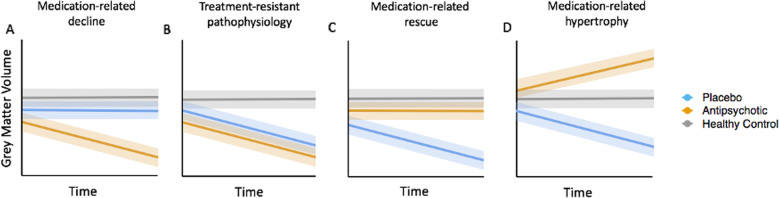
Fig. 1
Fig. 1. Disentangling illness-related and antipsychotic medication-induced brain changes in early psychosis using a randomised placebo-controlled design.
Each panel presents a schematic of expected results under different hypotheses. A A medication-related decline due to antipsychotics is indicated if medicated patients show accelerated GMV loss compared to patients in the placebo group and healthy controls. B An illness effect that is not modified by treatment is indicated if both treatment groups show accelerated GMV loss relative to controls. C An illness-related change that is rescued by antipsychotics is indicated if GMV loss is observed in the placebo group but not medicated patients. D Antipsychotic-related hypertrophy, where GMV is increased in the medicated group compared to the healthy controls and/or placebo group, could be consistent with either a possible medication-related rescue or the initial stages of a volume-loss process (e.g. an oedemic reaction). These possibilities could be disentangled by examining correlations with symptomatic or functional measures; e.g. an association between the volumetric increase and improved outcome would be consistent with possible rescue. For simplicity, controls are depicted as showing no change over time, but they may also show longitudinal increases or decreases. The key factor is whether the rate of change is greater in patients compared to controls. Solid lines represent group means and shaded areas represent some estimate of the error around the mean.
Fig. 2
Fig. 2. Recruitment diagram for the study.
The flow of patients and healthy contol participants though the study.
Fig. 3
Fig. 3. Primary Findings (Baseline to 3-months).
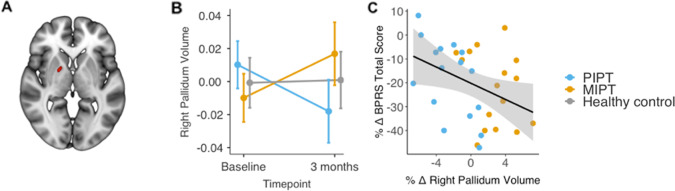
A Red = Location of the cluster within the right pallidum where a significant group × time interaction (p < 0.05, FWE-corrected) was detected. B The principal pallidal GMV eigenvariate for each group at baseline and 3-month follow-up, adjusted for model covariates. Error bars show 95% confidence intervals. C The association between percentage change (%Δ) in total Brief Psychiatric Rating Scale score (BPRS; y-axis) and percentage change in pallidal GMV volume within the two treatment groups.

References

    1. Jung WH, et al. Cortical thickness reduction in individuals at ultra-high-risk for psychosis. Schizophr Bull. 2011;37:839–49. - PMC - PubMed
    1. Fusar-Poli P, Radua J, McGuire P, Borgwardt S. Neuroanatomical maps of psychosis onset: voxel-wise meta-analysis of antipsychotic-naive VBM studies. Schizophr Bull. 2012;38:1297–307. - PMC - PubMed
    1. Fornito A, Yücel M, Patti J, Wood SJ, Pantelis C. Mapping grey matter reductions in schizophrenia: An anatomical likelihood estimation analysis of voxel-based morphometry studies. Schizophr Res. 2009;108:104–13. - PubMed
    1. Ho B-C, Andreasen NC, Ziebell S, Pierson R, Magnotta V. Long-term antipsychotic treatment and brain volumes. Arch Gen Psychiatry. 2011;68:128–37. - PMC - PubMed
    1. van Erp TGM, et al. Cortical brain abnormalities in 4474 individuals with schizophrenia and 5098 control subjects via the Enhancing Neuro Imaging Genetics Through Meta Analysis (ENIGMA) Consortium. Biol Psychiatry. 2018;84:644–54. - PMC - PubMed

Publication types

MeSH terms