


Racial/Ethnic Heterogeneity and Rural-Urban Disparity of COVID-19 Case Fatality Ratio in the USA: a Negative Binomial and GIS-Based Analysis
- PMID: 33638102
- PMCID: PMC7909733
- DOI: 10.1007/s40615-021-01006-7
Racial/Ethnic Heterogeneity and Rural-Urban Disparity of COVID-19 Case Fatality Ratio in the USA: a Negative Binomial and GIS-Based Analysis
Abstract
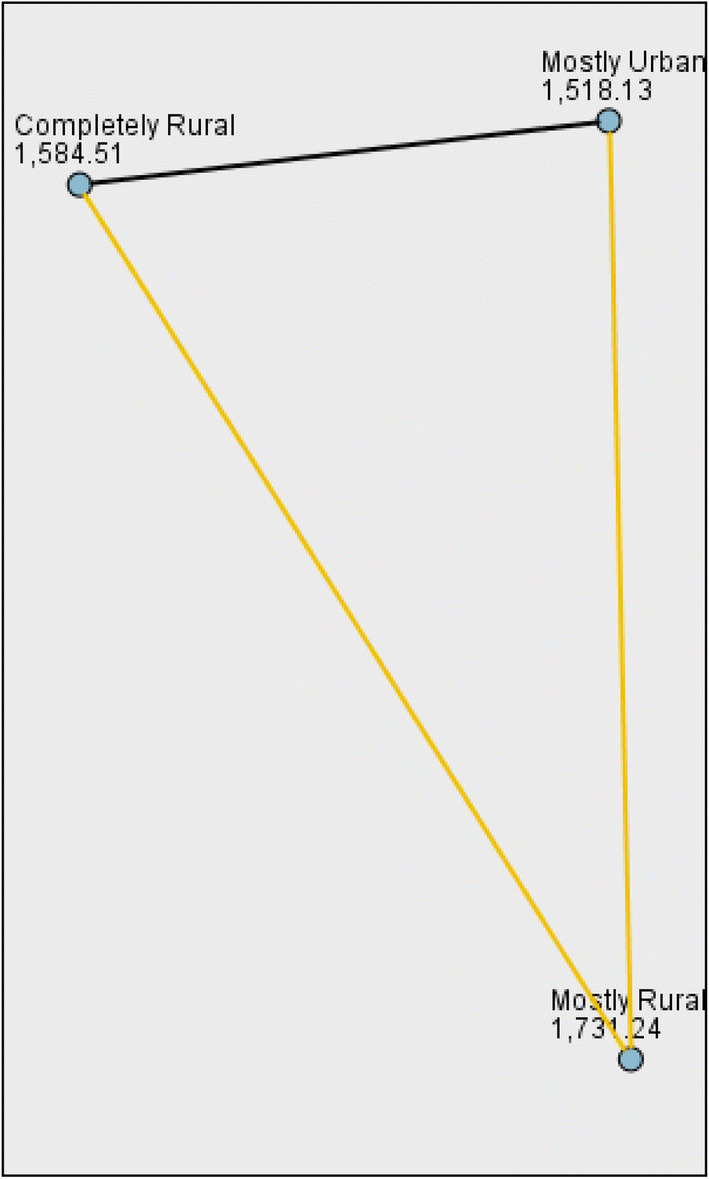
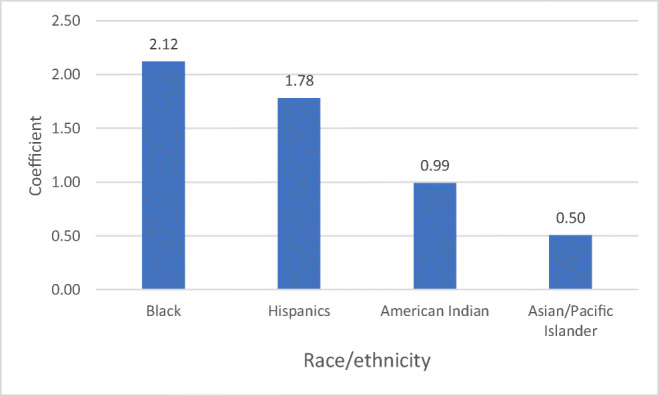
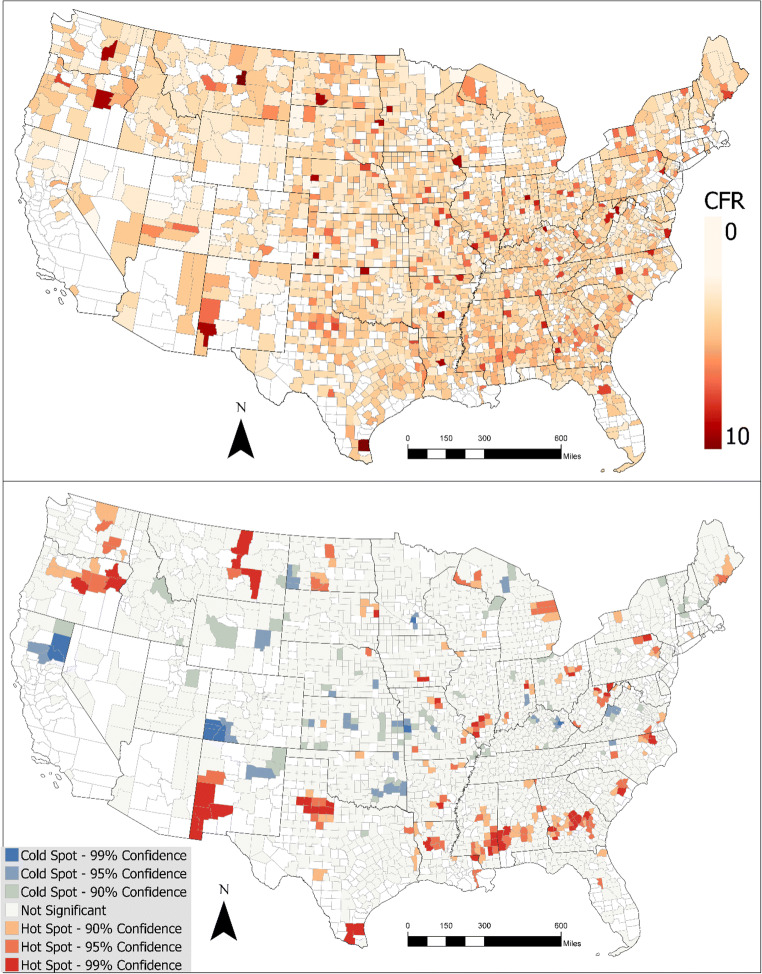
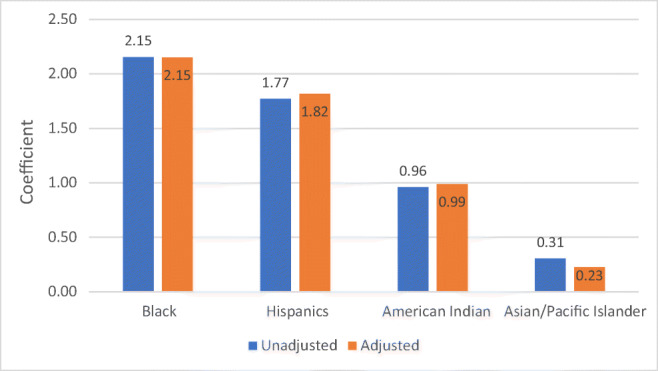
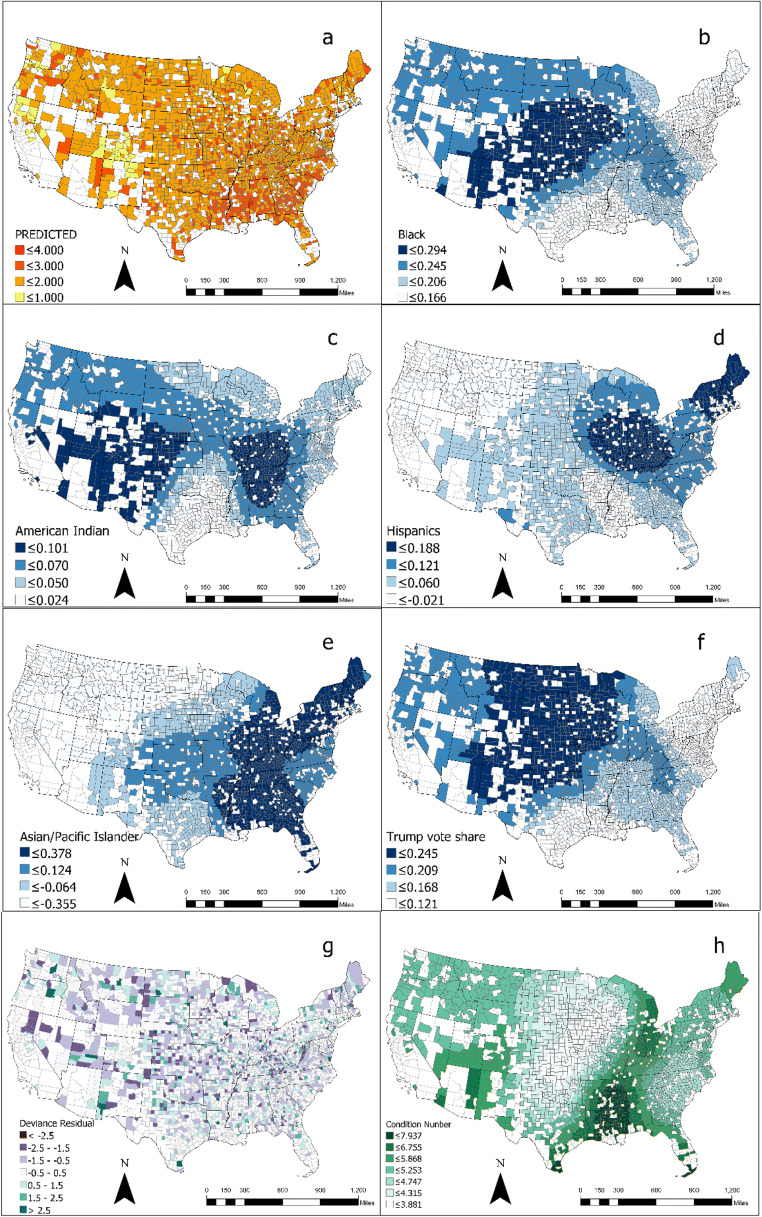
The 2019 coronavirus disease (COVID-19) has exacerbated inequality in the United States of America (USA). Black, indigenous, and people of color (BIPOC) are disproportionately affected by the pandemic. This study examines determinants of COVID-19 case fatality ratio (CFR) based on publicly sourced data from January 1 to December 18, 2020, and sociodemographic and rural-urban continuum data from the US Census Bureau. Nonspatial negative binomial Poisson regression and geographically weighted Poisson regression were applied to estimate the global and local relationships between the CFR and predictors-rural-urban continuum, political inclination, and race/ethnicity in 2407 rural counties. The mean COVID-19 CFR among rural counties was 1.79 (standard deviation (SD) = 1.07; 95% CI 1.73-1.84) higher than the total US counties (M = 1.69, SD = 1.18; 95% CI: 1.65-1.73). Based on the global NB model, CFR was positively associated with counties classified as "completely rural" (incidence rate ratio (IRR) = 1.24; 95% CI: 1.12-1.39) and "mostly rural" (IRR = 1.26; 95% CI: 1.15-1.38) relative to "mostly urban" counties. Nonspatial regression indicates that COVID-19 CFR increases by a factor of 8.62, 5.87, 2.61, and 1.36 for one unit increase in county-level percent Blacks, Hispanics, American Indians, and Asian/Pacific Islanders, respectively. Local spatial regression shows CFR was significantly higher in rural counties with a higher share of BIPOC in the Northeast and Midwest regions, and political inclination predicted COVID-19 CFR in rural counties in the Midwest region. In conclusion, spatial and racial/ethnic disparities exist for COVID-19 CFR across the US rural counties, and findings from this study have implications for public health.
Keywords: COVID-19 severity; Disease severity; Political inclination; Racial/ethnic minorities; Rural-urban continuum; Spatial analysis.
© 2021. W. Montague Cobb-NMA Health Institute.
Conflict of interest statement
The authors declare no competing interests.
Figures
Similar articles
-
Assessment of Structural Barriers and Racial Group Disparities of COVID-19 Mortality With Spatial Analysis.JAMA Netw Open. 2022 Mar 1;5(3):e220984. doi: 10.1001/jamanetworkopen.2022.0984. JAMA Netw Open. 2022. PMID: 35244703 Free PMC article.
-
COVID-19 Death Rates Are Higher in Rural Counties With Larger Shares of Blacks and Hispanics.J Rural Health. 2020 Sep;36(4):602-608. doi: 10.1111/jrh.12511. Epub 2020 Sep 7. J Rural Health. 2020. PMID: 32894612 Free PMC article.
-
Association of Social and Economic Inequality With Coronavirus Disease 2019 Incidence and Mortality Across US Counties.JAMA Netw Open. 2021 Jan 4;4(1):e2034578. doi: 10.1001/jamanetworkopen.2020.34578. JAMA Netw Open. 2021. PMID: 33471120 Free PMC article.
-
Epidemiology of the 2020 Pandemic of COVID-19 in the State of Texas: The First Month of Community Spread.J Community Health. 2020 Aug;45(4):696-701. doi: 10.1007/s10900-020-00854-4. J Community Health. 2020. PMID: 32500438 Free PMC article. Review.
-
Unspoken Consequences of Structural Racism in the USA: Diabetes and COVID-19.J Racial Ethn Health Disparities. 2024 Oct;11(5):2575-2582. doi: 10.1007/s40615-023-01722-2. Epub 2023 Jul 17. J Racial Ethn Health Disparities. 2024. PMID: 37460920 Review.
Cited by
-
Association of COVID-19 Case-Fatality Rate With State Health Disparity in the United States.Front Med (Lausanne). 2022 Jun 29;9:853059. doi: 10.3389/fmed.2022.853059. eCollection 2022. Front Med (Lausanne). 2022. PMID: 35847787 Free PMC article.
-
The rural mortality penalty in U.S. hospital patients with COVID-19.Popul Health Metr. 2024 Aug 14;22(1):20. doi: 10.1186/s12963-024-00340-2. Popul Health Metr. 2024. PMID: 39143603 Free PMC article.
-
SARS-CoV-2 transmission potential and rural-urban disease burden disparities across Alabama, Louisiana, and Mississippi, March 2020 - May 2021.Ann Epidemiol. 2022 Jul;71:1-8. doi: 10.1016/j.annepidem.2022.04.006. Epub 2022 Apr 25. Ann Epidemiol. 2022. PMID: 35472488 Free PMC article.
-
Rural/urban differences in mental health and social well-being among older US adults in the early months of the COVID-19 pandemic.Aging Ment Health. 2023 Mar;27(3):505-511. doi: 10.1080/13607863.2022.2060184. Epub 2022 Apr 4. Aging Ment Health. 2023. PMID: 35369828 Free PMC article.
-
Refining 2SVCA Method for Measuring Telehealth Accessibility of Primary Care Physicians in Baton Rouge, Louisiana.Cities. 2023 Jul;138:104364. doi: 10.1016/j.cities.2023.104364. Epub 2023 May 12. Cities. 2023. PMID: 37274944 Free PMC article.
References
-
- Onder G, Rezza G, Brusaferro S. Case-fatality rate and characteristics of patients dying in relation to COVID-19 in Italy. JAMA. 2020:323, 1775–1326 [cited 2021 Jan 20] Available from: 10.1001/jama.2020.4683, Case-Fatality Rate and Characteristics of Patients Dying in Relation to COVID-19 in Italy. - PubMed
-
- World Health Organization . Estimating mortality from COVID-19: scientific brief. 2020.
-
- Porta M. A dictionary of epidemiology: Oxford university press; 2014.
MeSH terms
LinkOut - more resources
Full Text Sources
Other Literature Sources
Medical