


High flow nasal oxygen therapy to avoid invasive mechanical ventilation in SARS-CoV-2 pneumonia: a retrospective study
- PMID: 33638752
- PMCID: PMC7910764
- DOI: 10.1186/s13613-021-00825-5
High flow nasal oxygen therapy to avoid invasive mechanical ventilation in SARS-CoV-2 pneumonia: a retrospective study
Abstract
Background: The efficacy of high flow nasal canula oxygen therapy (HFNO) to prevent invasive mechanical ventilation (IMV) is not well established in severe coronavirus disease 2019 (COVID-19). The aim of this study was to compare the risk of IMV between two strategies of oxygenation (conventional oxygenation and HFNO) in critically ill COVID 19 patients.
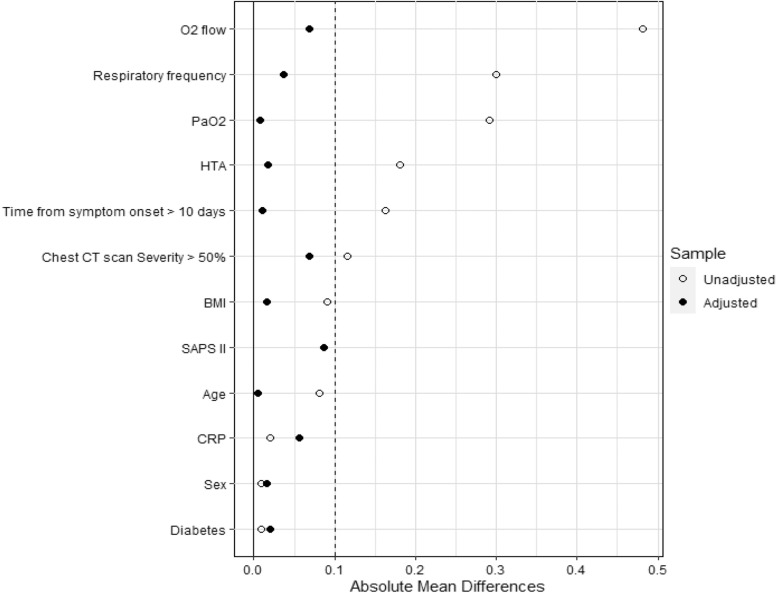
Methods: This was a bicenter retrospective study which took place in two intensive care units (ICU) of tertiary hospitals in the Paris region from March 11, to May 3, 2020. We enrolled consecutive patients hospitalized for COVID-19 and acute respiratory failure (ARF) who did not receive IMV at ICU admission. The primary outcome was the rate of IMV after ICU admission. Secondary outcomes were death at day 28 and day 60, length of ICU stay and ventilator-free days at day 28. Data from the HFNO group were compared with those from the standard oxygen therapy (SOT) group using weighted propensity score.
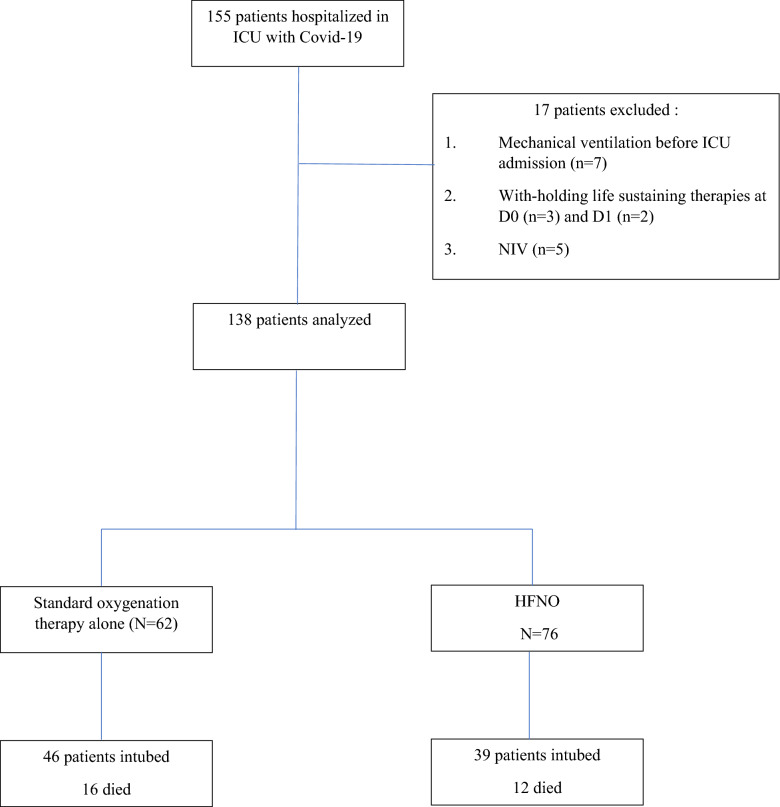
Results: Among 138 patients who met the inclusion criteria, 62 (45%) were treated with SOT alone, and 76 (55%) with HFNO. In HFNO group, 39/76 (51%) patients received IMV and 46/62 (74%) in SOT group (OR 0.37 [95% CI, 0.18-0.76] p = 0.007). After weighted propensity score, HFNO was still associated with a lower rate of IMV (OR 0.31 [95% CI, 0.14-0.66] p = 0.002). Length of ICU stay and mortality at day 28 and day 60 did not significantly differ between HFNO and SOT groups after weighted propensity score. Ventilator-free days at days 28 was higher in HNFO group (21 days vs 10 days, p = 0.005). In the HFNO group, predictive factors associated with IMV were SAPS2 score (OR 1.13 [95%CI, 1.06-1.20] p = 0.0002) and ROX index > 4.88 (OR 0.23 [95%CI, 0.008-0.64] p = 0.006).
Conclusions: High flow nasal canula oxygen for ARF due to COVID-19 is associated with a lower rate of invasive mechanical ventilation.
Keywords: Acute respiratory failure; COVID-19; High flow nasal canula; Intensive care unit.
Conflict of interest statement
JRZ reports personal fees from Pfizer, personal fees from Correvio, personal fees from Eumedica, personal fees from Merck Sharp and Dohme, outside the submitted work. NB, OM, MB, VL, NE, PK, YTL, GVDM, JO, MS, MG, AW, PA, SG ang YC report no conflict of interest.
Figures
References
-
- Grasselli G, Zangrillo A, Zanella A, Antonelli M, Cabrini L, Castelli A, et al. Baseline Characteristics and Outcomes of 1591 Patients Infected With SARS-CoV-2 Admitted to ICUs of the Lombardy Region. Italy JAMA American Medical Association. 2020;323:1574–1581. doi: 10.1001/jama.2020.5394. - DOI - PMC - PubMed
LinkOut - more resources
Full Text Sources
Other Literature Sources
Miscellaneous
