


Impacts of Dryland Cropping Systems on Ground Beetle Communities (Coleoptera: Carabidae) in the Northern Great Plains
- PMID: 33638987
- PMCID: PMC7913543
- DOI: 10.1093/jisesa/ieab008
Impacts of Dryland Cropping Systems on Ground Beetle Communities (Coleoptera: Carabidae) in the Northern Great Plains
Abstract
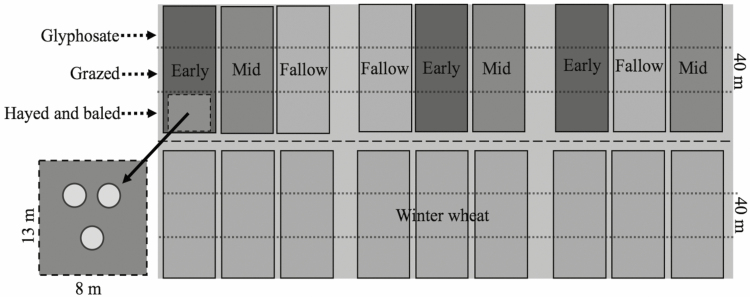
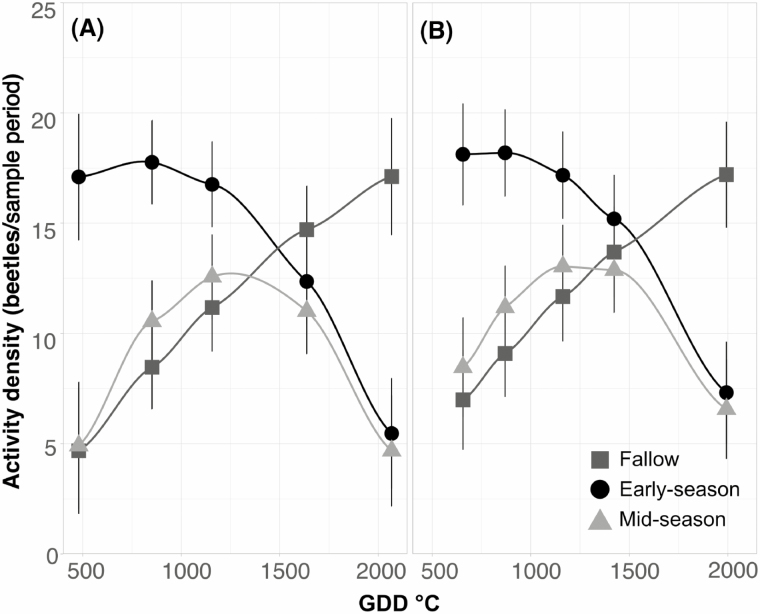
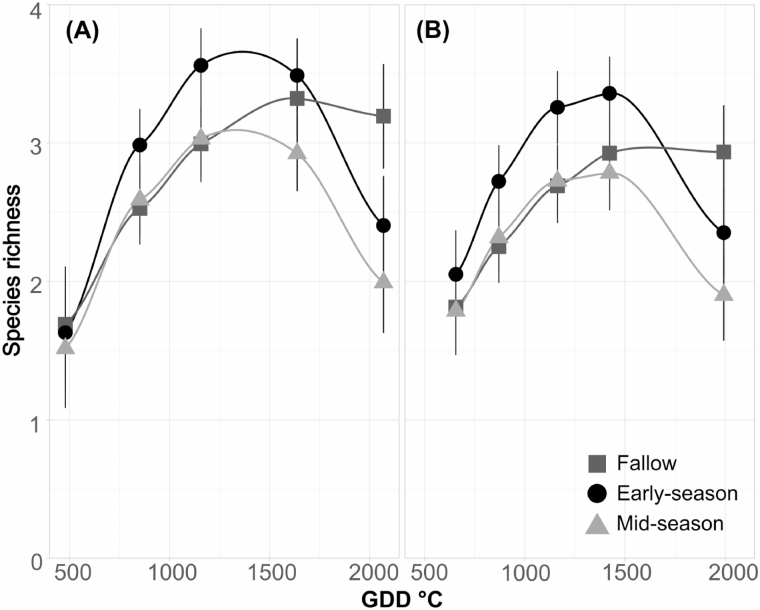
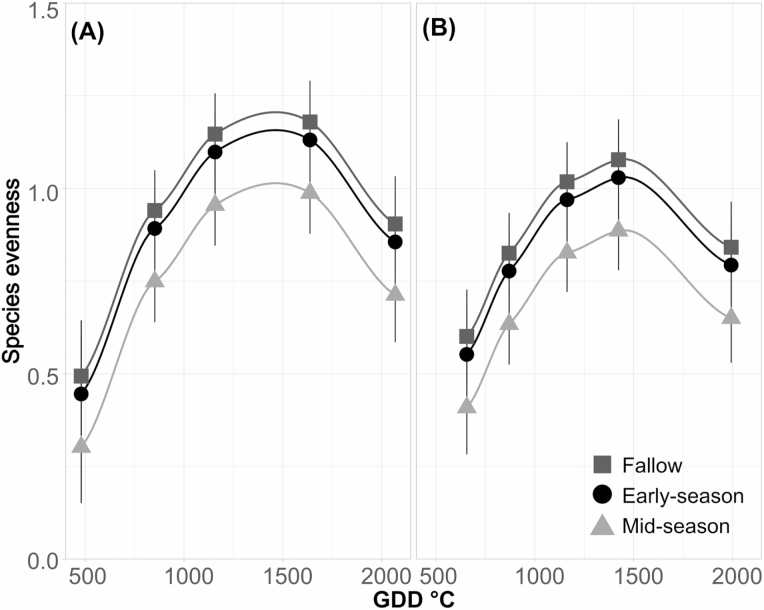
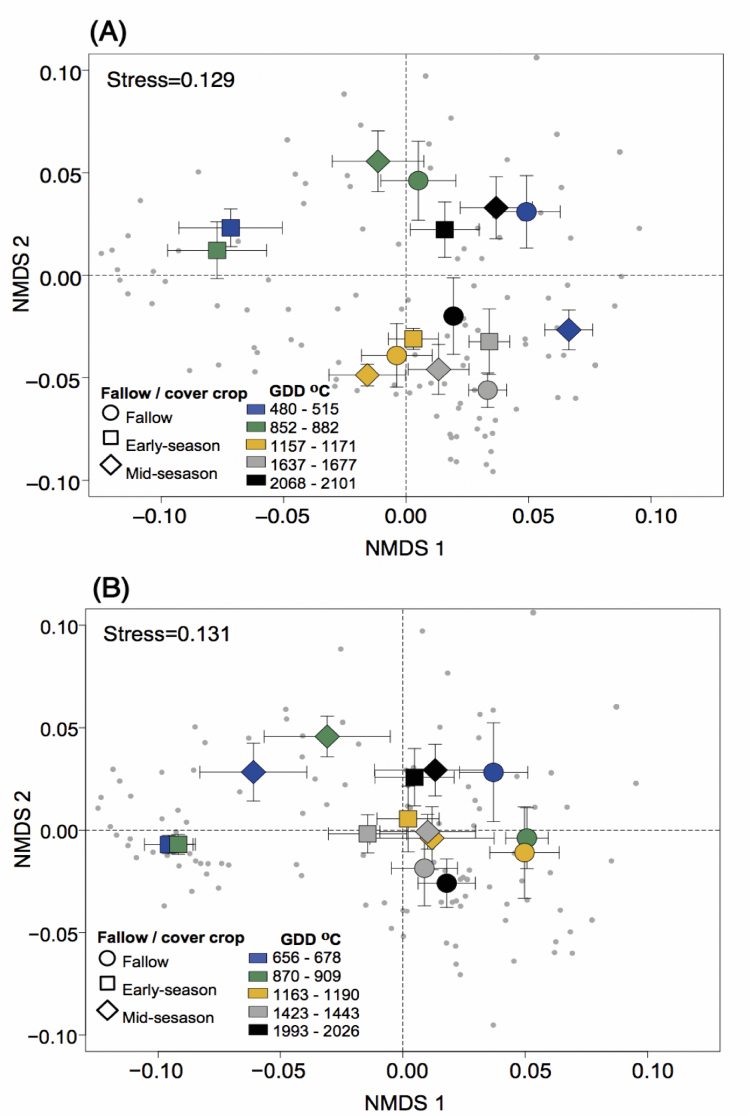
Ground beetles are natural predators of insect pests and small seeds in agroecosystems. In semiarid cropping systems of the Northern Great Plains, there is a lack of knowledge to how ground beetles are affected by diversified cover crop rotations. In a 2-yr study (2018 and 2019), our experiment was a restricted-randomization strip-plot design, comprising summer fallow, an early-season cover crop mixture (five species), and a mid-season cover crop mixture (seven species), with three cover crop termination methods (i.e., herbicide, grazing, and haying). Using pitfall traps, we sampled ground beetles in five 48-h intervals throughout the growing season (n = 135 per year) using growing degree day (GDD) accumulations to better understand changes to ground beetle communities. Data analysis included the use of linear mixed-effects models, perMANOVA, and non-metric multidimensional scaling ordinations. We did not observe differences among cover crop termination methods; however, activity density in the early-season cover crop mixture decreased and in summer fallow increased throughout the growing season, whereas the mid-season cover crop mixture peaked in the middle of the summer. Ground beetle richness and evenness showed a nonlinear tendency, peaking in the middle of the growing season, with marginal differences between cover crops or fallow after the termination events. Also, differences in ground beetle composition were greatest in the early- and mid-season cover crop mixtures earlier in the growing season. Our study supports the use of cover crop mixtures to enhance ground beetle communities, with potential implications for pest management in dryland cropping systems.
Keywords: cover crop mixture; cover crop termination; generalist predator; growing degree day.
© Crown copyright 2021.
Figures
References
-
- Adhikari, S., and F. D. Menalled. . 2018. Impacts of dryland farm management systems on weeds and ground beetles (Carabidae) in the Northern Great Plains. Sustainability 10: 2146.
-
- Adhikari, S., and F. D. Menalled. . 2020. Supporting beneficial insects for agricultural austainability: the role of livestock-integrated organic and cover cropping to enhance ground beetle (Carabidae) communities. Agronomy 10: 1210.
-
- Anderson, C. R., J. Bruil, M. J. Chappell, C. Kiss, and M. P. Pimbert. . 2019. From transition to domains of transformation: getting to sustainable and just food systems through agroecology. Sustainability 11: 5272.
-
- Bates, D., M. Maechler, B. Bolker aut, cre, S. Walker, R. H. B. Christensen, H. Singmann, B. Dai, F. Scheipl, G. Grothendieck, P. Green, and J. Fox. . 2020. lme4: linear mixed-effects models using “Eigen” and S4. Journal of Statistical Software.
-
- Baucom, R. S. 2019. Evolutionary and ecological insights from herbicide-resistant weeds: what have we learned about plant adaptation, and what is left to uncover? New Phytol. 223: 68–82. - PubMed
MeSH terms
LinkOut - more resources
Full Text Sources
Other Literature Sources
