


SARS-CoV-2 infections in children following the full re-opening of schools and the impact of national lockdown: Prospective, national observational cohort surveillance, July-December 2020, England
- PMID: 33639175
- PMCID: PMC7904496
- DOI: 10.1016/j.jinf.2021.02.022
SARS-CoV-2 infections in children following the full re-opening of schools and the impact of national lockdown: Prospective, national observational cohort surveillance, July-December 2020, England
Abstract
Introduction: The reopening of schools during the COVID-19 pandemic has raised concern for the safety of staff and students, their families and the wider community. We monitored SARS-CoV-2 infection rates in school-aged children and compared them with adult infection rates before and after schools reopened in England.
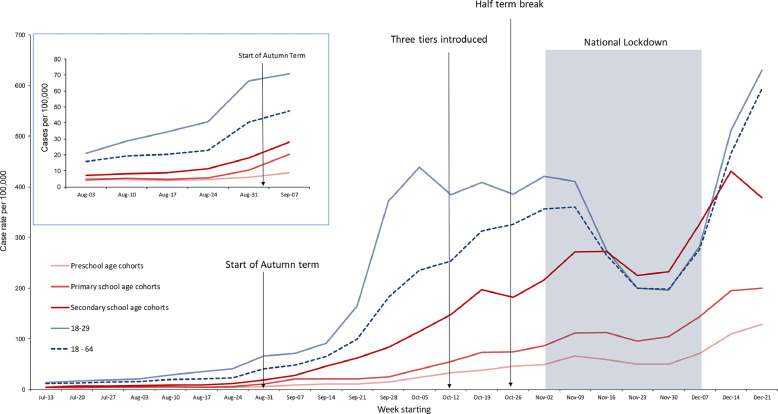
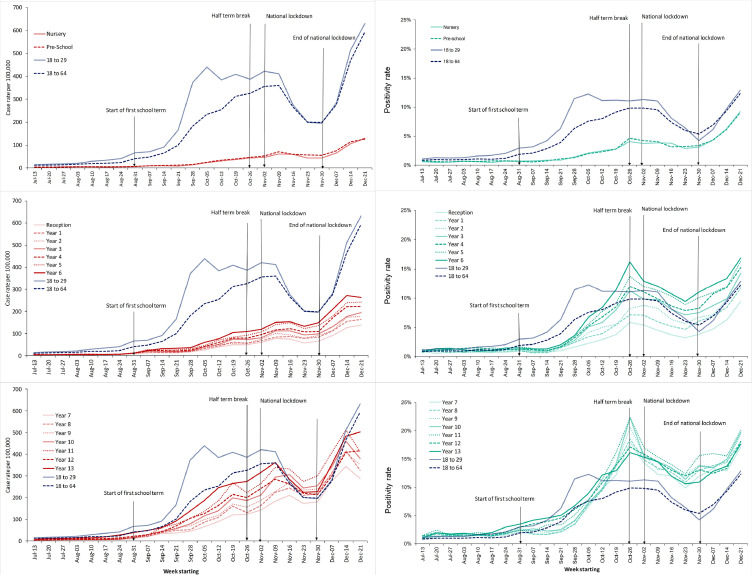
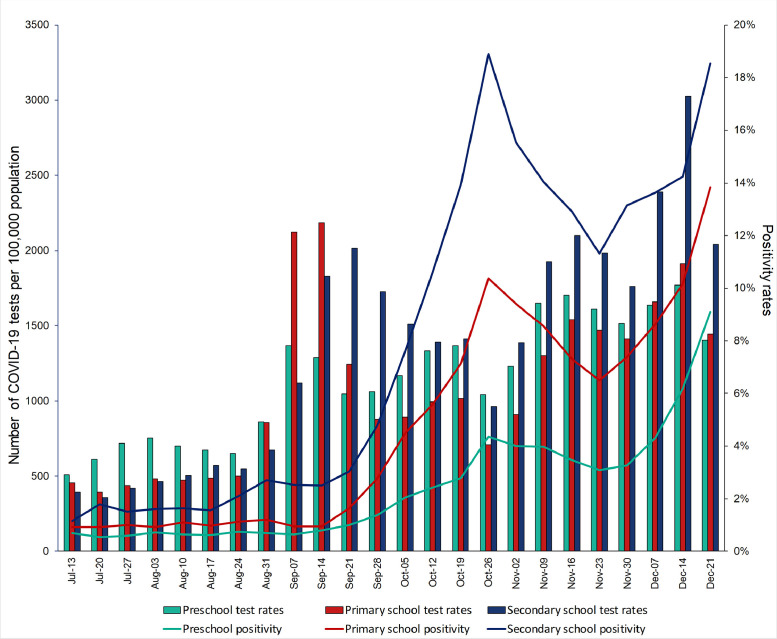
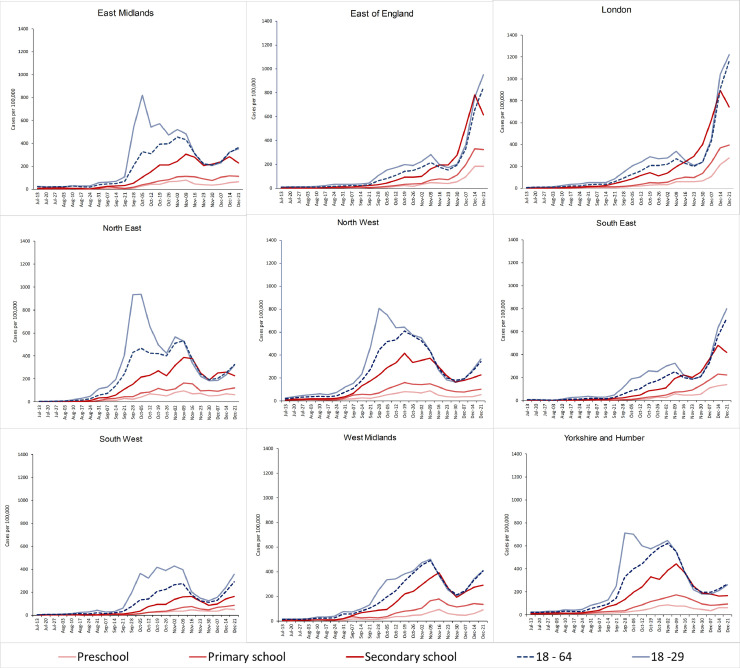
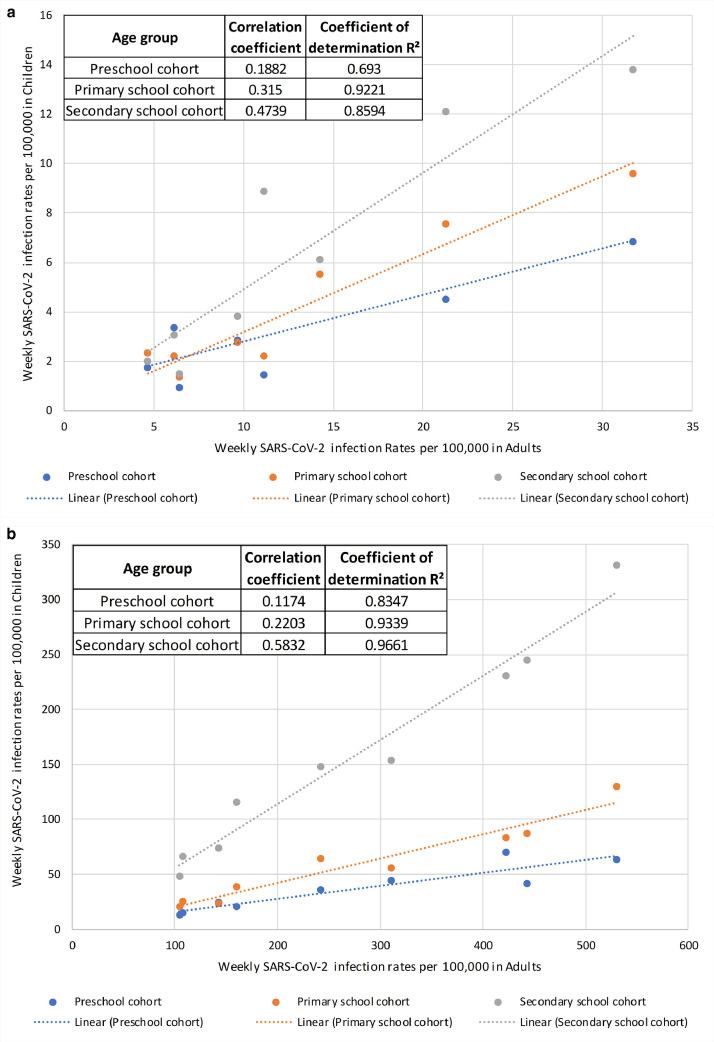
Methods: Public Health England receives daily electronic reports of all SARS-CoV-2 tests nationally. SARS-CoV-2 infection rates by school year from July to December 2020 were analysed, including the effect of a national month-long lockdown whilst keeping schools open in November 2020 RESULTS: SARS-CoV-2 infections rates were low during early summer but started increasing in mid-August, initially in young adults followed by secondary and then primary school-aged children prior to schools reopening in September 2020. Cases in school-aged children lagged behind and followed adult trends after schools reopened, with a strong age gradient in weekly infection rates. There was a strong (P<0.001) correlation in regional infection rates between adults and secondary (R2=0.96-0.98), primary (R2=0.93-0.94) and preschool-aged (R2=0.62-0.85) children. The November lockdown was associated with declines in adult infection rates, followed a week later, by declines in student cases. From 23 November 2020, cases in adults and children increased rapidly following the emergence of a more transmissible novel variant of concern (VOC-202,012/01; B.1.1.7).
Conclusions: In school-aged children, SARS-CoV-2 infections followed the same trajectory as adult cases and only declined after national lockdown was implemented whilst keeping schools open. Maintaining low community infection rates is critical for keeping schools open during the pandemic.
Keywords: COVID-19; Children; SARS-CoV-2; Schools; Transmission.
Copyright © 2021. Published by Elsevier Ltd.
Conflict of interest statement
Declaration of Competing Interest We declare no conflicts of interest.
Figures
References
-
- Levinson M., Cevik M., Lipsitch M. Reopening primary schools during the pandemic. N Engl J Med. 2020;383:981–985. - PubMed
-
- Snape M.D., Viner R.M. COVID-19 in children and young people. Science. 2020;370:286–288. - PubMed
-
- Viner R.M., Bonell C., Drake L. Reopening schools during the COVID-19 pandemic: governments must balance the uncertainty and risks of reopening schools against the clear harms associated with prolonged closure. Arch Dis Child. 2020 doi: 10.1136/archdischild-2020-319963. Aug 3;archdischild-2020-319963Online ahead of print. - DOI - PMC - PubMed
-
- Public Health England (PHE). Weekly coronavirus disease 2019 (COVID-19) surveillance report: summary of COVID-19 surveillance systems. 2020. Available at: https://assets.publishing.service.gov.uk/government/uploads/system/uploa.... Accessed: 12 February 2021.
-
- Department for Education (DfE). Guidance for full opening: schools. 2020. Available at: https://www.gov.uk/government/publications/actions-for-schools-during-th.... Accessed: 12 February 2021.
Publication types
MeSH terms
Grants and funding
LinkOut - more resources
Full Text Sources
Other Literature Sources
Medical
Miscellaneous
