Review
. 2021 May:67:101311.
doi: 10.1016/j.arr.2021.101311. Epub 2021 Feb 24.

Region-specific vulnerability in neurodegeneration: lessons from normal ageing

Affiliations
Review

Region-specific vulnerability in neurodegeneration: lessons from normal ageing

Virenkumar A Pandya et al. Ageing Res Rev. 2021 May.

Abstract

A number of age-associated neurodegenerative diseases, including Alzheimer's disease (AD), Parkinson's disease (PD) and amyotrophic lateral sclerosis (ALS), possess a shared characteristic of region-specific neurodegeneration. However, the mechanisms which determine why particular regions within the nervous system are selectively vulnerable to neurodegeneration, whilst others remain relatively unaffected throughout disease progression, remain elusive. Here, we review how regional susceptibility to the ubiquitous physiological phenomenon of normal ageing might underlie the vulnerability of these same regions to neurodegeneration, highlighting three regions archetypally associated with AD, PD and ALS (the hippocampus, substantia nigra pars compacta and ventral spinal cord, respectively), as especially prone to age-related alterations. Placing particular emphasis on these three regions, we comprehensively explore differential regional susceptibility to nervous system tissue, cellular and molecular level ageing to provide an integrated perspective on why age-related neurodegenerative diseases exhibit region-selective vulnerability. Combining these principles with increasingly recognised differences between chronological and biological ageing (termed differential or 'delta' ageing) might ultimately guide therapeutic approaches for these devastating neurodegenerative diseases, for which a paucity of disease modifying and/or life promoting treatments currently exist.

Keywords: Ageing; Alzheimer’s disease; Amyotrophic lateral sclerosis; Parkinson’s disease; Region-specific; Selective vulnerability.


Conflict of interest statement

The authors declare no conflict of interest.

Figures
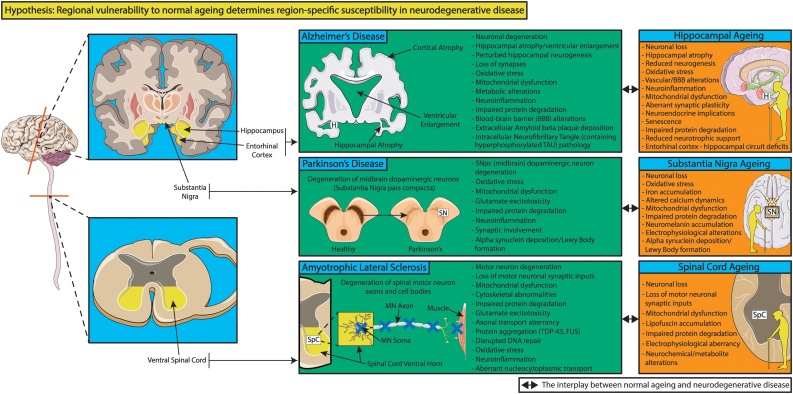
Fig. 1
Fig. 1
Age-related neurodegenerative diseases display region-specific pathological patterns. Particular regions of the nervous system are selectively susceptible to degenerative decline in Alzheimer’s disease (AD), Parkinson’s disease (PD) and amyotrophic lateral sclerosis (ALS), however the mechanisms establishing the regionally restricted nature of age-related neurodegenerative diseases remain undefined. Indeed, regional pathological involvement of the hippocampus, substantia nigra pars compacta and ventral spinal cord determines major clinical and personal manifestations of AD, PD and ALS respectively, with important consequences for quality of life, healthspan and/or lifespan. There is an interplay between normal regional ageing and neurodegenerative disease pathology. Whether certain regions, such as the hippocampus, substantia nigra pars compacta and ventral spinal cord are more susceptible to age-associated alterations than other nervous system regions, which in turn renders them prone to disease-specific pathology, is reviewed in the main text. H = hippocampus; SN(pc) = substantia nigra (pars compacta); SpC = spinal cord. MN = motor neuron. Templates used/adapted to create this figure are freely available from Servier Medical Art (https://smart.servier.com/). (References used to create this figure: Bettio et al., 2017; Branch et al., 2014; Cenini and Voos, 2019; De Strooper and Karran, 2016; Hindle, 2010; Keller et al., 2000; Mu and Gage, 2011; Pandya and Patani, 2019; Penney et al., 2020; Piekarz et al., 2020; Reagh et al., 2018; Reeve et al., 2014; Trist et al., 2019; Van Damme et al., 2017).
Fig. 2
Fig. 2
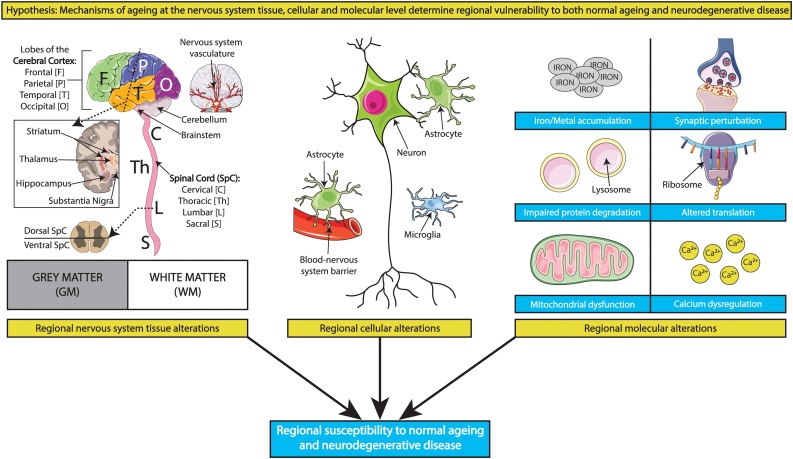
An integrated multi-scale perspective of regional ageing and disease susceptibility. A variety of age-associated mechanisms at the nervous system tissue, cellular and molecular levels might determine regional vulnerability to ageing, and in turn partially explain why age-related neurodegenerative disease pathology affects certain regions whilst leaving others relatively unaffected. Some contributory mechanisms at these levels are depicted above but reviewed comprehensively in the main text. Templates used/adapted to create this figure are freely available from Servier Medical Art (https://smart.servier.com/).
Fig. 3
Fig. 3
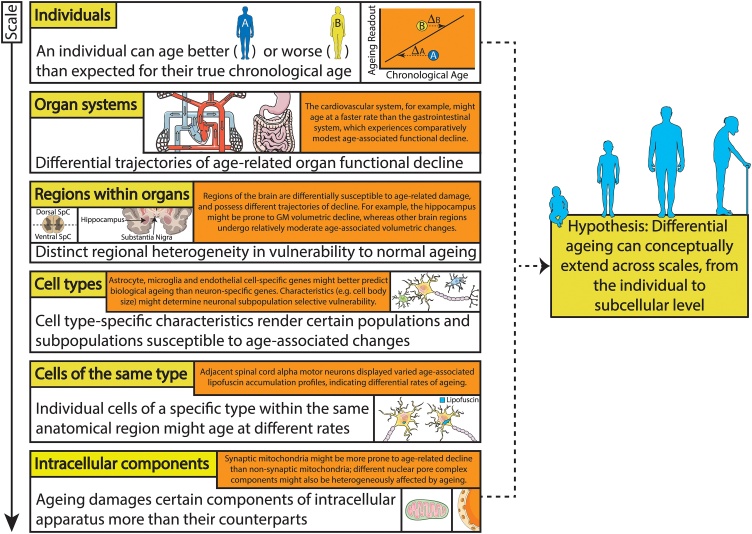
The concept of differential ageing can be applied on an increasingly smaller scale. Differential ageing has been evidenced on an organism level, where an individual can biologically age better or worse than is expected for their chronological age. As well as different individuals ageing differently, ageing affects the function of various organ systems heterogeneously. Moreover, similar principles can be applied to nervous system regions, individual cells and even components within a single cell, which might age disproportionately to their counterparts. Some examples of differential ageing at each scale are provided above, which might have important consequences for age-related disease research. The experimental tractability of analysing nervous system tissue, cellular and molecular differential/delta ageing, as well as its possible future implications therapeutically, are reviewed in the discussion section. GM = grey matter; SpC = spinal cord. Templates used/adapted to create this figure are freely available from Servier Medical Art (https://smart.servier.com/). (References used to create this figure: D’Angelo et al., 2009; Fjell et al., 2013; Jernigan et al., 2001; Khan et al., 2017; Maxwell et al., 2018; Rhinn and Abeliovich, 2017; Soreq et al., 2017; Stauch et al., 2014).

References

    1. Ahadi S., Zhou W., Schüssler-Fiorenza Rose S.M., Sailani M.R., Contrepois K., Avina M., Ashland M., Brunet A., Snyder M. Personal aging markers and ageotypes revealed by deep longitudinal profiling. Nat. Med. 2020;26:83–90. doi: 10.1038/s41591-019-0719-5. - DOI - PMC - PubMed
    1. Allen N.J., Lyons D.A. Glia as architects of central nervous system formation and function. Science. 2018;362:181–185. doi: 10.1126/science.aat0473. - DOI - PMC - PubMed
    1. Armstrong M.J., Okun M.S. Diagnosis and treatment of parkinson disease: a review. JAMA. 2020;323:548–560. doi: 10.1001/jama.2019.22360. - DOI - PubMed
    1. Ashraf A., Michaelides C., Walker T.A., Ekonomou A., Suessmilch M., Sriskanthanathan A., Abraha S., Parkes A., Parkes H.G., Geraki K., So P.W. Regional distributions of Iron, copper and zinc and their relationships with glia in a normal aging mouse model. Front. Aging Neurosci. 2019;11:351. doi: 10.3389/fnagi.2019.00351. - DOI - PMC - PubMed
    1. Azevedo F.A., Carvalho L.R., Grinberg L.T., Farfel J.M., Ferretti R.E., Leite R.E., Jacob Filho W., Lent R., Herculano-Houzel S. Equal numbers of neuronal and nonneuronal cells make the human brain an isometrically scaled-up primate brain. J. Comp. Neurol. 2009;513:532–541. doi: 10.1002/cne.21974. - DOI - PubMed

Publication types