


Advanced machine learning for predicting individual risk of flares in rheumatoid arthritis patients tapering biologic drugs
- PMID: 33640008
- PMCID: PMC7913400
- DOI: 10.1186/s13075-021-02439-5
Advanced machine learning for predicting individual risk of flares in rheumatoid arthritis patients tapering biologic drugs
Abstract
Background: Biological disease-modifying anti-rheumatic drugs (bDMARDs) can be tapered in some rheumatoid arthritis (RA) patients in sustained remission. The purpose of this study was to assess the feasibility of building a model to estimate the individual flare probability in RA patients tapering bDMARDs using machine learning methods.
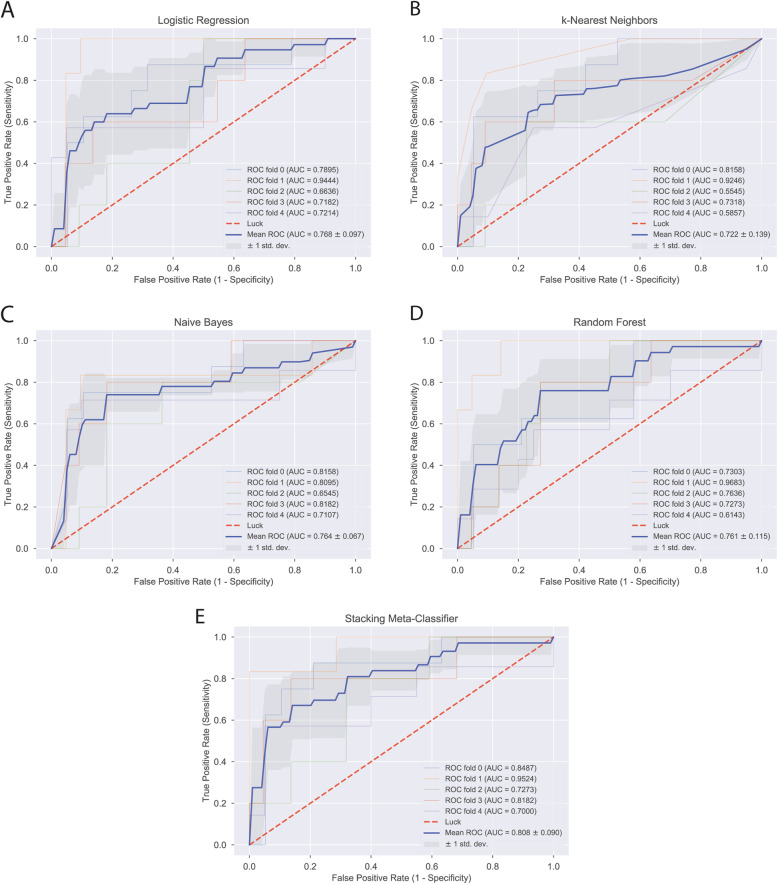
Methods: Longitudinal clinical data of RA patients on bDMARDs from a randomized controlled trial of treatment withdrawal (RETRO) were used to build a predictive model to estimate the probability of a flare. Four basic machine learning models were trained, and their predictions were additionally combined to train an ensemble learning method, a stacking meta-classifier model to predict the individual flare probability within 14 weeks after each visit. Prediction performance was estimated using nested cross-validation as the area under the receiver operating curve (AUROC). Predictor importance was estimated using the permutation importance approach.
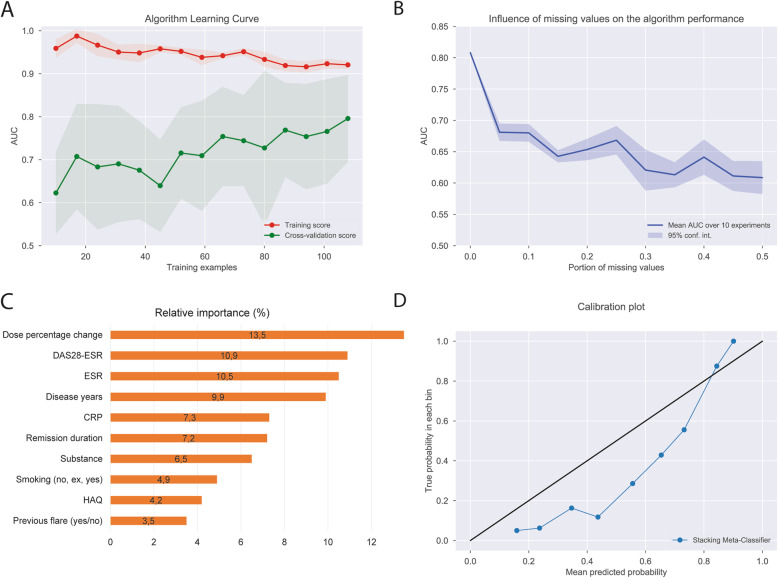
Results: Data of 135 visits from 41 patients were included. A model selection approach based on nested cross-validation was implemented to find the most suitable modeling formalism for the flare prediction task as well as the optimal model hyper-parameters. Moreover, an approach based on stacking different classifiers was successfully applied to create a powerful and flexible prediction model with the final measured AUROC of 0.81 (95%CI 0.73-0.89). The percent dose change of bDMARDs, clinical disease activity (DAS-28 ESR), disease duration, and inflammatory markers were the most important predictors of a flare.
Conclusion: Machine learning methods were deemed feasible to predict flares after tapering bDMARDs in RA patients in sustained remission.
Keywords: Flare prediction; Machine learning; Rheumatoid arthritis.
Conflict of interest statement
None to declare.
Figures
References
-
- Aga AB, Lie E, Uhlig T, Olsen IC, Wierod A, Kalstad S, Rodevand E, Mikkelsen K, Kvien TK, Haavardsholm EA. Time trends in disease activity, response and remission rates in rheumatoid arthritis during the past decade: results from the NOR-DMARD study 2000–2010. Ann Rheum Dis. 2015;74(2):381–388. doi: 10.1136/annrheumdis-2013-204020. - DOI - PubMed
-
- Combe B, Rincheval N, Benessiano J, Berenbaum F, Cantagrel A, Daures JP, Dougados M, Fardellone P, Fautrel B, Flipo RM, et al. Five-year favorable outcome of patients with early rheumatoid arthritis in the 2000s: data from the ESPOIR cohort. J Rheumatol. 2013;40(10):1650–1657. doi: 10.3899/jrheum.121515. - DOI - PubMed
-
- Haschka J, Englbrecht M, Hueber AJ, Manger B, Kleyer A, Reiser M, Finzel S, Tony HP, Kleinert S, Feuchtenberger M, et al. Relapse rates in patients with rheumatoid arthritis in stable remission tapering or stopping antirheumatic therapy: interim results from the prospective randomised controlled RETRO study. Ann Rheum Dis. 2016;75(1):45–51. doi: 10.1136/annrheumdis-2014-206439. - DOI - PubMed
-
- Tanaka Y, Hirata S, Kubo S, Fukuyo S, Hanami K, Sawamukai N, Nakano K, Nakayamada S, Yamaoka K, Sawamura F, et al. Discontinuation of adalimumab after achieving remission in patients with established rheumatoid arthritis: 1-year outcome of the HONOR study. Ann Rheum Dis. 2015;74(2):389–395. doi: 10.1136/annrheumdis-2013-204016. - DOI - PMC - PubMed
Publication types
MeSH terms
Substances
LinkOut - more resources
Full Text Sources
Other Literature Sources
Medical
Miscellaneous
