


Seroprevalence of antibodies to SARS-CoV-2 in healthcare workers & implications of infection control practice in India
- PMID: 33642348
- PMCID: PMC8184075
- DOI: 10.4103/ijmr.IJMR_3911_20
Seroprevalence of antibodies to SARS-CoV-2 in healthcare workers & implications of infection control practice in India
Abstract
Background & objectives: Healthcare workers (HCWs) are considered to be at a high risk of contracting COVID-19 infection. Besides, control of nosocomial infections transmitted from HCWs to the patients is also a cause of concern. This study was undertaken to investigate the seroprevalence of antibodies against the SARS-CoV-2 virus among the hospital staff of a tertiary care health facility in north India.
Methods: The HCWs were tested for SARS-CoV-2 serology (IgG+IgM) using chemiluminescence immunoassay between June 22 and July 24, 2020. Venous blood (2 ml) was collected and tested for SARS-CoV-2 IgG and IgM antibodies.
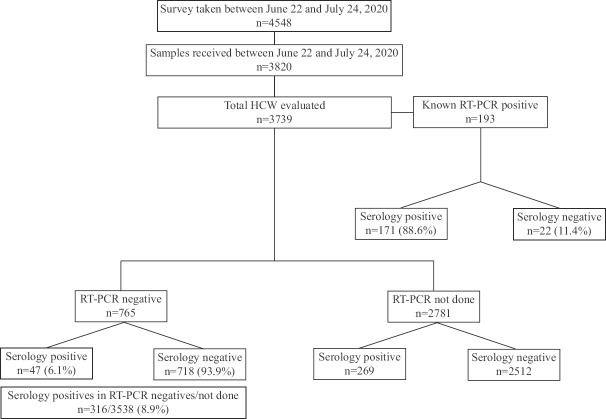
Results: Of the 3739 HCWs tested, 487 (13%) were positive for total SARS-CoV-2 antibodies. The highest seroprevalence was observed in administrative staff (19.6%) and least in physicians (5.4%). The staff who used public (20%) and hospital transportation (16.9%) showed higher seroprevalence compared to staff using personal transportation (12.4%). No difference was observed between HCWs posted in COVID versus non-COVID areas. All seropositive symptomatic HCWs in our study (53.6%) had mild symptoms, and the remaining 46.4 per cent were asymptomatic. The antibody positivity rate progressively increased from 7.0 per cent in the first week to 18.6 per cent in the fourth week during the study.
Interpretation & conclusions: The presence of antibodies to SARS-CoV-2 in a significant number of asymptomatic HCWs, association with the use of public transport, relatively lower seroprevalence compared with the non-HCWs and rising trend during the period of the study highlight the need for serosurveillance, creating awareness for infection control practices including social distancing and study of infection dynamics in the community for effective control of an infectious pandemic.
Keywords: Healthcare workers; SARS-CoV-2; high risk; immunoassay; pandemic; seroprevalence.
Conflict of interest statement
None
Figures
Comment in
-
Interpreting the impact of hydroxychloroquine prophylaxis on SARS-CoV-2 infection.Indian J Med Res. 2021 May;153(5&6):564-565. doi: 10.4103/ijmr.ijmr_1092_21. Indian J Med Res. 2021. PMID: 34414921 Free PMC article. No abstract available.
-
Authors' response.Indian J Med Res. 2021 May;153(5&6):565-567. doi: 10.4103/0971-5916.323967. Indian J Med Res. 2021. PMID: 34643565 Free PMC article. No abstract available.
References
-
- Sahoo H, Mandal C, Mishra S, Banerjee S. Burden of COVID-19 pandemic in India: Perspectives from heath infrastructure. medRxiv. 2020 doi: 10.1101/2020.05.26.20113456.
-
- World Health Organization. WHO Director-General's opening remarks at the media briefing on COVID-19 - 11 March 2020. [accessed on March 12, 2020]. Available from: https://www.who.int/director-general/speeches/detail/who-director-genera... .
-
- Indian Council of Medical Research. Newer Additional Strategies for COVID-19 Testing. [accessed on June 24, 2020]. Available from: https://www.icmr.gov.in/pdf/covid/strategy/New_additional_Advisory_23062... .
Publication types
MeSH terms
Substances
LinkOut - more resources
Full Text Sources
Medical
Miscellaneous