


Decreased Plasma Levels of Angiotensin-Converting Enzyme Among Patients With Bipolar Disorder
- PMID: 33642980
- PMCID: PMC7904895
- DOI: 10.3389/fnins.2021.617888
Decreased Plasma Levels of Angiotensin-Converting Enzyme Among Patients With Bipolar Disorder
Abstract
Background: Dysfunctions in the renin-angiotensin system (RAS) seem to be involved in the pathophysiology of several mental illness, including schizophrenia and mood disorders. We carried out a cross-sectional study assessing the levels of RAS-related molecules among bipolar disorder (BD) patients compared to healthy controls.
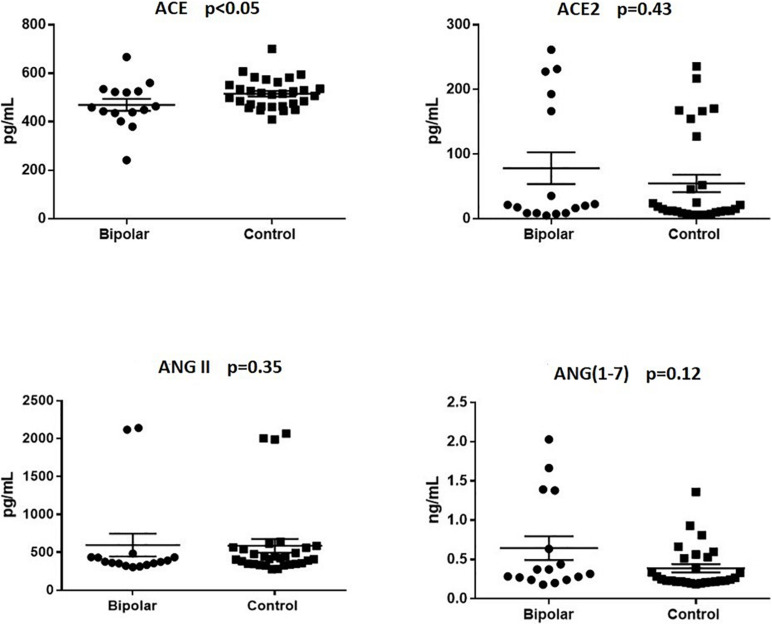
Methods: our sample consisted of 30 outpatients with BD type 1 (10 males, 20 females, age = 35.53 ± 10.59 years, 14 euthymic, 16 experiencing mood episodes) and 30 healthy controls (10 males, 20 females, age = 34.83 ± 11.49 years). Plasma levels of angiotensin-converting enzyme (ACE), angiotensin-converting enzyme 2 (ACE2), angiotensin-II (Ang II), and angiotensin (1-7) [Ang-(1-7)] were determined by ELISA.
Results: BD patients experiencing ongoing mood episodes had significantly lower ACE levels compared to controls (median: 459.00 vs. 514.10, p < 0.05). There was no association between the levels of these biomarkers and clinical parameters.
Conclusion: Our findings support the involvement of RAS dysfunction in the pathophysiology of BD. Considering the potential therapeutic implications linked to a better understanding of the role of RAS dysfunction in BD, studies allowing a better characterization of RAS-related molecules level and activity across different mood states are of high interest.
Keywords: angiotensin II; angiotensin converting enzyme; bipolar disorder; depression; mood disorders; renin-angiotensin system.
Copyright © 2021 Sanches, Colpo, Cuellar, Bockmann, Rogith, Soares and Teixeira.
Conflict of interest statement
The authors declare that the research was conducted in the absence of any commercial or financial relationships that could be construed as a potential conflict of interest.
Figures
References
-
- Baskan N. M., Basaran A., Yenilmez C., Kurt H., Ozdemir F., Gunes H. V., et al. (2010). Investigation of association between Angiotensin-converting enzyme gene insertion/deletion polymorphism frequency in Turkish patients with schizophrenia. Genet. Test. Mol. Biomarkers 14 753–757. 10.1089/gtmb.2010.0064 - DOI - PubMed
LinkOut - more resources
Full Text Sources
Other Literature Sources
Miscellaneous
