


Associations Between Employment Changes and Mental Health: US Data From During the COVID-19 Pandemic
- PMID: 33643165
- PMCID: PMC7904880
- DOI: 10.3389/fpsyg.2021.631510
Associations Between Employment Changes and Mental Health: US Data From During the COVID-19 Pandemic
Abstract
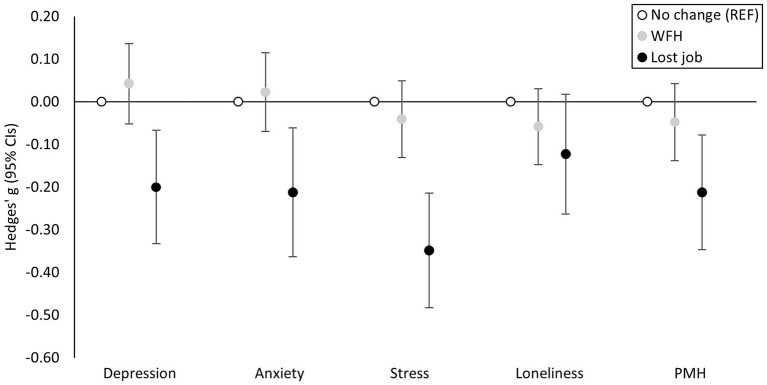
Objectives: To examine associations of changing employment conditions, specifically switching to working from home (WFH) or job loss, with mental health, using data collected during the COVID-19 pandemic. Methods: Data from 2,301 US adults in employment prior to COVID-19 were collected April 3rd-7th, 2020. Participants reported whether their employment remained unchanged, they were WFH when they had not been before, or they had lost their job due to the pandemic. Outcomes were symptoms of depression, anxiety, stress, loneliness, and positive mental health (PMH) assessed using validated questionnaires. Linear regression quantified associations of employment changes with mental health outcomes, controlling for age, sex, race, BMI, smoking status, screen time, physical activity, marital status, chronic conditions, and current COVID-19 containment strategies being followed. Results: Compared to participants whose employment remained unchanged, those who switched to WFH did not differ in any measures of mental health (all p ≥ 0.200). Participants who had lost their job reported higher symptoms of depression (g = -0.200, 95%CI = -0.333 to -0.067; p = 0.003), anxiety (g = -0.212, -0.363 to -0.061; p = 0.008), and stress (g = -0.348, -0.482 to -0.214; p < 0.001), and lower PMH (g = -0.212, -0.347 to -0.078; p = 0.002). Loneliness did not differ between groups (p = 0.087). Conclusion: This study demonstrates (1) that concerns around potential adverse mental health effects, particularly increases in loneliness, should not preclude WFH in the general population, while considering each individual's personal circumstances, and (2) the acute adverse association of job loss with mental health. Tailored and sensitive interventions may be required to prevent deteriorations in mental health associated with job loss during periods of societal stress.
Keywords: anxiety; coronavirus; depression; employment; lonelineness; positive mental health; stress; working from home (WFH).
Copyright © 2021 McDowell, Herring, Lansing, Brower and Meyer.
Conflict of interest statement
The authors declare that the research was conducted in the absence of any commercial or financial relationships that could be construed as a potential conflict of interest.
Figures
References
-
- Beck A. T., Steer R. A., Brown G. (1996). Beck Depression Inventory–II. Psychological Assessment. 10.1037/t00742-000 - DOI
-
- Borenstein M., Hedges L. V., Higgins J. P. T., Rothstein H. R. (2009). Introduction to Meta-Analysis. Wiley: John Wiley & Sons Inc; 10.1002/9780470743386 - DOI
-
- Brynjolfsson E., Horton J. J., Ozimek A., Rock D., Sharma G., TuYe H. Y. (2020). Covid-19 and Remote Work: An Early Look at Us Data. Available online at: https://www.nber.org/papers/w27344 (accessed July 27, 2020).
LinkOut - more resources
Full Text Sources
Other Literature Sources
Miscellaneous
