


Automatic detection of COVID-19 disease using U-Net architecture based fully convolutional network
- PMID: 33643425
- PMCID: PMC7896819
- DOI: 10.1016/j.bspc.2021.102518
Automatic detection of COVID-19 disease using U-Net architecture based fully convolutional network
Abstract
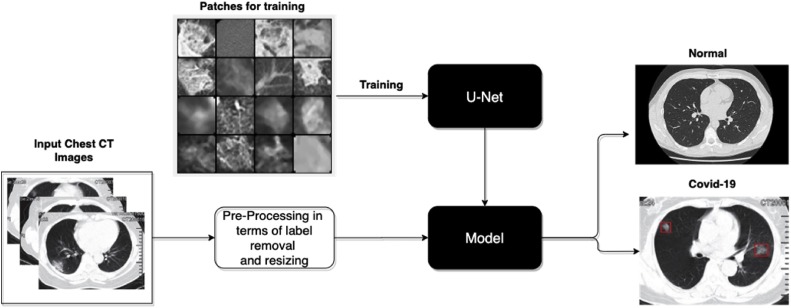
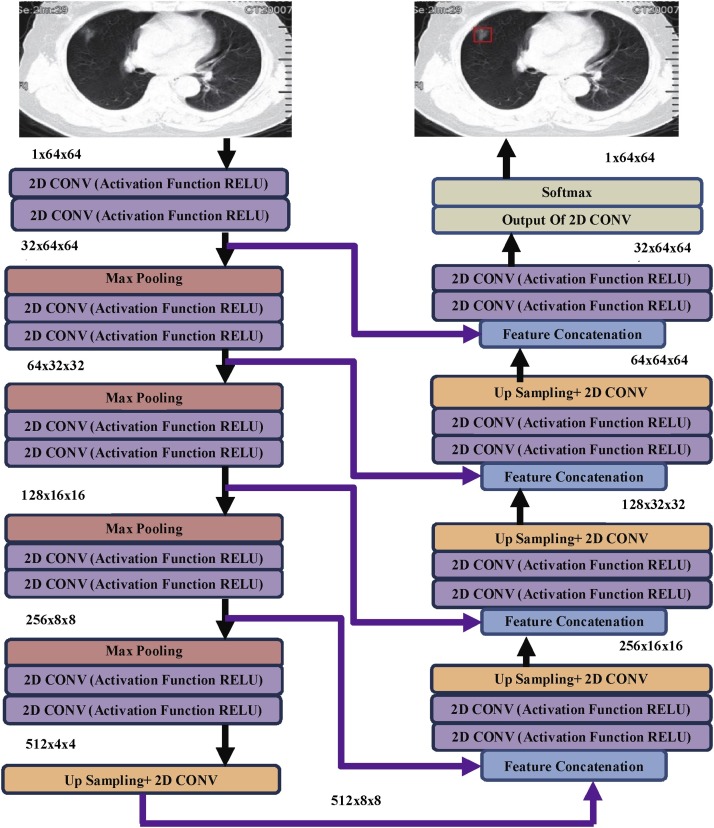
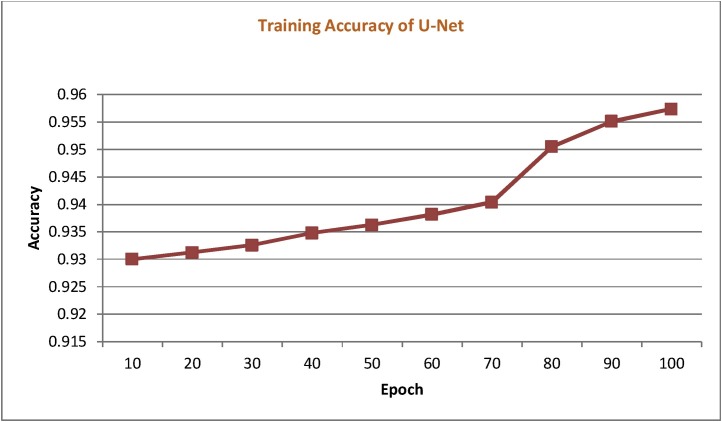
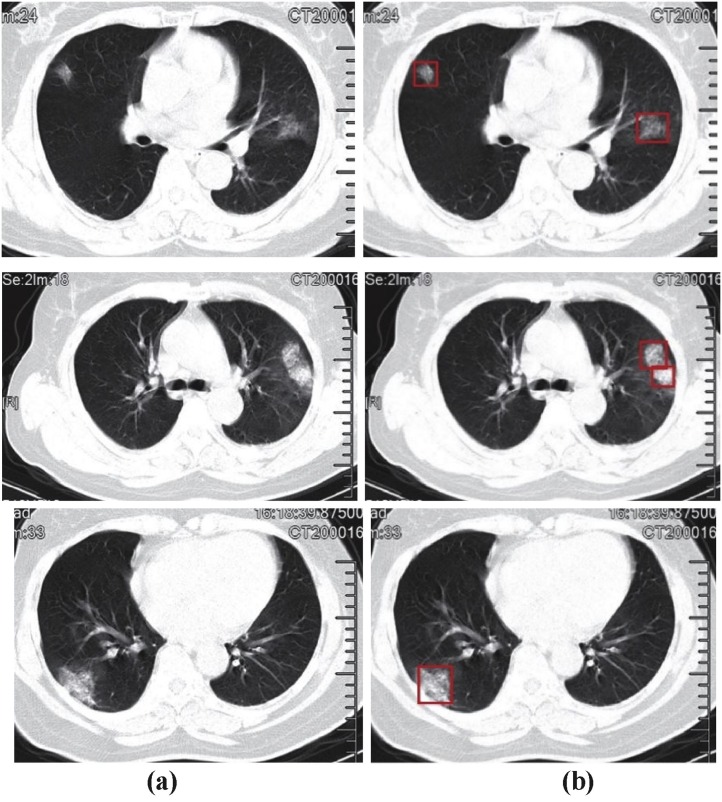
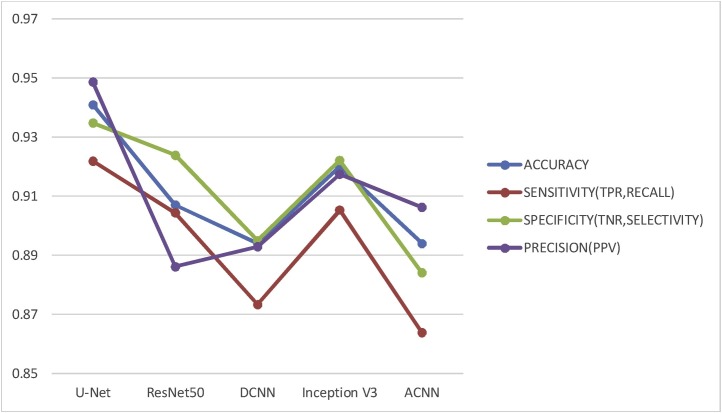
The severe acute respiratory syndrome coronavirus 2, called a SARS-CoV-2 virus, emerged from China at the end of 2019, has caused a disease named COVID-19, which has now evolved as a pandemic. Amongst the detected Covid-19 cases, several cases are also found asymptomatic. The presently available Reverse Transcription - Polymerase Chain Reaction (RT-PCR) system for detecting COVID-19 lacks due to limited availability of test kits and relatively low positive symptoms in the early stages of the disease, urging the need for alternative solutions. The tool based on Artificial Intelligence might help the world to develop an additional COVID-19 disease mitigation policy. In this paper, an automated Covid-19 detection system has been proposed, which uses indications from Computer Tomography (CT) images to train the new powered deep learning model- U-Net architecture. The performance of the proposed system has been evaluated using 1000 Chest CT images. The images were obtained from three different sources - Two different GitHub repository sources and the Italian Society of Medical and Interventional Radiology's excellent collection. Out of 1000 images, 552 images were of normal persons, and 448 images were obtained from COVID-19 affected people. The proposed algorithm has achieved a sensitivity and specificity of 94.86% and 93.47% respectively, with an overall accuracy of 94.10%. The U-Net architecture used for Chest CT image analysis has been found effective. The proposed method can be used for primary screening of COVID-19 affected persons as an additional tool available to clinicians.
Keywords: COVID-19; Deep learning; RT-PCR; SARS-CoV-2; U-Net architecture.
© 2021 Published by Elsevier Ltd.
Figures
References
-
- Yan L., Zhang H.T., Xiao Y., Wang M., Guo Y., Sun C., Tang X., Jing L., Li S., Zhang M., Xiao Y., Cao H., Chen Y., Ren T., Jin J., Wang F., Xiao Y., Huang S., Tan X., Huang N., Jiao B., Zhang Y., Luo A., Cao Z., Xu H., Yuan Y. Prediction of criticality in patients with severe Covid-19 infection using three clinical features: a machine learning-based prognostic model with clinical data in Wuhan. medRxiv preprint. 2020:1–18. doi: 10.1101/2020.02.27.20028027. - DOI
-
- Espy M.J., Uhl J.R., Sloan L.M., Buckwalter S.P., Jones M.F., Vetter E.A., Yao J.D.C., Wengenack N.L., Rosenblatt J.E., Cockerill F.R., III, Smith T.F. Real-time PCR in clinical microbiology: applications for routine laboratory testing. Clin. Microbiol. Rev. 2006;19(January 1):165–256. doi: 10.1128/CMR.19.1.165-256.2006. - DOI - PMC - PubMed
LinkOut - more resources
Full Text Sources
Other Literature Sources
Miscellaneous