


Medical therapies for postoperative Crohn's disease
- PMID: 33643440
- PMCID: PMC7890708
- DOI: 10.1177/1756284821993581
Medical therapies for postoperative Crohn's disease
Abstract
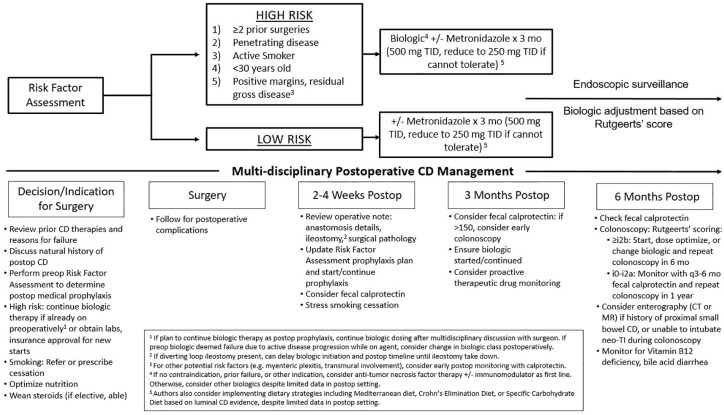
Postoperative recurrence of Crohn's disease is common and requires a multidisciplinary approach between surgeons and gastroenterologists in the perioperative and postoperative period to improve outcomes in this patient population. Endoscopic recurrence precedes clinical and surgical recurrence and endoscopic monitoring is crucial to guide postoperative management. Risk stratification of patients is recommended to guide early prophylactic management, and follow-up endoscopic monitoring can guide intensification of therapy. This review summarizes evidence behind postoperative recurrence rates, disease monitoring techniques, nonbiologic and biologic therapies available to prevent and treat postoperative recurrence, risk factors associated with recurrence, and postoperative management strategies guided by endoscopic monitoring.
Keywords: anti-tumor necrosis factor; postoperative Crohn’s disease.
© The Author(s), 2021.
Conflict of interest statement
Conflict of interest statement: The authors declare that there is no conflict of interest.
Figures
References
-
- Bernstein CN, Loftus EV, Jr, Ng SC, et al. Hospitalisations and surgery in Crohn’s disease. Gut 2012; 61: 622–629. - PubMed
-
- Nguyen GC, Nugent Z, Shaw S, et al. Outcomes of patients with Crohn’s disease improved from 1988 to 2008 and were associated with increased specialist care. Gastroenterology 2011; 141: 90–97. - PubMed
-
- Vind I, Riis L, Jess T, et al. Increasing incidences of inflammatory bowel disease and decreasing surgery rates in Copenhagen city and county, 2003–2005: a population-based study from the Danish Crohn colitis database. Am J Gastroenterol 2006; 101: 1274–1282. - PubMed
-
- Ramadas AV, Gunesh S, Thomas GAO, et al. Natural history of Crohn’s disease in a population-based cohort from Cardiff (1986–2003): a study of changes in medical treatment and surgical resection rates. Gut 2010; 59: 1200–1206. - PubMed
Publication types
LinkOut - more resources
Full Text Sources
Other Literature Sources
