


Is central sensitization an important determinant of functional disability in patients with chronic inflammatory arthritides?
- PMID: 33643445
- PMCID: PMC7890747
- DOI: 10.1177/1759720X21993252
Is central sensitization an important determinant of functional disability in patients with chronic inflammatory arthritides?
Abstract
Background: Central sensitization (CS) is a condition characterized by a disproportionate response to pain stimuli. We sought to investigate the prevalence of CS in patients with inflammatory arthritides and its association with measures of disease activity and functional disability.
Methods: We conducted an observational retrospective study in psoriatic arthritis (PsA) and rheumatoid arthritis (RA) patients. We administered to all the subjects in the study the CS inventory (CSI), a questionnaire that has been used for the diagnosis of CS. Demographic and clinical characteristics were collected as well as measures or disease activity [i.e. Simple Disease Activity Index, Disease Activity Score in PsA (DAPSA)] and functional disability [Health Assessment Questionnaire Disability Index (HAQ-DI)]. Patients with fibromyalgia were excluded from the analyses. The primary outcome measure was the presence of functional disability as assessed by HAQ-DI >1.
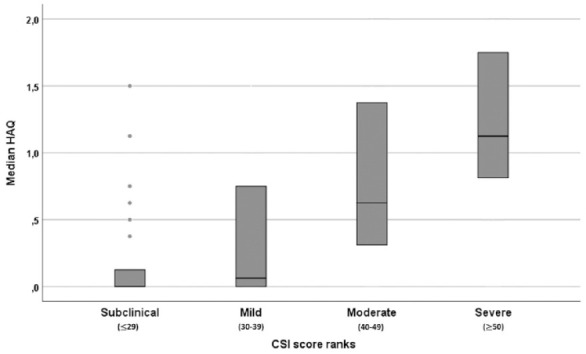
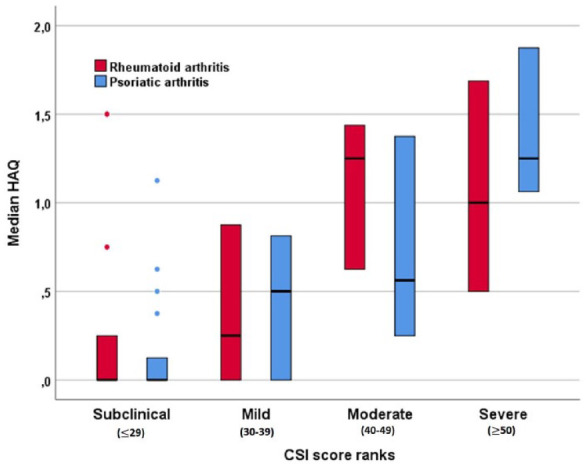
Results: We enrolled 150 patients with inflammatory arthritides (78 PsA and 72 RA). Prevalence of CS was observed in 35.3% of the overall sample (29% in RA, 42.9% in PsA). Binary logistic regressions showed a strong, independent and linear association between functional disability and CS in both PsA and RA patients. The strength of this association was greater in PsA than in RA.
Conclusion: CS is an important determinant of functional disability in patients with chronic inflammatory arthritides. PsA appeared to be more vulnerable to CS. In addition, in the presence of CS, DAPSA did not adequately capture the occurrence of functional disability. Therefore, special attention should be paid to PsA patients, in whom the concomitant diagnosis of CS should be routinely ruled out.
Keywords: biopsychosocial; central sensitization; disability; pain; psoriasis; psoriatic arthritis; rheumatoid arthritis.
© The Author(s), 2021.
Conflict of interest statement
Conflict of interest statement: Angelo Fassio reports personal fees from Abiogen, Novartis, Neopharmed, outside the submitted work. Luca Idolazzi reports personal fees from Eli-Lilly, Merck Sharp & Dohme, Novartis, Sanofi, Celgene, UCB outside the submitted work. Maurizio Rossini reports personal fees from AbbVie, Abiogen, Eli-Lilly, Merck Sharp & Dohme, Novartis, Sanofi, UCB, outside the submitted work. Davide Gatti has received advisory board honoraria, consultancy fees and/or speaker fees from Abiogen, Celgene, Eli-Lilly, Neopharmed-Gentili, Pfizer, UCB. All other authors do not have anything to disclose.
Figures
References
-
- Bas DB, Su J, Wigerblad G, et al. Pain in rheumatoid arthritis: models and mechanisms. Pain Manag 2016; 6: 265–284. - PubMed
-
- Sarzi-Puttini P, Salaffi F, Di Franco M, et al. Pain in rheumatoid arthritis: a critical review. Reumatismo 2014; 66: 18–27. - PubMed
-
- Bidad K, Gracey E, Hemington KS, et al. Pain in ankylosing spondylitis: a neuro-immune collaboration. Nat Rev Rheumatol 2017; 13: 410–420. - PubMed
-
- Morris VH, Cruwys SC, Kidd BL. Characterisation of capsaicin-induced mechanical hyperalgesia as a marker for altered nociceptive processing in patients with rheumatoid arthritis. Pain 1997; 71: 179–186. - PubMed
LinkOut - more resources
Full Text Sources
Other Literature Sources
Research Materials
Miscellaneous
