


Chemical composition, antioxidative, antibacterial, and time-kill activities of some selected plant essential oils against foodborne pathogenic and spoilage organisms
- PMID: 33643586
- PMCID: PMC7904113
- DOI: 10.30466/vrf.2018.91902.2223
Chemical composition, antioxidative, antibacterial, and time-kill activities of some selected plant essential oils against foodborne pathogenic and spoilage organisms
Abstract
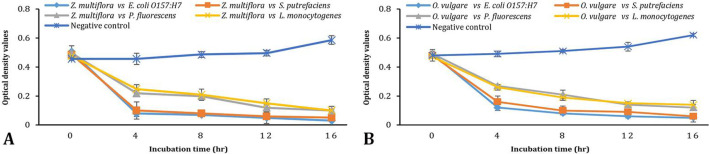
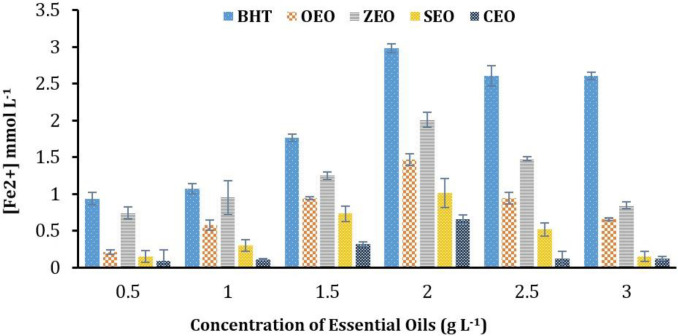
Essential oils (EOs) have been utilized as a growth inhibitor of microorganisms. This study was aimed to recognize the composition, antioxidative, antibacterial, and time-kill activities of Origanum vulgare, Zataria multiflora, Syzygium aromaticum; and Cinnamomum verum EOs against Listeria monocytogenes, Escherichia coli O157:H7, Shewanella putrefaciens and Pseudomonas fluorescens. Gas chromatography-mass spectrometry was used to determine the chemical composition of EOs. Disc diffusion, minimum inhibitory concentration, minimum bactericidal concentration, and time-kill methods were used to determine the antibacterial activity of EOs. The antioxidative activity of EOs were determined by 2, 20-diphenyl-1-picrylhydrazyl radical scavenging and ferric reducing antioxidative power methods. All EOs exhibited antibacterial activity, however, Z. multiflora EO was the most effective followed by O. vulgare EO. The lowest antibacterial activity was observed in C. verum EO. The most sensitive among tested bacteria to Z. multiflora and O. vulgare EOs was E. coli O157:H7 and to S. aromaticum; and C. verum EOs were S. putrefaciens and P. fluorescens, respectively. Z. multiflora and O. vulgare EOs were able to kill 85.00% and 80.00% of the E. coli O157: H7 and S. putrefaciens cells in 4 hr, respectively. The highest antioxidative activity was observed in Z. multiflora EO. The tested EOs showed the highest antioxidative activity at a concentration of 2.00 g L-1. Ferric reducing antioxidant power value of Z. multiflora, O. vulgare, S. aromaticum and C. verum was 2.01 ± 0.03, 1.47 ± 0.04, 1.01 ± 0.03, and 0.66 ± 0.34, respectively. High concentrations of tested EOs showed a decrease in antioxidative activity.
Keywords: Antibacterial activity; Antioxidative assay; Essential oil; Minimum bactericidal concentration; Minimum inhibitory concentration.
© 2020 Urmia University. All rights reserved.
Figures
References
-
- Hossain MK, Dewan MW, Hosur M, et al. Mechanical performances of surface modified jute fiber reinforced biopol nanophased green composites. Compos Part B Eng. 2011;42:1701–1707.
-
- Mittal M, Gupta N, Parashar P, et al. Phytochemical evaluation and pharmacological activity of Syzygium aromaticum: A comprehensive review. Int J Pharm Pharm Sci. 2014;6(8):67–72.
-
- Mohammadi A, Hashemi M, Hosseini SM. The control of botrytis fruit rot in strawberry using combined treatments of chitosan with Zataria multiflora or Cinnamomum zeylanicum essential oil. J Food Sci Technol. 2015;52(11):7441–7448.
-
- Govaris A, Solomakos N, Pexara A, et al. The anti-microbial effect of oregano essential oil, nisin and their combination against Salmonella Enteritidis in minced sheep meat during refrigerated storage. Int J Food Microbiol. 2010;137(2-3):175–180. - PubMed
-
- Gruenwald J, Brendler T, Jaenicke C. PDR for Herbal Medicines. Medical Economic: Montvale, USA; 2000. pp. 783–785.
LinkOut - more resources
Full Text Sources