Review
. 2021 Feb 11:9:628157.
doi: 10.3389/fcell.2021.628157. eCollection 2021.

Beneficial and Detrimental Effects of Reactive Oxygen Species on Lifespan: A Comprehensive Review of Comparative and Experimental Studies

Affiliations
Review

Beneficial and Detrimental Effects of Reactive Oxygen Species on Lifespan: A Comprehensive Review of Comparative and Experimental Studies

Hazel J Shields et al. Front Cell Dev Biol. .

Abstract

Aging is the greatest risk factor for a multitude of diseases including cardiovascular disease, neurodegeneration and cancer. Despite decades of research dedicated to understanding aging, the mechanisms underlying the aging process remain incompletely understood. The widely-accepted free radical theory of aging (FRTA) proposes that the accumulation of oxidative damage caused by reactive oxygen species (ROS) is one of the primary causes of aging. To define the relationship between ROS and aging, there have been two main approaches: comparative studies that measure outcomes related to ROS across species with different lifespans, and experimental studies that modulate ROS levels within a single species using either a genetic or pharmacologic approach. Comparative studies have shown that levels of ROS and oxidative damage are inversely correlated with lifespan. While these studies in general support the FRTA, this type of experiment can only demonstrate correlation, not causation. Experimental studies involving the manipulation of ROS levels in model organisms have generally shown that interventions that increase ROS tend to decrease lifespan, while interventions that decrease ROS tend to increase lifespan. However, there are also multiple examples in which the opposite is observed: increasing ROS levels results in extended longevity, and decreasing ROS levels results in shortened lifespan. While these studies contradict the predictions of the FRTA, these experiments have been performed in a very limited number of species, all of which have a relatively short lifespan. Overall, the data suggest that the relationship between ROS and lifespan is complex, and that ROS can have both beneficial or detrimental effects on longevity depending on the species and conditions. Accordingly, the relationship between ROS and aging is difficult to generalize across the tree of life.

Keywords: aging; antioxidants; free radical theory of aging; genetics; lifespan; model organisms; reactive oxygen species.


Conflict of interest statement

The authors declare that the research was conducted in the absence of any commercial or financial relationships that could be construed as a potential conflict of interest. The handling editor declared a past co-authorship with one of the authors JV.

Figures
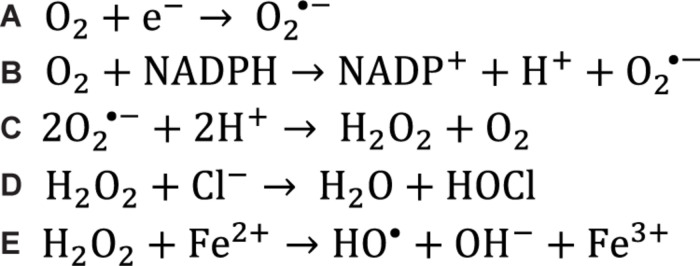
FIGURE 1
FIGURE 1
Chemical reactions that generate reactive oxygen species. (A) Superoxide is generated in the mitochondria when electrons leak out of the electron transport chain and reduce singlet oxygen. (B) Superoxide can also be generated in the cell when enzymes catalyze the transfer of an electron from NADPH to singlet oxygen, often during metabolism reactions. (C) Two superoxide molecules can be converted to hydrogen peroxide and oxygen by the superoxide dismutase enzymes. (D) Myeloperoxidase catalyzes the conversion of hydrogen peroxide and a chloride anion to hypochlorous acid which acts as a potent oxidizer in the respiratory burst. (E) When hydrogen peroxide encounters free ferrous iron within the cell, the Fenton reaction occurs, producing a hydroxyl radical.
FIGURE 2
FIGURE 2
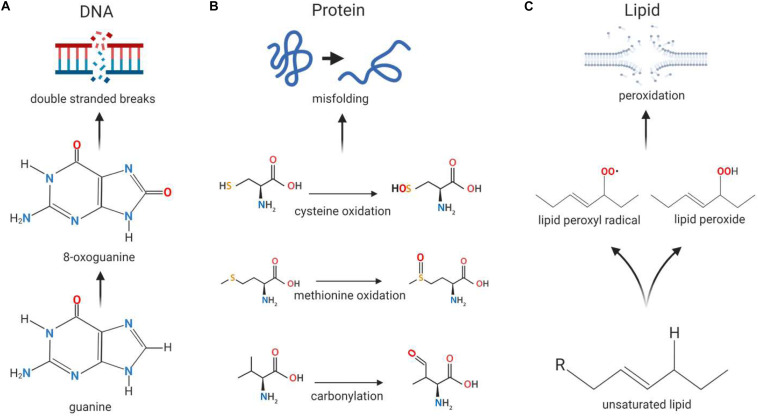
Macromolecular damage caused by reactive oxygen species. Reactive oxygen species (ROS) can cause damage to the basic building blocks of the cell including DNA, protein and lipids. (A) DNA damage can occur in the form of double stranded breaks as a result of ROS-induced conversion of guanine to 8-oxoguanine. As 8-oxoguanine can be mis-paired with adenine, transversion mutations can occur, resulting in double stranded breaks after replication. (B) Proteins can become misfolded when exposed to ROS due to oxidation of amino acids cysteine and methionine, as well as carbonylation of the peptide backbone, resulting in changes to the molecular interactions that normally occur within the peptide. (C) Exposure to ROS can induce membrane damage when lipid peroxidation occurs as a result of the formation of lipid peroxides and lipid peroxide radicals, the latter of which can cause further oxidative damage to other lipids.
FIGURE 3
FIGURE 3
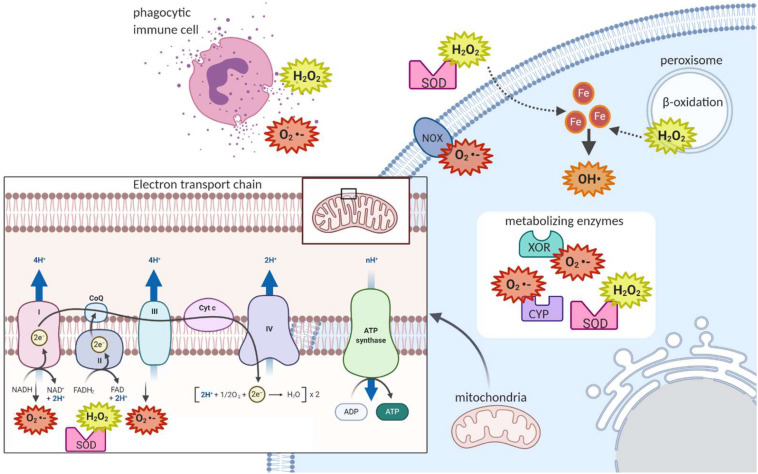
Sites of reactive oxygen species generation in the cell. As electrons are being passed from Complex I or Complex II to Complex III via ubiquinone in the mitochondrial electron transport chain, some of these electrons can escape and react with oxygen to form superoxide. The enzymes superoxide dismutase can convert the superoxide to hydrogen peroxide, which can then exit the mitochondria. In the cytoplasm, metabolism reactions such as those of the cytochrome p family of enzymes (CYP) produce ROS. In the peroxisome, fatty acid beta-oxidation produces hydrogen peroxide. At the plasma membrane, NADPH Oxidase produces superoxide. Extracellularly, ROS can be released in processes such as the respiratory burst, where phagocytic immune cells release ROS to attack pathogens. Extracellular superoxide dismutase can then convert extracellular superoxide to hydrogen peroxide. Hydrogen peroxide, which can cross membranes, can be converted to the potent hydroxyl radical when in contact with cellular ferrous iron.
FIGURE 4
FIGURE 4
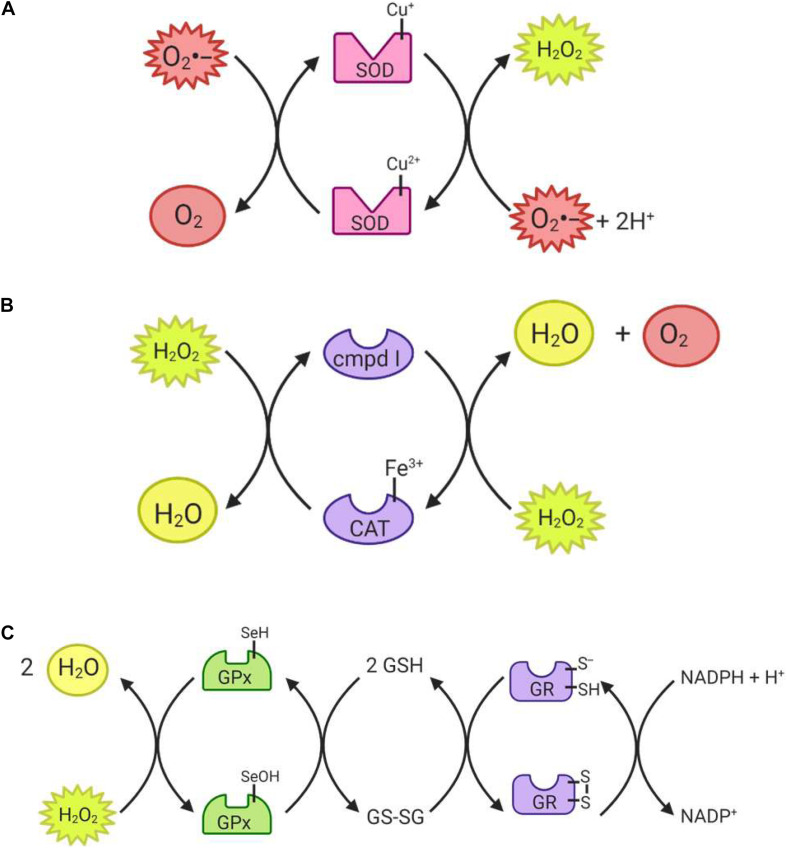
Reactions catalyzed by antioxidant enzymes I. (A) Superoxide dismutase (SOD) uses either a reduced copper or manganese active site to reduce two superoxide radicals, producing hydrogen peroxide in the process. (B) Catalase (CAT) can convert hydrogen peroxide to water, and is itself converted to compound I in the process. In order to return to its active state, the enzyme must reduce another hydrogen peroxide molecule to water and oxygen. (C) Glutathione peroxidase (GPx) can reduce both hydrogen peroxide and organic peroxides using its selenocysteine active site. The enzyme then returns to its active state through reduction by glutathione (GSH). Glutathione reductase (GR) can then reduce glutathione disulfide (GSSG) back to GSH molecules.
FIGURE 5
FIGURE 5
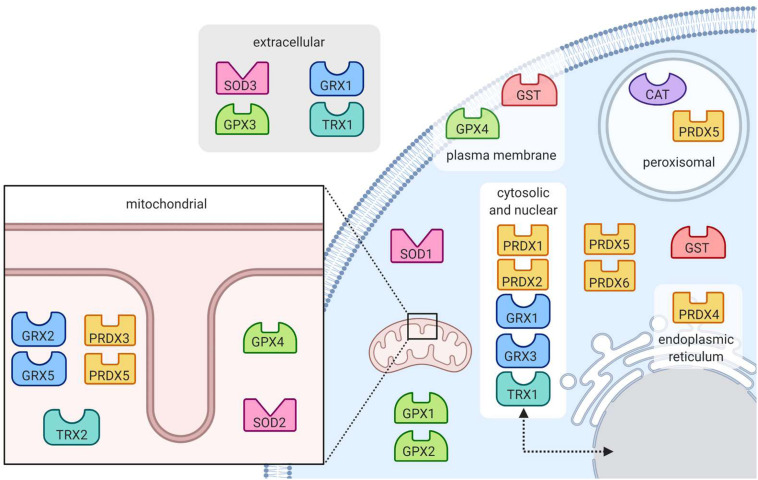
Location of antioxidant enzymes within the cell. Superoxide dismutase enzymes (SOD) are found in the mitochondria, cytoplasm and extracellular space. Catalase (CAT) works to eradicate hydrogen peroxide in the peroxisome. Peroxide-reducing peroxiredoxins (PRX) are present throughout the cell, notably in peroxisomes. Also reducing peroxides, glutathione peroxidases (GPX) are present in the mitochondria and cytoplasm, at the plasma membrane and in the extracellular space. Protein-protecting glutaredoxins (GRX) and thioredoxins (TRX) are present in many subcellular locations including in the mitochondria, cytoplasm, nucleus, and extracellular space. Glutathione s-transferases (GST) are located in the cytoplasm and at the plasma membrane.
FIGURE 6
FIGURE 6
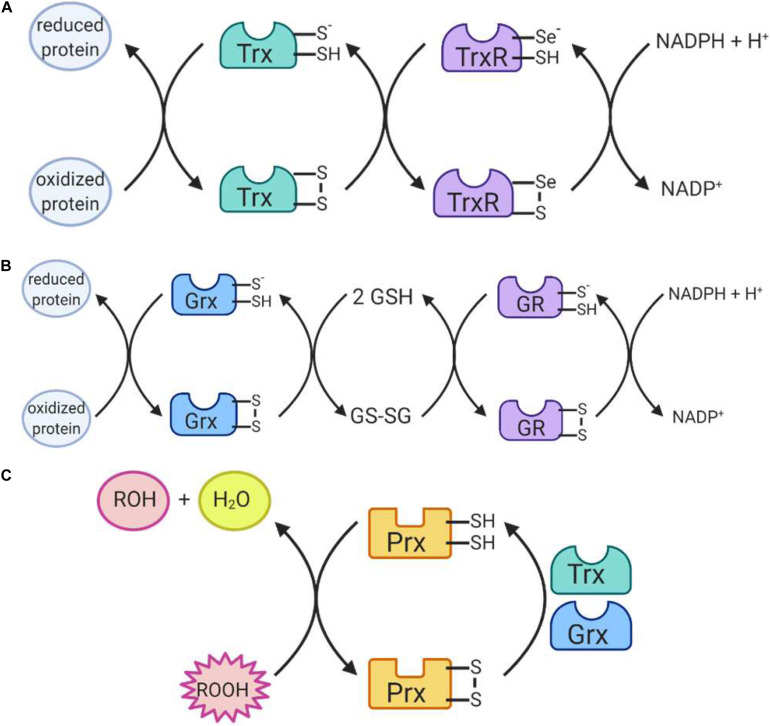
Reactions catalyzed by antioxidant enzymes II. (A) Thioredoxin (Trx) uses its thiol containing active site to return proteins to a reduced state. Trx itself is then reduced by the selenium-containing active site of thioredoxin reductase (TrxR), which is in turn reduced by NADPH. (B) Glutaredoxin (Grx) also uses its thiol-containing active site to reduce proteins. The enzyme is then reduced by 2 glutathione (GSH) molecules, producing glutathione disulfide (GSSG). GSSG is reduced by the thiol-containing active site of glutathione reductase (GR) which is in turn reduced by NADPH. (C) Peroxiredoxins (Prx) work to reduce hydrogen peroxide and organic peroxides using its thiol-containing active site. The enzyme is itself then reduced by Trx or Grx to return to its active state.

References

    1. Ahmad T., Suzuki Y. J. (2019). Juglone in oxidative stress and cell signaling. Antioxidants (Basel) 8:91. 10.3390/antiox8040091 - DOI - PMC - PubMed
    1. Aldini G., Altomare A., Baron G., Vistoli G., Carini M., Borsani L., et al. (2018). N-Acetylcysteine as an antioxidant and disulphide breaking agent: the reasons why. Free Radic. Res. 52 751–762. 10.1080/10715762.2018.1468564 - DOI - PubMed
    1. Alleman R. J., Katunga L. A., Nelson M. A., Brown D. A., Anderson E. J. (2014). The “Goldilocks Zone” from a redox perspective-Adaptive vs. deleterious responses to oxidative stress in striated muscle. Front. Physiol. 5:358. 10.3389/fphys.2014.00358 - DOI - PMC - PubMed
    1. Allen J. F. (2004). Chloroplast redox poise and signaling. Encyclop. Biol. Chem. 1 438–445. 10.1016/b0-12-443710-9/00111-3 - DOI
    1. Anaissi-Afonso L., Oramas-Royo S., Ayra-Plasencia J., Martín-Rodríguez P., García-Luis J., Lorenzo-Castrillejo I., et al. (2018). Lawsone, Juglone, and β-lapachone derivatives with enhanced mitochondrial-based toxicity. ACS Chem. Biol. 13 1950–1957. 10.1021/acschembio.8b00306 - DOI - PubMed

LinkOut - more resources