


The P2X7 Receptor in Osteoarthritis
- PMID: 33644066
- PMCID: PMC7905059
- DOI: 10.3389/fcell.2021.628330
The P2X7 Receptor in Osteoarthritis
Abstract
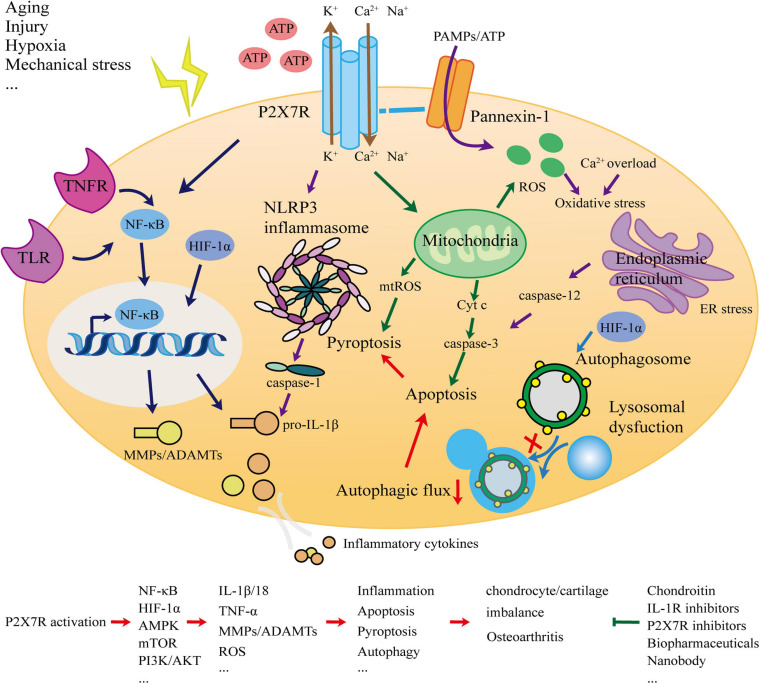
Osteoarthritis (OA) is the most common joint disease. With the increasing aging population, the associated socio-economic costs are also increasing. Analgesia and surgery are the primary treatment options in late-stage OA, with drug treatment only possible in early prevention to improve patients' quality of life. The most important structural component of the joint is cartilage, consisting solely of chondrocytes. Instability in chondrocyte balance results in phenotypic changes and cell death. Therefore, cartilage degradation is a direct consequence of chondrocyte imbalance, resulting in the degradation of the extracellular matrix and the release of pro-inflammatory factors. These factors affect the occurrence and development of OA. The P2X7 receptor (P2X7R) belongs to the purinergic receptor family and is a non-selective cation channel gated by adenosine triphosphate. It mediates Na+, Ca2+ influx, and K+ efflux, participates in several inflammatory reactions, and plays an important role in the different mechanisms of cell death. However, the relationship between P2X7R-mediated cell death and the progression of OA requires investigation. In this review, we correlate potential links between P2X7R, cartilage degradation, and inflammatory factor release in OA. We specifically focus on inflammation, apoptosis, pyroptosis, and autophagy. Lastly, we discuss the therapeutic potential of P2X7R as a potential drug target for OA.
Keywords: P2X7 receptor; apoptosis; autophagy; inflammation; osteoarthritis; pyroptosis.
Copyright © 2021 Li, Huang and Bai.
Conflict of interest statement
The authors declare that the research was conducted in the absence of any commercial or financial relationships that could be construed as a potential conflict of interest.
Figures
References
-
- Almonte-Becerril M., Navarro-Garcia F., Gonzalez-Robles A., Vega-Lopez M. A., Lavalle C., Kouri J. B. (2010). Cell death of chondrocytes is a combination between apoptosis and autophagy during the pathogenesis of Osteoarthritis within an experimental model. Apoptosis 15 631–638. 10.1007/s10495-010-0458-z - DOI - PubMed
-
- Archer C. W., Francis-West P. (2003). The chondrocyte. Int. J. Biochem. Cell Biol. 35 401–404. - PubMed
Publication types
LinkOut - more resources
Full Text Sources
Other Literature Sources
Miscellaneous
