


One Health drivers of antibacterial resistance: Quantifying the relative impacts of human, animal and environmental use and transmission
- PMID: 33644290
- PMCID: PMC7892992
- DOI: 10.1016/j.onehlt.2021.100220
One Health drivers of antibacterial resistance: Quantifying the relative impacts of human, animal and environmental use and transmission
Abstract
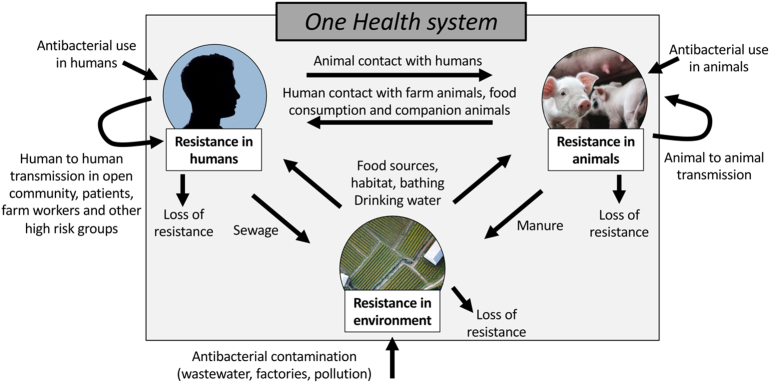
Objectives: Antibacterial resistance (ABR) is a major global health security threat, with a disproportionate burden on lower-and middle-income countries (LMICs). It is not understood how 'One Health', where human health is co-dependent on animal health and the environment, might impact the burden of ABR in LMICs. Thailand's 2017 "National Strategic Plan on Antimicrobial Resistance" (NSP-AMR) aims to reduce AMR morbidity by 50% through 20% reductions in human and 30% in animal antibacterial use (ABU). There is a need to understand the implications of such a plan within a One Health perspective.
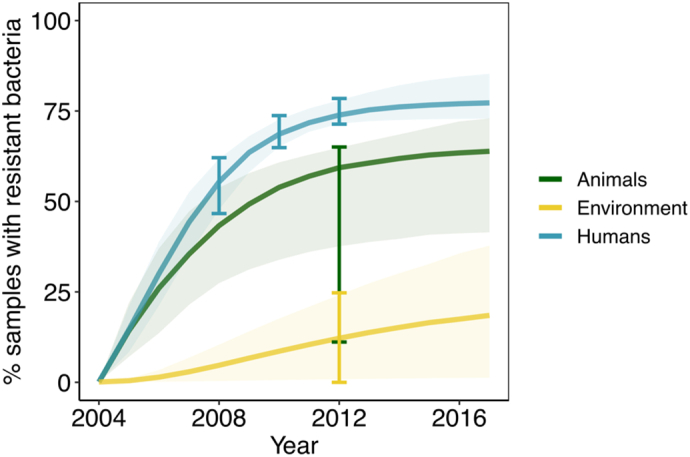
Methods: A model of ABU, gut colonisation with extended-spectrum beta-lactamase (ESBL)-producing bacteria and transmission was calibrated using estimates of the prevalence of ESBL-producing bacteria in Thailand. This model was used to project the reduction in human ABR over 20 years (2020-2040) for each One Health driver, including individual transmission rates between humans, animals and the environment, and to estimate the long-term impact of the NSP-AMR intervention.
Results: The model predicts that human ABU was the most important factor in reducing the colonisation of humans with resistant bacteria (maximum 65.7-99.7% reduction). The NSP-AMR is projected to reduce human colonisation by 6.0-18.8%, with more ambitious targets (30% reductions in human ABU) increasing this to 8.5-24.9%.
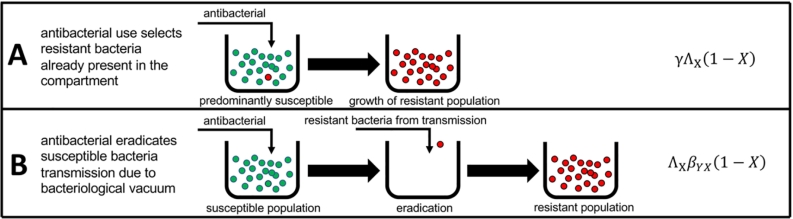
Conclusions: Our model provides a simple framework to explain the mechanisms underpinning ABR, suggesting that future interventions targeting the simultaneous reduction of transmission and ABU would help to control ABR more effectively in Thailand.
Keywords: Antibacterial resistance; Antibacterial usage; Mathematical model; One health; Thailand; Transmission.
© 2021 The Authors.
Conflict of interest statement
Declarations of interest: none
Figures
References
-
- O'Neill J. 2016. Tackling drug-resistant infections globally: Final report and recommendations The Review on Antimicrobial Resistance Chaired by Jim O’Neill.
-
- WHO Antimicrobial resistance. Global report on surveillance. World Heal. Organ. 2014 doi: 10.1007/s13312-014-0374-3. - DOI
-
- WHO . World Heal. Organ; 2015. Global Action Plan on Antimicrobial Resistance.
Grants and funding
LinkOut - more resources
Full Text Sources
Other Literature Sources
