


The longitudinal relationship between family and peer teasing in young adulthood and later unhealthy weight control behaviors: The mediating role of body image
- PMID: 33644886
- PMCID: PMC8119351
- DOI: 10.1002/eat.23492
The longitudinal relationship between family and peer teasing in young adulthood and later unhealthy weight control behaviors: The mediating role of body image
Abstract
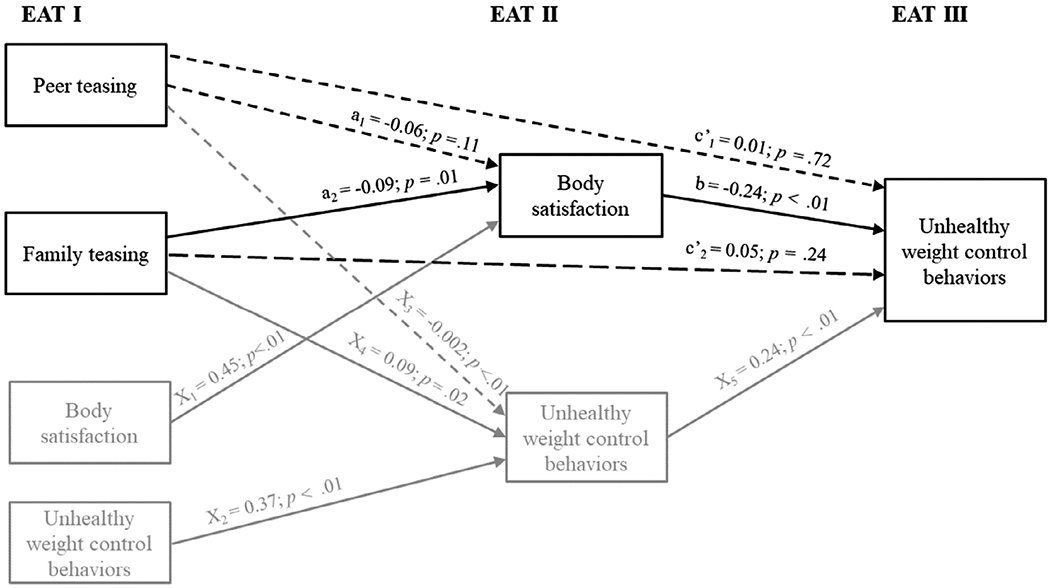
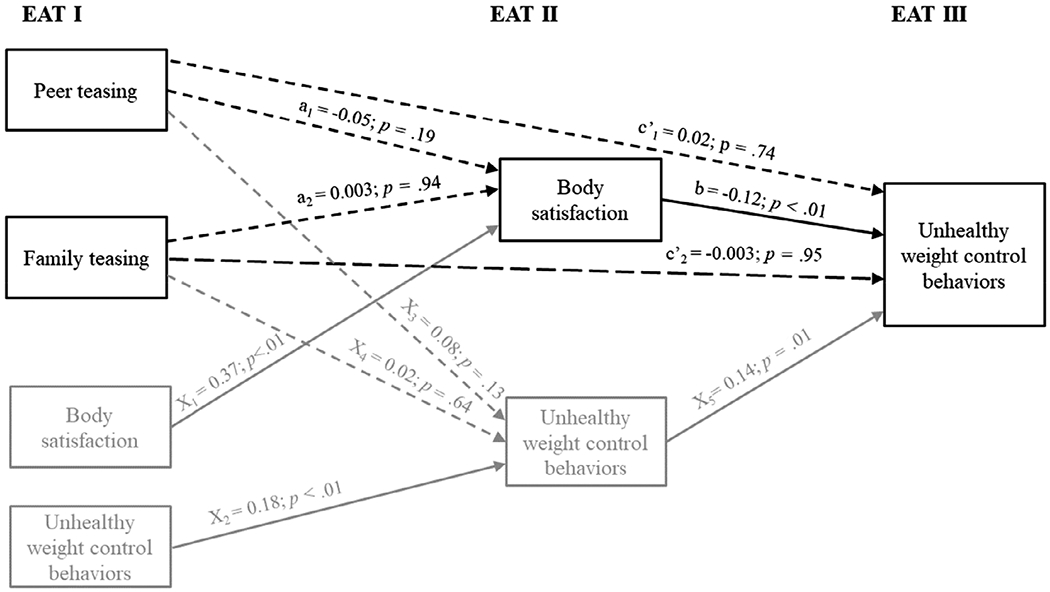
Objective: Sociocultural theories hold that family and peer weight-related teasing increases the risk for unhealthy weight control behaviors (UWCBs) by negatively impacting body image. Although much cross-sectional support exists for these pathways, longitudinal data are lacking. This study tested the longitudinal relationships among peer and family teasing (occurrence and perceived impact) in early adolescence, body satisfaction in late adolescence, and UWCBs in young adulthood among a racially/ethnically and socioeconomically diverse population.
Method: Data were drawn from three waves of Project EAT over a 15-year period (Eating and Activity in Teens and Young Adults), and included responses from 1,902 young adults (57% female).
Results: Among female participants, a mediated indirect pathway emerged with family weight-related teasing predicting increased engagement in UWCBs in early adulthood via poorer body image in late adolescence. In contrast, peer teasing did not predict body image or UWCBs. Among boys, the mediated indirect pathways were not significant. However, poor body image in late adolescent males predicted higher likelihood of engaging in UCWBs in early adulthood.
Discussion: These findings support the long-term impact of family weight-related teasing on greater risk for UWCBs among girls and young women, and poor body image as a mechanism accounting for this relationship. Moreover, the results highlight the poor body image among adolescent boys as a factor for increased risk of engaging in UWCBs in early adulthood. Pending replication in current cohorts, health promotion and prevention involving family members of early adolescents that address family weight teasing and body image are needed.
Keywords: EAT; UWCB; body dissatisfaction; family; longitudinal; peer; teasing.
© 2021 Wiley Periodicals LLC.
Conflict of interest statement
CONFLICT OF INTEREST
The authors declare no potential conflict of interest.
Figures
References
-
- Aubie CD, & Jarry JL (2009). Weight-related teasing increases eating in binge eaters. Journal of Social and Clinical Psychology, 28(7), 909–936. 10.1521/jscp.2009.28.7.909 - DOI
Publication types
MeSH terms
Grants and funding
LinkOut - more resources
Full Text Sources
Other Literature Sources
