Review
. 2021 Jul 12;60(29):15705-15723.
doi: 10.1002/anie.202016575. Epub 2021 Mar 23.

Pseudo Natural Products-Chemical Evolution of Natural Product Structure

Affiliations
Review

Pseudo Natural Products-Chemical Evolution of Natural Product Structure

George Karageorgis et al. Angew Chem Int Ed Engl. .

Abstract

Pseudo-natural products (PNPs) combine natural product (NP) fragments in novel arrangements not accessible by current biosynthesis pathways. As such they can be regarded as non-biogenic fusions of NP-derived fragments. They inherit key biological characteristics of the guiding natural product, such as chemical and physiological properties, yet define small molecule chemotypes with unprecedented or unexpected bioactivity. We iterate the design principles underpinning PNP scaffolds and highlight their syntheses and biological investigations. We provide a cheminformatic analysis of PNP collections assessing their molecular properties and shape diversity. We propose and discuss how the iterative analysis of NP structure, design, synthesis, and biological evaluation of PNPs can be regarded as a human-driven branch of the evolution of natural products, that is, a chemical evolution of natural product structure.

Keywords: biological activity; chemical biology; fragment-based design; natural products; natural selection.


Conflict of interest statement

The authors declare no conflict of interest. G.K. is now an employee of AstraZeneca, U.K.

Figures
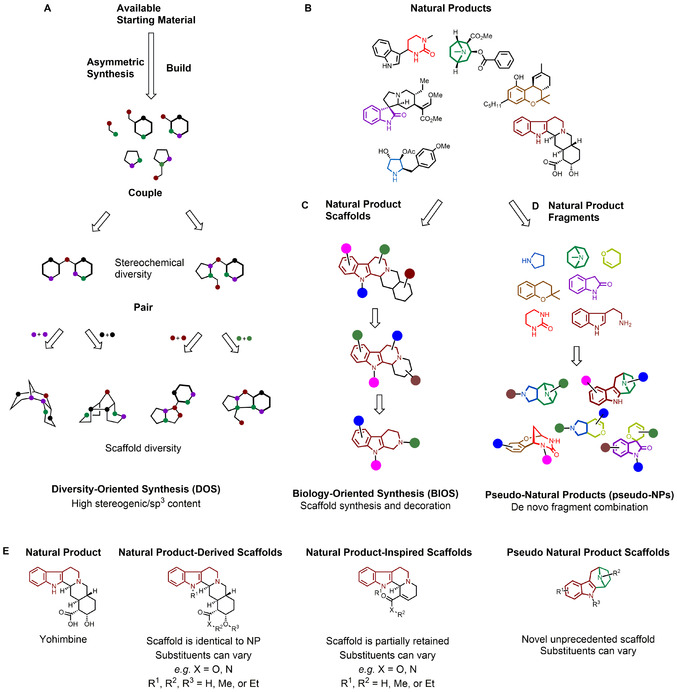
Figure 1
Figure 1
Approaches for the design and preparation of novel biologically relevant molecular scaffolds. A) DOS employs a build‐couple‐pair approach leading to diverse scaffolds that can be considered NP‐like. B) Natural products are secondary metabolites that provide inspiration for the discovery of bioactive small molecules. C) BIOS draws inspiration from NPs, preparing analogues of NP‐derived scaffolds with reduced structural complexity. D) Pseudo‐natural products emerge from unprecedented combinations of NP‐derived fragments. E) Differences between (left to right) NPs, NP‐derived scaffolds (i.e. scaffold is identical to NP scaffold), NP‐inspired scaffolds (i.e. scaffold is closely related to NP‐scaffold[13]), and pseudo‐NP scaffolds.
Figure 2
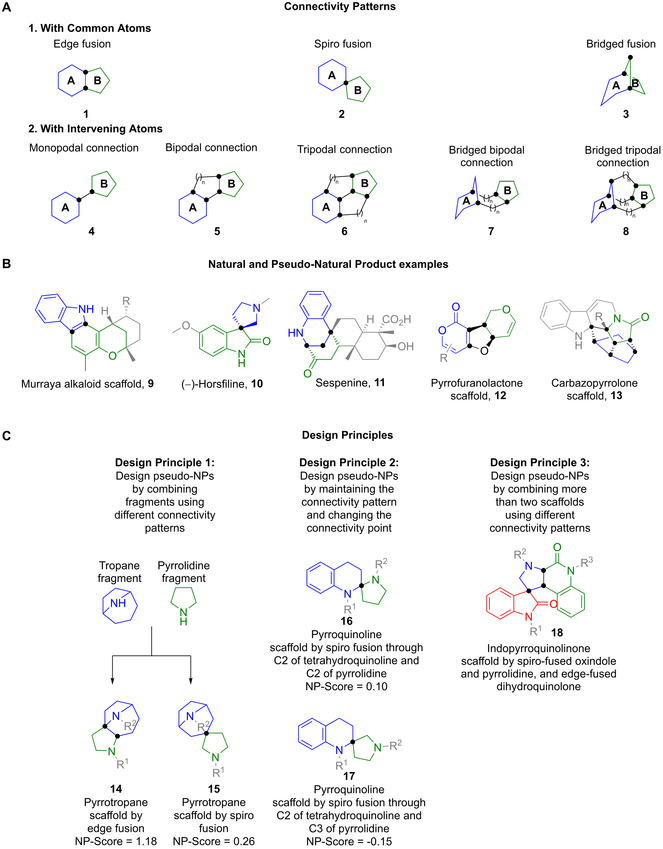
Figure 2
Design principles for pseudo‐NP scaffolds. In general, pseudo‐NP scaffolds should have high stereogenic content and three‐dimensional character, complementary heteroatom content, and combine fragments from different sources. Parts of structures have been greyed for clarity. Fragments are coloured for distinction. Black dots represent connectivity atoms. A) Examples of connectivity patterns illustrated with abstract structures. B) Examples of the connectivity patterns in natural and pseudo‐natural product scaffolds. C) Design principles for pseudo‐NPs. Pseudo‐NP scaffolds arise by combining different fragments using different connectivity patterns, or by combining the same fragments and the same connectivity patterns through different common atoms. It is also possible to combine more than two fragments.
Scheme 1
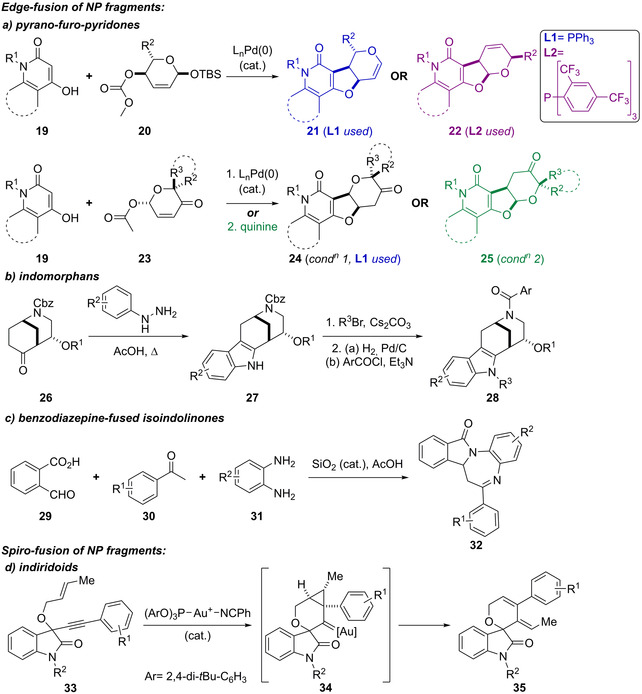
Scheme 1
De novo synthesis of edge‐ and spiro‐fused pseudo‐NPs. a–c) Synthesis of edge‐fused pseudo‐NPs, including a) pyrano‐furo‐pyridones 2122 and 2425, by Pd‐ or quinine‐catalysed cascades; b) indomorphans 26, by Fischer indolisations; c) isoindolinones 32, by a mesoporous silica nanoparticle‐catalysed multi‐component reaction. d) Synthesis of spiro‐fused indiridoids 35 by an AuI‐catalysed cascade.
Scheme 2
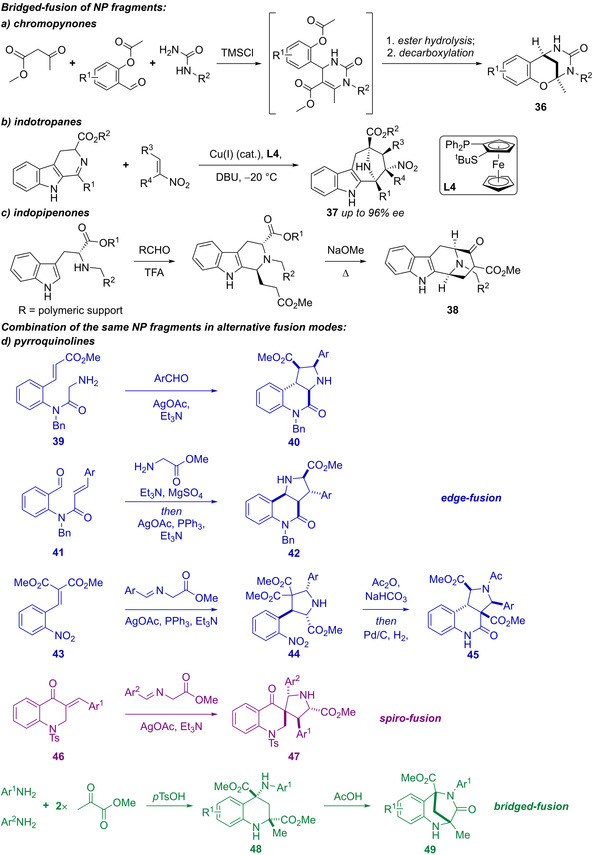
Scheme 2
De novo synthesis of bridged‐fused pseudo‐natural products and combination of pyrrolidine and tetrahydroquinoline NP fragments in alternative fusion modes. a–c) Synthesis of bridge‐fused pseudo‐NPs, including a) chromopynones 36, via a multicomponent reaction; b) indotropanes 37, using a a CuI‐catalysed enantioselective 1,3‐dipolar cycloaddition; c) indopipenones 38, via an enantioselective Pictet–Spengler reaction. d) Combination of the same NP fragments in different connectivity patterns, using Ag‐catalysed 1,3‐dipolar cycloadditions as a general unifying approach. Bridged bicycles 49 were prepared via a Povarov‐type reaction.
Scheme 3
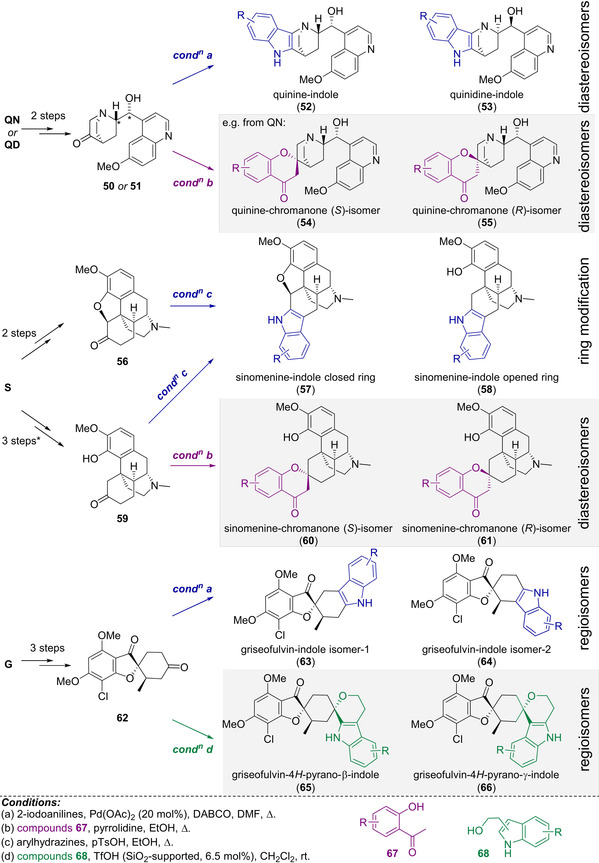
Scheme 3
Synthesis of 244 pseudo‐NPs from natural product fragments using indolisation reactions (blue arrows, conditions a and c); oxa‐Pictet–Spengler reactions (green arrows, condition d); and Kabbe reactions (pink arrows, condition c). * 1 step from 56.
Scheme 4
Scheme 4
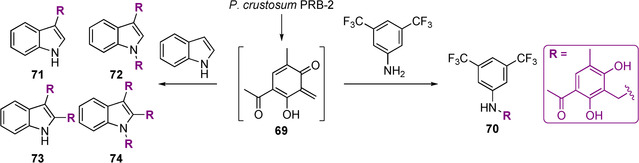
Synthesis of pseudo‐natural products by incubation of nucleophiles with P. crustosum PRB‐2. Exploiting a microorganism to source the reactive ortho‐quinone methide 69 provided access to a total of 15 diverse compounds including chemotypes 7074.
Figure 3
Figure 3
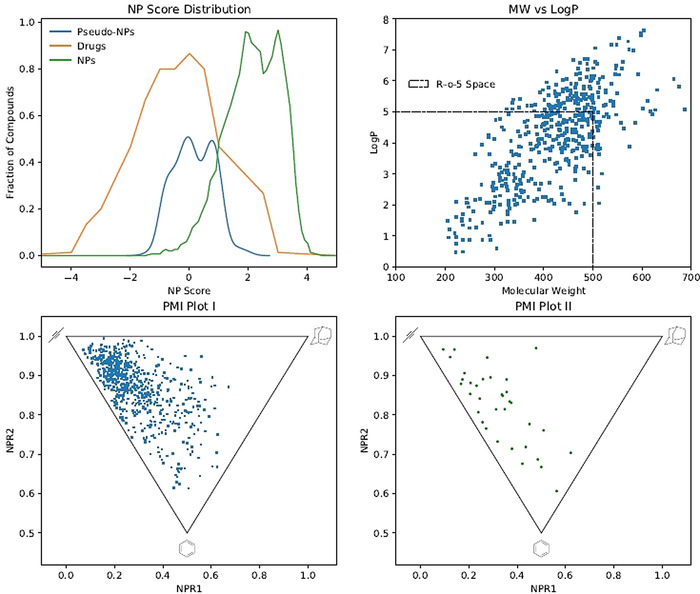
Cheminformatic analyses of pseudo‐NPs. Top left: NP‐score distributions of pseudo‐NPs (blue line), approved and experimental drugs in DrugBank, and NPs in the ChEMBL repository. Top right: Plot of molecular weight against lipophilicity of each molecule: 76 % of compounds fall within the “rule‐of‐five” space denoted by the dashed black line. Bottom left: PMI plot demonstrating the high degree of three‐dimensional character of pseudo‐NPs, as most of the molecules lie away from the rod‐disc‐like axis. Bottom right: PMI plot of selected natural products and non‐naturally occurring bioactive compounds, demonstrating a similar breadth and distribution with pseudo‐NPs (see SI, Scheme S7 for chemical structures).
Figure 4
Figure 4
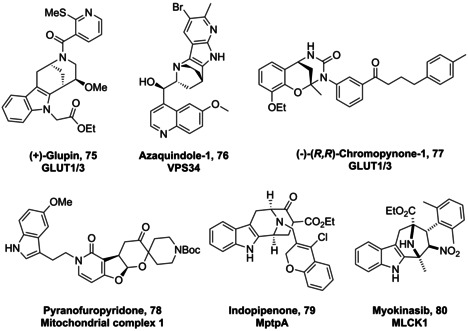
Structures of bioactive pseudo‐NPs and their molecular targets. Pseudo‐NPs display a diverse range of biological activities ranging from metabolic (GLUT inhibition) to anti‐microbial (MptpA) related targets. GLUT=glucose transporter; VPS34=vacuolar protein sorting 34; MLCK1=myosin light chain kinase 1.
Figure 5
Figure 5
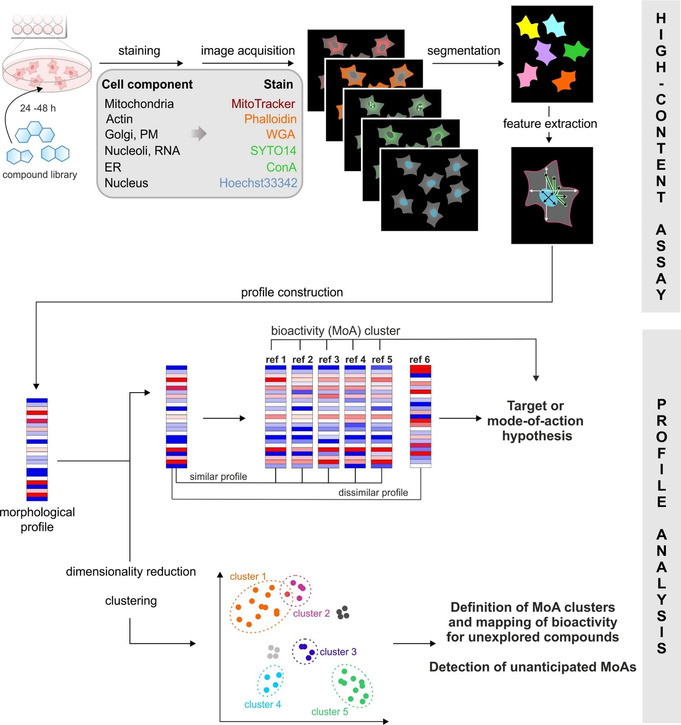
Morphological profiling using the cell painting assay. Cells are incubated with test compounds before being fixed and stained with dyes for different cellular components. Automated image acquisition and analysis allows morphological fingerprints to be generated for each small molecule. These can be compared to generate target or mode‐of‐action hypotheses, as well as clustering of bioactive molecules. Adapted from Ziegler et al..
Figure 6
Figure 6
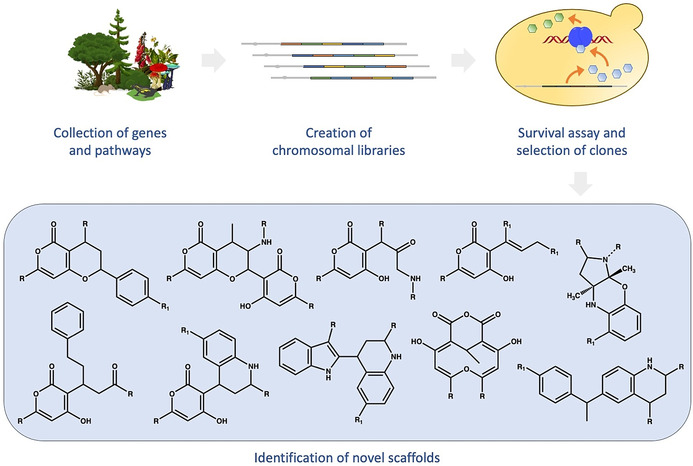
Scheme of the “synthetic biology combinatorial genetics” approach developed by Evolva. Briefly, the procedure starts with the collection and cloning of genetic material encoding biosynthetic pathways together with cDNA libraries from diverse natural sources. After recombination and expression in a microbial host, additional or altered enzymes will supplement or modify existing pathways, thereby enabling the synthesis of new or modified natural products. Their presence and possible action in vivo can be challenged in cellular assays in which surviving clones may reveal a “fitter” or, simply, altered behaviour. Clones are sorted according to selective criteria and submitted to a range of preparative and analytic procedures for obtaining and identifying small molecules.
Figure 7
Figure 7
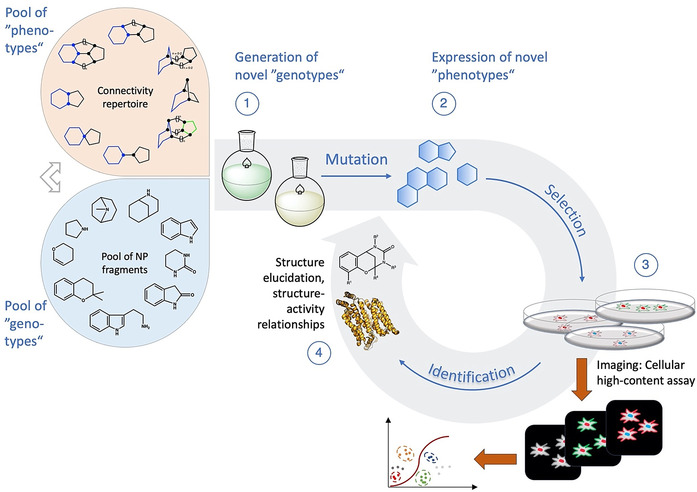
Focused chemical evolution. (1) The cyclic procedure starts with the generation of a “pool of genotypes” which is synthesised from NP fragments (=inheritable chemical information) using synthetic strategies that allow for the combinatorial application of a set of feasible connectivity patterns as well as further derivatisations. (2) Structural properties of the resulting compound library, such as content of sp3‐hybridised atoms, stereocentres, heteroatoms, and aromaticity, account for the expression of “phenotypes”—the potential to interact with specific structural motifs of proteins. (3) The compound library then is applied to a cellular screening platform (e.g., yeast cells) which is optically monitored for structural changes, e.g., by fluorescence imaging. Data are combined, analysed, and sorted according to selective constraints. (4) Molecules causing a desired change in the cellular system are isolated and identified (NMR, MS) and submitted to further structural characterisation, for example, by co‐crystallisation with putative target proteins (example used here: 4PYP[67]). The outcome of this round is the beginning of a new cycle which includes the “new chemical information” that was received.
Figure 8
Figure 8
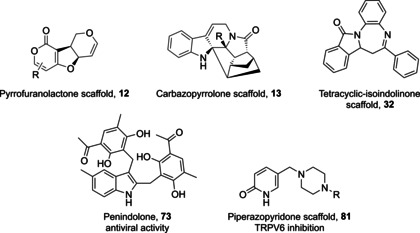
Structures of independently reported pseudo‐natural products. Specific biological activity has already been attributed to penindilones such as 73 and piperazopyridinones (scaffold 81). Other scaffolds such as 12, 13, or 32 may be biologically active, however, no specific activity has been attributed to them to date.

Similar articles

Cited by

References

    1. Kinch M. S., Drug Discovery Today 2014, 19, 1831–1835. - PubMed
    1. Edwards A. M., Isserlin R., Bader G. D., Frye S. V., Willson T. M., Yu F. H., Nature 2011, 470, 163. - PubMed
    1. Dobson C. M., Nature 2004, 432, 824–828. - PubMed
    1. Langdon S. R., Brown N., Blagg J., J. Chem. Inf. Model. 2011, 51, 2174–2185. - PMC - PubMed
    1. Schreiber S. L., Nature 2009, 457, 153–154. - PubMed

MeSH terms

Substances