


Use of sit-to-stand test to assess the physical capacity and exertional desaturation in patients post COVID-19
- PMID: 33645261
- PMCID: PMC7923980
- DOI: 10.1177/1479973121999205
Use of sit-to-stand test to assess the physical capacity and exertional desaturation in patients post COVID-19
Abstract
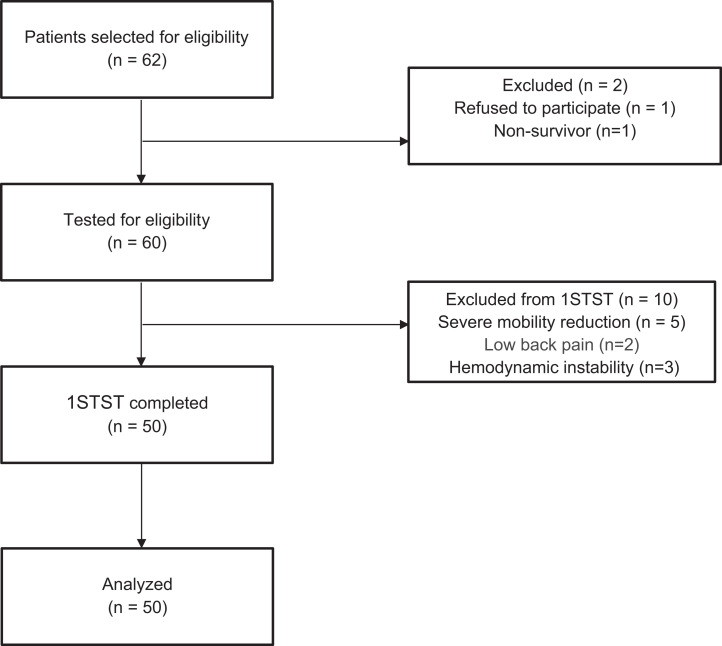
We propose the use of the 1-minute sit-to-stand test (1STST) to evaluate the physical capacity and exertional desaturation one month after discharge in a sample of patients who survived COVID-19 pneumonia. This was a cross-sectional study that collected routine data from consecutive patients admitted to the outpatient program in a public hospital in Chile. Patients were asked to complete a 1STST. Data were analyzed according to those with and without a prolonged hospital stay of >10 days. Eighty-three percent of the patients were able to complete the test (N = 50). The median age was 62.7 ± 12.5 years. The average number of repetitions in the 1STST was 20.9 ± 4.8. Thirty-two percent of patients had a decrease in pulse oxygen saturation (SpO2) ≥ 4 points. The prolonged hospital stay subgroup had a significant increase in exertional desaturation (mean difference = 2.6; 95% CI = 1.2 to 3.9; p = 0.001) and dyspnea (mean difference = 1.1; 95% CI = 0.4 to 2.1; p = 0.042) compared to the group of length of stay ≤10 days. In-hospital survivors of COVID-19, the 1STST showed a decrease in physical capacity at one month in those 90% who were able to complete it. The 1STST was able to discriminate between those with and without a prolonged hospital stay and was able to detect exertional desaturation in some patients.
Keywords: SARS-CoV-2; coronavirus disease 2019; functional capacity; rehabilitation.
Conflict of interest statement
References
-
- Phelan AL, Katz R, Gostin LO. The novel coronavirus originating in Wuhan, China: challenges for global health governance. JAMA 2020; 323: 709–710. - PubMed
-
- Epidemiology Working Group for NCIP Epidemic Response, Chinese Center for Disease Control and Prevention. [The epidemiological characteristics of an outbreak of 2019 novel coronavirus diseases (COVID-19) in China]. Zhonghua Liu Xing Bing Xue Za Zhi 2020; 41: 145–151. - PubMed
-
- Murthy S, Gomersall CD, Fowler RA. Care for critically Ill patients With COVID-19. JAMA 2020; 323: 1499–1500. - PubMed
MeSH terms
LinkOut - more resources
Full Text Sources
Other Literature Sources
Medical
Miscellaneous
