. 2021 Mar 1;83(4):36.
doi: 10.1007/s11538-021-00865-9.

A Model to Investigate the Impact of Farm Practice on Antimicrobial Resistance in UK Dairy Farms

Affiliations

A Model to Investigate the Impact of Farm Practice on Antimicrobial Resistance in UK Dairy Farms

Christopher W Lanyon et al. Bull Math Biol. .

Abstract

The ecological and human health impact of antibiotic use and the related antimicrobial resistance (AMR) in animal husbandry is poorly understood. In many countries, there has been considerable pressure to reduce overall antibiotic use in agriculture or to cease or minimise use of human critical antibiotics. However, a more nuanced approach would consider the differential impact of use of different antibiotic classes; for example, it is not known whether reduced use of bacteriostatic or bacteriolytic classes of antibiotics would be of greater value. We have developed an ordinary differential equation model to investigate the effects of farm practice on the spread and persistence of AMR in the dairy slurry tank environment. We model the chemical fate of bacteriolytic and bacteriostatic antibiotics within the slurry and their effect on a population of bacteria, which are capable of resistance to both types of antibiotic. Through our analysis, we find that changing the rate at which a slurry tank is emptied may delay the proliferation of multidrug-resistant bacteria by up to five years depending on conditions. This finding has implications for farming practice and the policies that influence waste management practices. We also find that, within our model, the development of multidrug resistance is particularly sensitive to the use of bacteriolytic antibiotics, rather than bacteriostatic antibiotics, and this may be cause for controlling the usage of bacteriolytic antibiotics in agriculture.

Keywords: Agriculture; Antibiotics; Antimicrobial resistance; Modelling; Ordinary differential equations; Slurry.


Conflict of interest statement

No conflicts of interest.

Figures
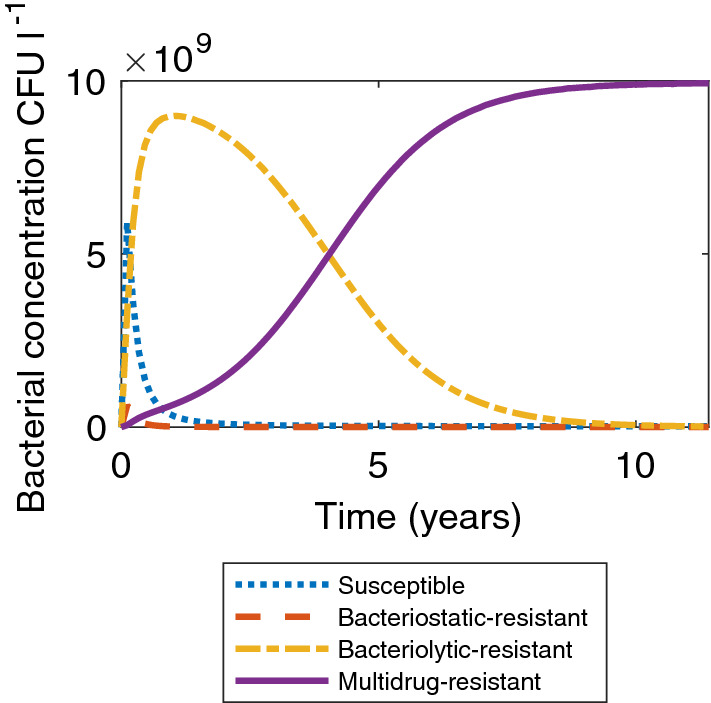
Fig. 1
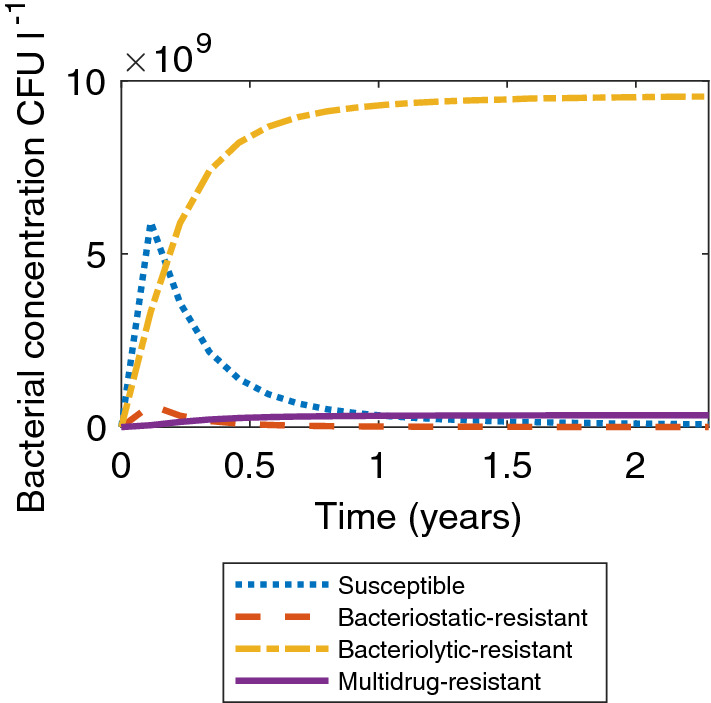
Fig. 1
The model simulated using standard parameter values, as in Table 1
Fig. 2
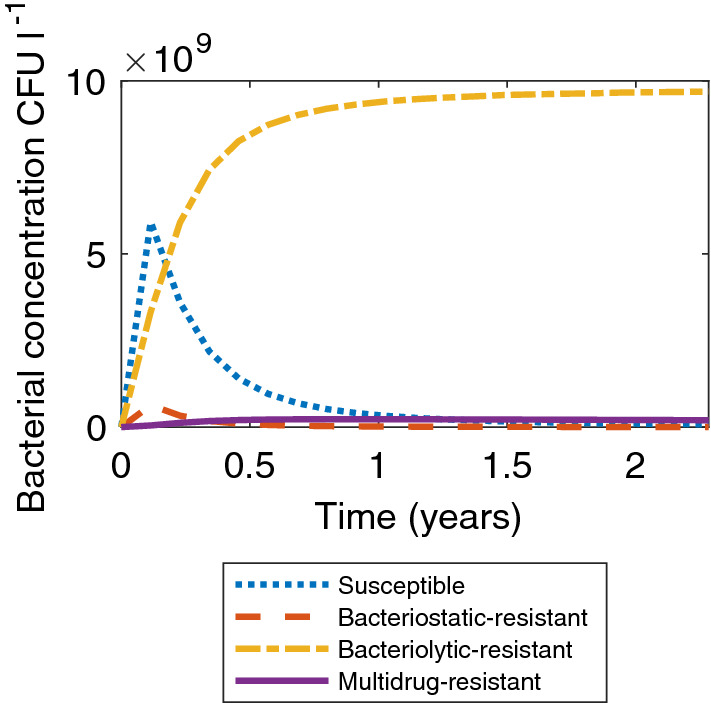
Fig. 2
Plot of bacterial concentration when the rate of MDR transfer, βu, is zero
Fig. 3
Fig. 3
Plot of bacterial concentration when the relative cost of MDR, αu, is 0.2
Fig. 4
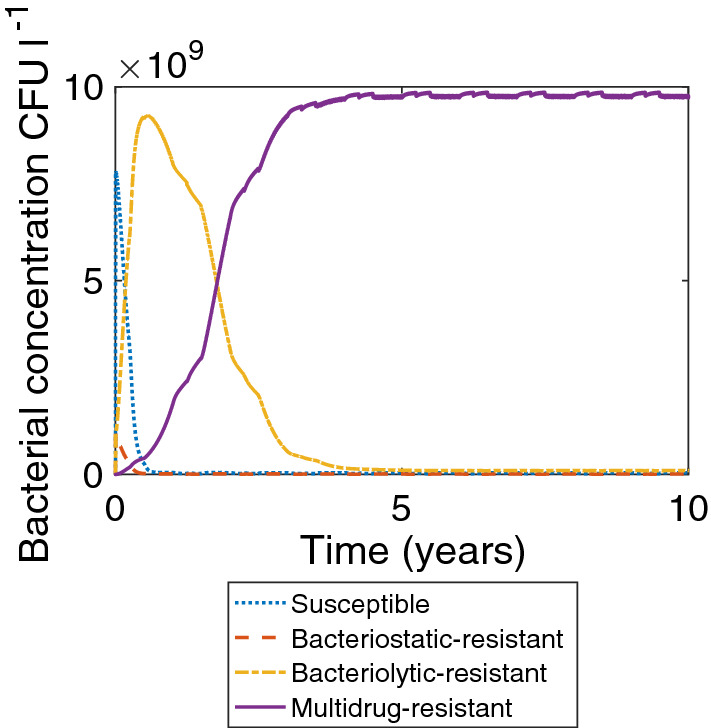
Fig. 4
Plot of bacterial concentration when there is a seasonal emptying regime
Fig. 5
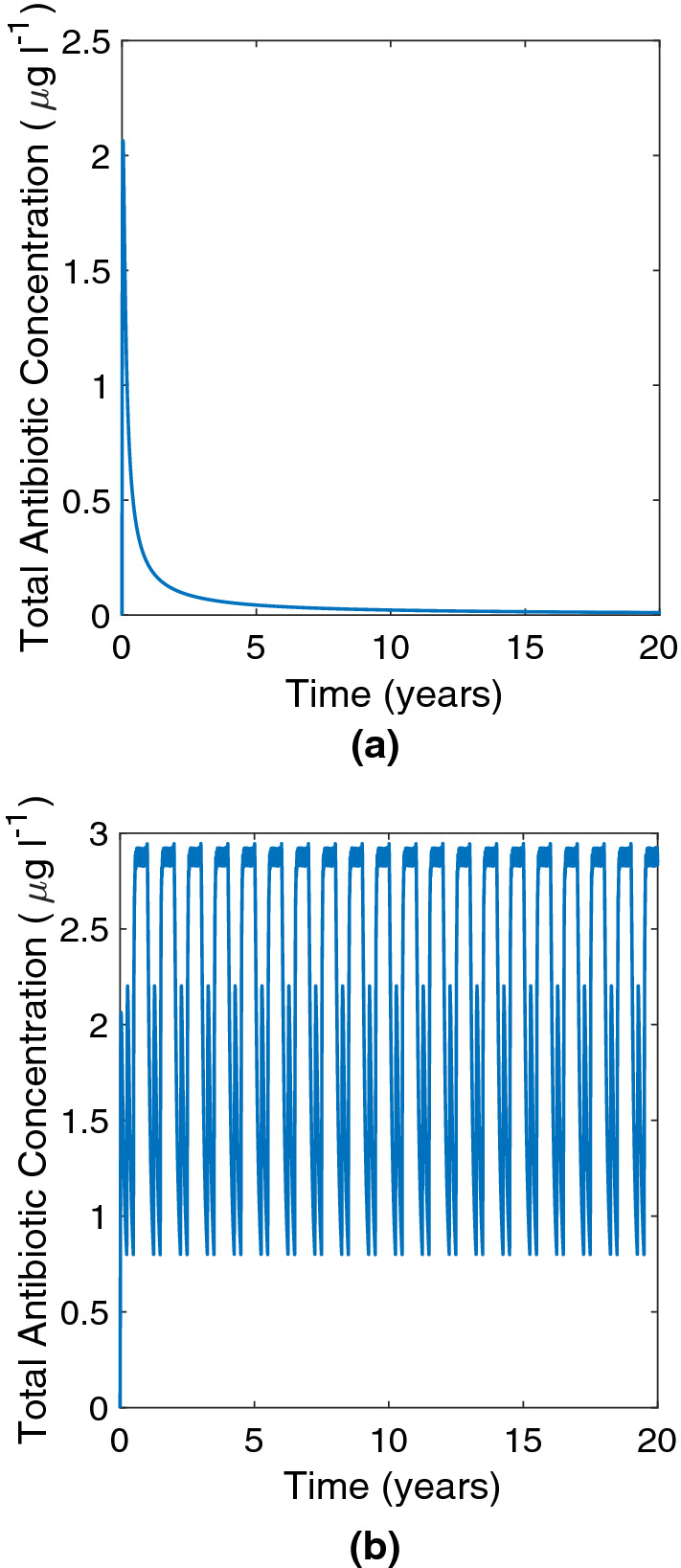
Fig. 5
Plots of the total antibiotic concentration in slurry (Al+As) under no-emptying and seasonal emptying regimes. a Total antibiotic concentration under a no-emptying regime. b Total antibiotic concentration under a seasonal emptying regime
Fig. 6
Fig. 6
Effects of varying the time between tank emptying, τe, and the initial tank volume, V1, on the time to reach 95% multidrug-resistant bacteria within the tank. The dot in 6a indicates the time to 95% MDR using the seasonal emptying frequency. A seasonal emptying regime is being used in 6b. a Varying the time between tank emptying, τe. b Varying the initial tank volume, V1
Fig. 7
Fig. 7
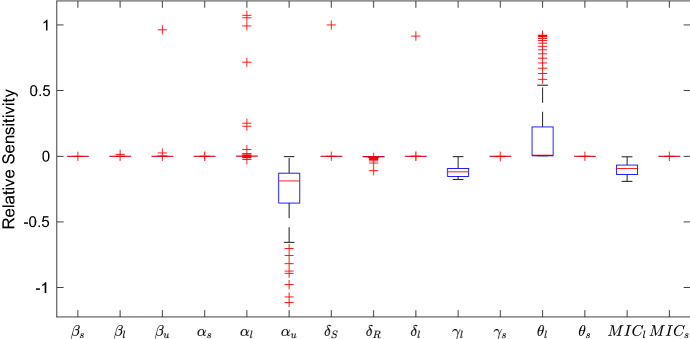
Sensitivity analysis of the model parameters where the proportion of multidrug-resistant bacteria is the output of interest under the no emptying regime. See Table 1 for parameter definitions. The system is particularly sensitive to αu, the relative cost of multidrug resistance and θl the inflow rate of bacteriolytic antibiotic. It is also sensitive to other parameters relating to bacteriolytic antibiotics
Fig. 8
Fig. 8
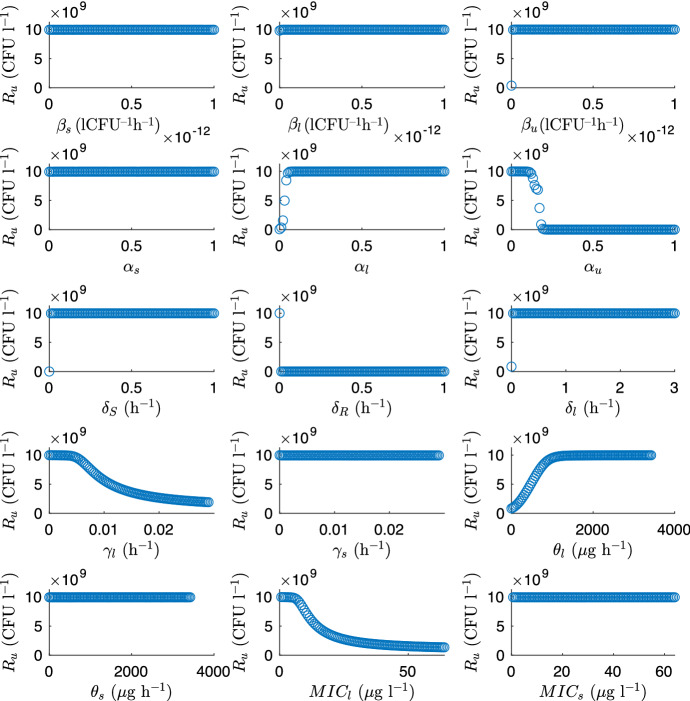
The quantity of multidrug-resistant bacteria, Ru, after 20 years as each of the parameters in Table 2 varies
Fig. 9
Fig. 9
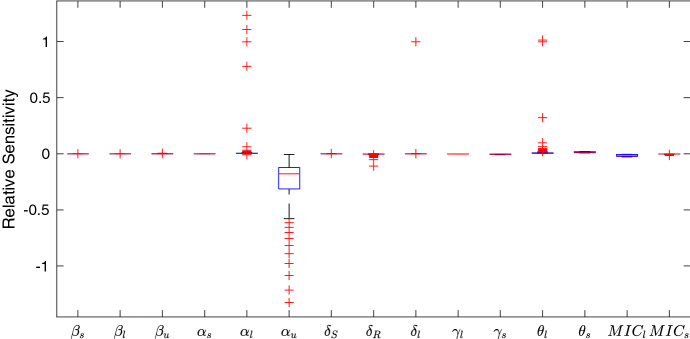
Sensitivity analysis of the model parameters where the proportion of multidrug-resistant bacteria is the output of interest and a seasonal emptying regime is used. See Table 1 for parameter definitions. Compared to the infinite tank simulations the system is much less sensitive (see Fig. 7), but αu, the relative cost of multidrug resistance remains the most sensitive parameter. Similarly, the system is also sensitive to θl, the inflow rate of bacteriolytic antibiotic, and αl, the cost of bacteriolytic resistance
Fig. 10
Fig. 10
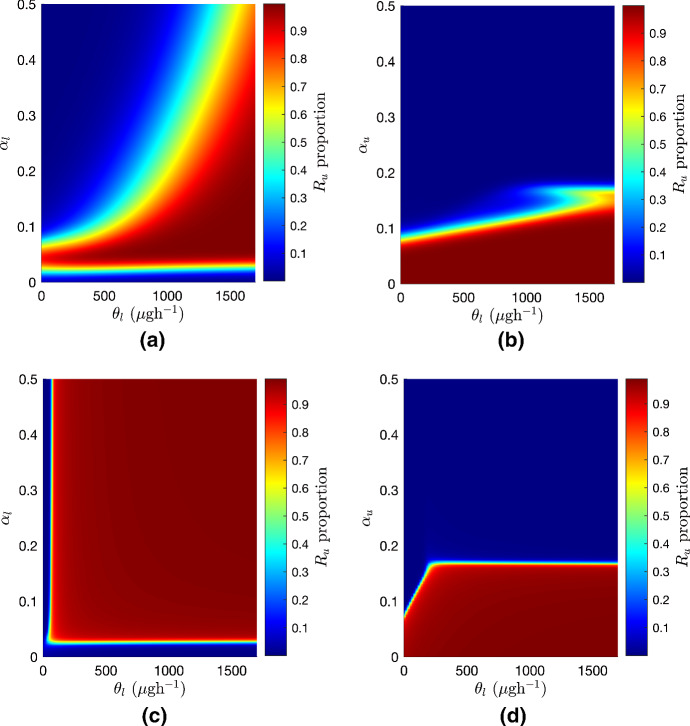
Heatmaps showing the multidrug-resistant proportion in the tank after 20 years when varying the relative cost of bacteriolytic resistance, αl, and the relative cost of MDR, αu, against the inflow rate of bacteriolytic antibiotic, θl, under no-emptying and seasonal emptying regimes. a Relative cost of bacteriolytic resistance, αl, plotted against the inflow rate of bacteriolytic antibiotic, θl, under a no-emptying regime. b Relative cost of MDR, αu, plotted against the inflow rate of bacteriolytic antibiotic, θl, under a no-emptying regime. c Relative cost of bacteriolytic resistance, αl, plotted against the inflow rate of bacteriolytic antibiotic, θl, under a seasonal emptying regime. d Relative cost of MDR, αu, plotted against the inflow rate of bacteriolytic antibiotic, θl, under a seasonal emptying regime
Fig. 11
Fig. 11
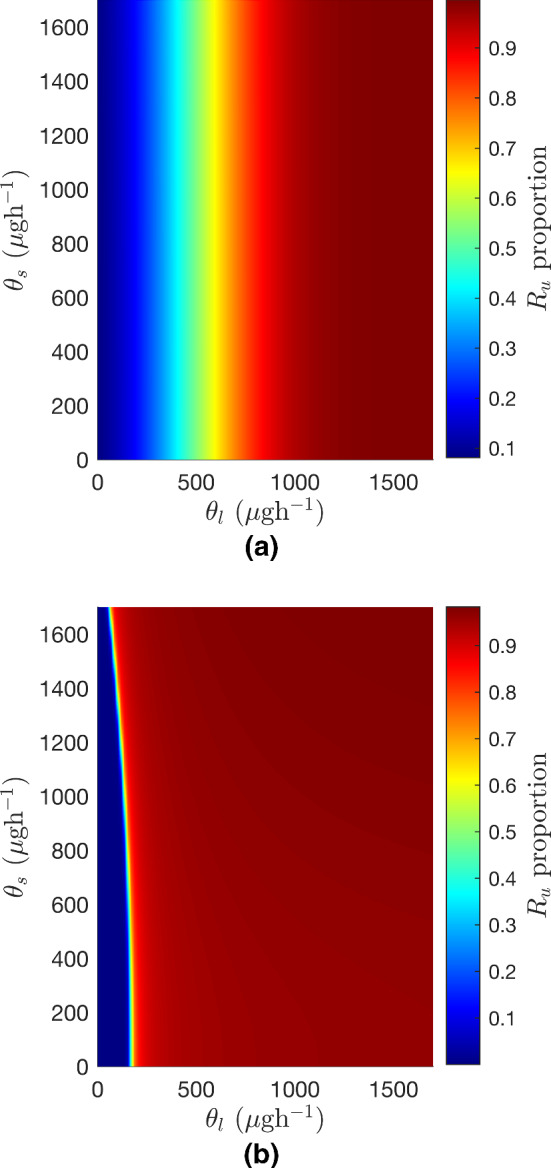
Heatmaps showing the multidrug-resistant proportion in the tank after 20 years when varying the inflow rate of bacteriostatic antibiotic, θs, and the inflow rate of bacteriolytic antibiotic, θl, under a no-emptying regime and a seasonal emptying regime. a Inflow rate of bacteriostatic antibiotic, θs, plotted against the inflow rate of bacteriolytic antibiotic, θl, under a no-emptying regime. b Inflow rate of bacteriostatic antibiotic, θs, plotted against the inflow rate of bacteriolytic antibiotic, θl, under a seasonal emptying regime

References

    1. AHDB Dairy (2019) Cost effective slurry storage stategies, AHDB dairy. https://dairy.ahdb.org.uk/resources-library/technical-information/health.... Accessed 04 April 2019
    1. AHDB Dairy (2020) Pathogens—the cause of mastitis. https://ahdb.org.uk/pathogens-the-cause-of-mastitis. Accessed 13 May 2020
    1. Aubry-Damon H, Grenet K, Sall-Ndiaye P, Che D, Cordeiro E, Bougnoux M-E, Rigaud E, Le Strat Y, Lemanissier V, Armand-Lefèvre L, et al. Antimicrobial resistance in commensal flora of pig farmers. Emerg Infect Dis. 2004;10(5):873. - PMC - PubMed
    1. Awad YM, Kim S-C, El-Azeem SAMA, Kim K-H, Kim K-R, Kim K, Jeon C, Lee SS, Ok YS. Veterinary antibiotics contamination in water, sediment, and soil near a swine manure composting facility. Environ Earth Sci. 2013;71(3):1433–1440.
    1. Ayscue P, Lanzas C, Ivanek R, Gröhn Y. Modeling on-farm Escherichia coli O157: H7 population dynamics. Foodborne Pathog Dis. 2009;6(4):461–470. - PMC - PubMed

Publication types

Substances

LinkOut - more resources