


Assessing sub-regional-specific strengths of healthcare systems associated with COVID-19 prevalence, deaths and recoveries in Africa
- PMID: 33647032
- PMCID: PMC7920381
- DOI: 10.1371/journal.pone.0247274
Assessing sub-regional-specific strengths of healthcare systems associated with COVID-19 prevalence, deaths and recoveries in Africa
Abstract
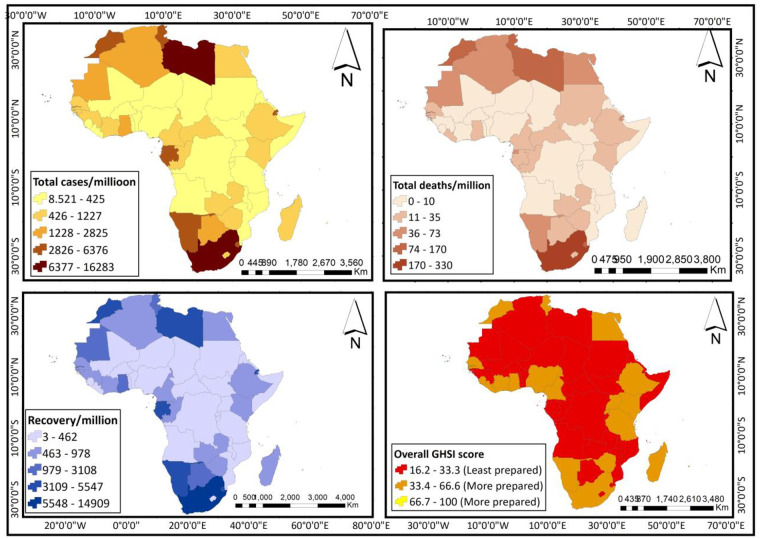
Introduction: The coronavirus 2019 (COVID-19) has overwhelmed the health systems of several countries, particularly those within the African region. Notwithstanding, the relationship between health systems and the magnitude of COVID-19 in African countries have not received research attention. In this study, we investigated the relationship between the pervasiveness of the pandemic across African countries and their Global Health Security Index (GHSI) scores.
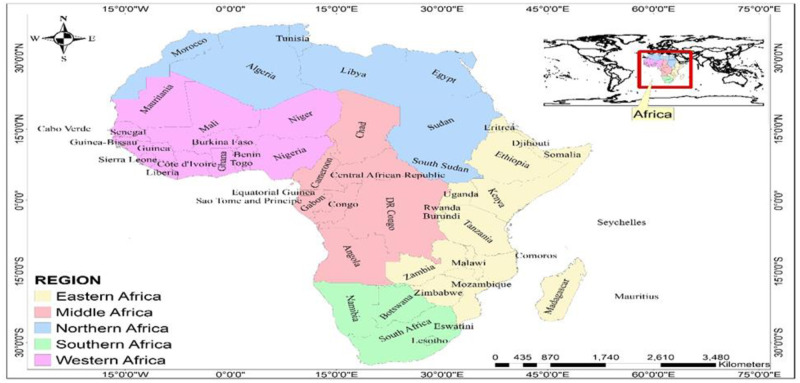
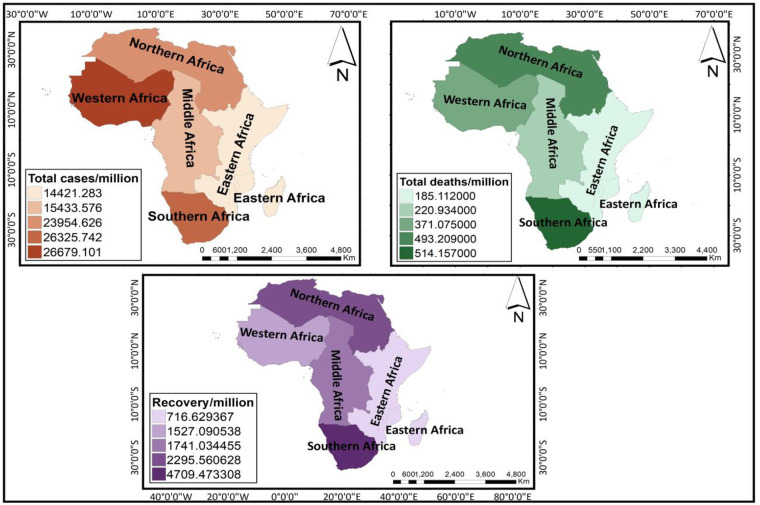
Materials and methods: The study included 54 countries in five regions viz Western (16); Eastern (18); Middle (8); Northern (7); and Southern (5) Africa. The outcome variables in this study were the total confirmed COVID-19 cases (per million); total recoveries (per million); and the total deaths (per million). The data were subjected to Spearman's rank-order (Spearman's rho) correlation to determine the monotonic relationship between each of the predictor variables and the outcome variables. The predictor variables that showed a monotonic relationship with the outcome were used to predict respective outcome variables using multiple regressions. The statistical analysis was conducted at a significance level of 0.05.
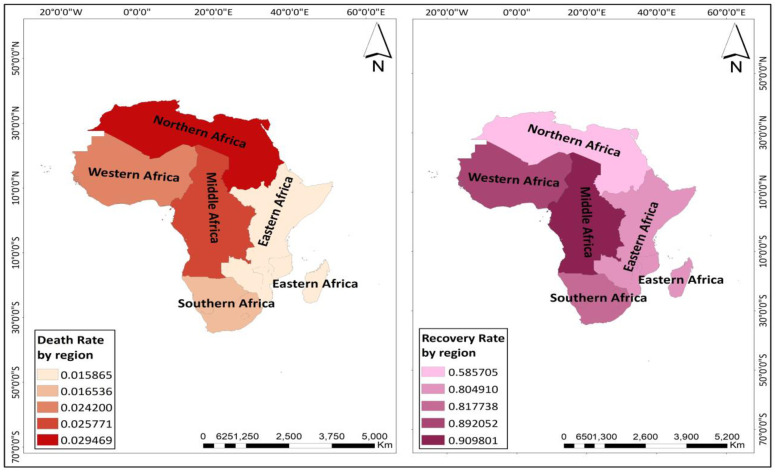
Results: Our results indicate that total number of COVID-19 cases (per million) has strong correlations (rs >0.5) with the median age; aged 65 older; aged 70 older; GDP per capita; number of hospital beds per thousand; Human Development Index (HDI); recoveries (per million); and the overall risk environment of a country. All these factors including the country's commitments to improving national capacity were related to the total number of deaths (per million). Also, strong correlations existed between the total recoveries (per million) and the total number of positive cases; total deaths (per million); median age; aged 70 older; GDP per capita; the number of hospital beds (per thousand); and HDI. The fitted regression models showed strong predictive powers (R-squared>99%) of the variances in the total number of COVID-19 cases (per million); total number of deaths (per million); and the total recoveries (per million).
Conclusions: The findings from this study suggest that patient-level characteristics such as ageing population (i.e., 65+), poverty, underlying co-morbidities-cardiovascular disease (e.g., hypertension), and diabetes through unhealthy behaviours like smoking as well as hospital care (i.e., beds per thousand) can help explain COVID-19 confirmed cases and mortality rates in Africa. Aside from these, other determinants (e.g., population density, the ability of detection, prevention and control) also affect COVID-19 prevalence, deaths and recoveries within African countries and sub-regions.
Conflict of interest statement
The authors declare no competing interest.
Figures
References
-
- IBON International. Overwhelmed health systems, more state repression as the Covid-19 arrived in Africa—IBON INTERNATIONAL [Internet]. [cited 2020 Oct 30]. https://iboninternational.org/2020/04/01/overwhelmed-health-systems-more...
-
- Johns Hopkins University. Homepage—GHS Index [Internet]. [cited 2020 Oct 30]. https://www.ghsindex.org/
-
- WHO. Responding to community spread of COVID-19. Interim Guid 7 March [Internet]. 2020;(March):1–6. https://www.who.int/publications/i/item/responding-to-community-spread-o...
-
- CDC. Implementation of Mitigation Strategies for Communities with Local COVID-19 Transmission [Internet]. 2020. https://www.cdc.gov/coronavirus/2019-ncov/downloads/communitymitigation-...
MeSH terms
LinkOut - more resources
Full Text Sources
Other Literature Sources
Medical
