


ALV-J-contaminated commercial live vaccines induced pathogenicity in Three-Yellow chickens: one of the transmission routes of ALV-J to commercial chickens
- PMID: 33647716
- PMCID: PMC7921873
- DOI: 10.1016/j.psj.2021.101027
ALV-J-contaminated commercial live vaccines induced pathogenicity in Three-Yellow chickens: one of the transmission routes of ALV-J to commercial chickens
Erratum in
-
ALV-J-contaminated commercial live vaccines induced pathogenicity in Three-Yellow chickens: one of the transmission routes of ALV-J to commercial chickens.Poult Sci. 2021 Jul;100(7):101153. doi: 10.1016/j.psj.2021.101153. Poult Sci. 2021. PMID: 34210468 Free PMC article. No abstract available.
Abstract
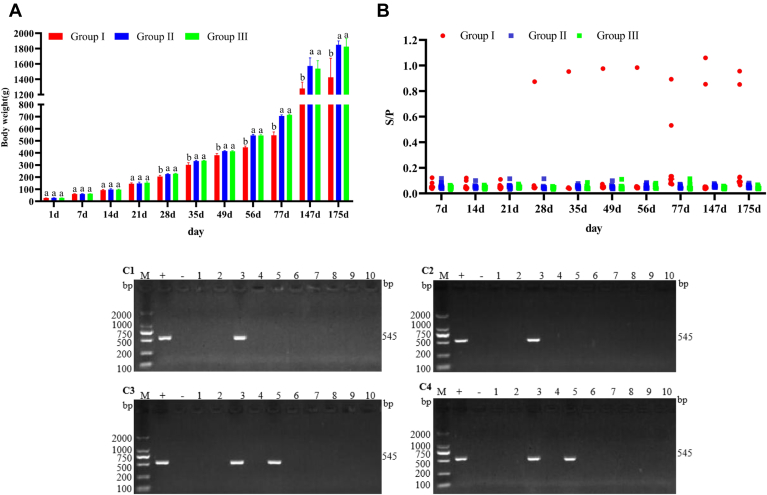
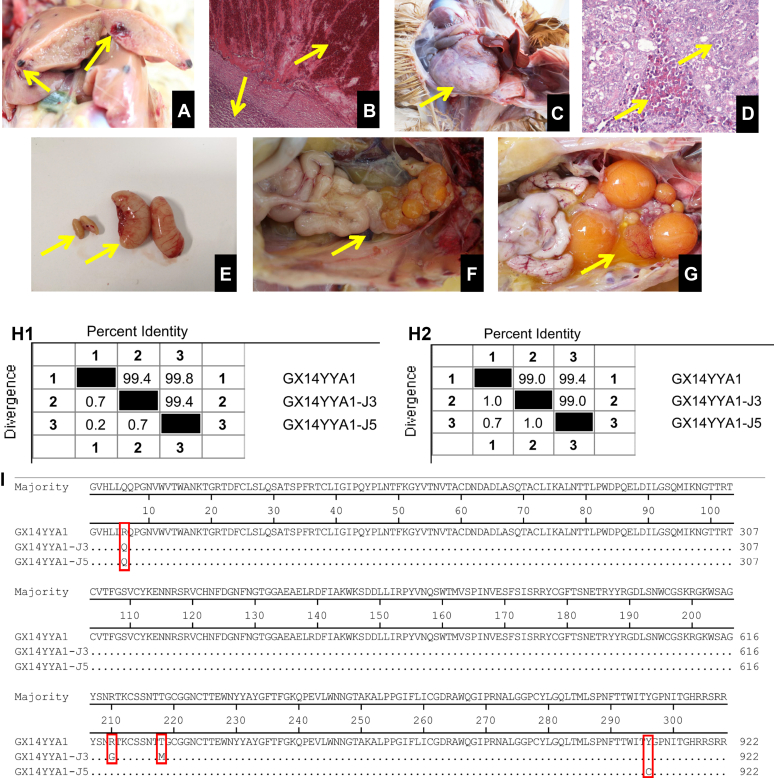
One avian leukosis virus of subgroup J (ALV-J) strain GX14YYA1 was isolated from a commercial bivalent Newcastle disease (ND)-infectious bronchitis (IB) vaccine in our previous study. To evaluate the pathogenicity of the ALV-J-contaminated vaccine on commercial chickens, day-old Three-Yellow chicks in group I were vaccinated with ALV-J-contaminated bivalent ND-IB live vaccine by intranasal and eye drop at 1-day-old for the primary vaccination and at 7-day-old for the secondary vaccination. Groups II and III were kept as the normal vaccination group with the noncontaminated ND-IB vaccine and blank control groups, respectively. The birds of different groups were maintained separately in isolators for 175 d. The first viremia was detected at 4 wk of age and 20% (2/10) of the birds maintained viremia during 11 to 25 wk of age. At the same time, the birds in group I experienced a significant suppression of body weight gain when compared with those of groups II and III (P < 0.05). In addition, the birds in group I showed obvious ALV-J hemangioma-type anatomical lesions in the liver and tumors were observed in the abdominal cavity. The results demonstrated that the ALV-J contaminated commercial live vaccines can induce pathogenicity in commercial Three-Yellow chickens and indicate that ALV-J-contaminated commercial live vaccines could be one of the transmission routes of ALV-J to commercial chickens.
Keywords: avian leukosis virus subgroup J; hemangioma; live vaccine; pathogenicity; transmission.
Copyright © 2021 The Authors. Published by Elsevier Inc. All rights reserved.
Figures
References
-
- Du Y., Cui Z.Z., Qin A.J., Silva R.F., Lee L.F. Isoaltion of Subgroup J avian leukosis viruses and their partial sequence comparison. Chin. J. Virol. 2000;6:341–346.
-
- Fadly A., Pandiri R. Silva.A., Davis C. Isolation and characterization of an Adventitious avian leukosis virus isolated from commercial Marek's disease vaccines. Avian Dis. 2006;50:380–385. - PubMed
-
- Guan X., Zhang Y., Yu M., Ren C., Gao Y., Yun B., Liu Y., Wang Y., Qi X., Liu C., Cui H., Zhang Y., Gao L., Li K., Pan Q., Zhang B., Wang X., Gao Y. Residues 28 to 39 of the Extracellular Loop 1 of chicken Na+/H+ Exchanger type I Mediate cell Binding and Entry of subgroup J avian leukosis virus. J. Virol. 2017;92 e01627-17. - PMC - PubMed
-
- Li H.J., Wang P.K., Lin L.L., Shi M.Y., Gu Z.M., Huang T., Mo M.L., Wei T.C., Zhang H.M., Wei P. The emergence of the infection of subgroup J avian leucosis virus escalated the tumour incidence in commercial Yellow chickens in Southern China in recent years. Transbound. Emerg. Dis. 2019;66:312–316. - PubMed
MeSH terms
LinkOut - more resources
Full Text Sources
Other Literature Sources
