


Growing-rod implantation improves nutrition status of early-onset scoliosis patients: a case series study of minimum 3-year follow-up
- PMID: 33648467
- PMCID: PMC7923317
- DOI: 10.1186/s12893-021-01120-7
Growing-rod implantation improves nutrition status of early-onset scoliosis patients: a case series study of minimum 3-year follow-up
Abstract
Background: Early onset scoliosis (EOS) may cause malnutrition in affected patients. Growing-rod treatment has been an effective protocol for treating EOS. The objective of this study is to demonstrate whether growing-rod treatment improves nutritional status of EOS patients.
Methods: Fifty-two EOS patients who had dual growing-rod surgery was enrolled. The minimum follow-up was 3-years. Their body weights were normalized based on the data of two National Population Census of China. Z-scores were used to indicate the standard deviation from the median body weight-for-age.
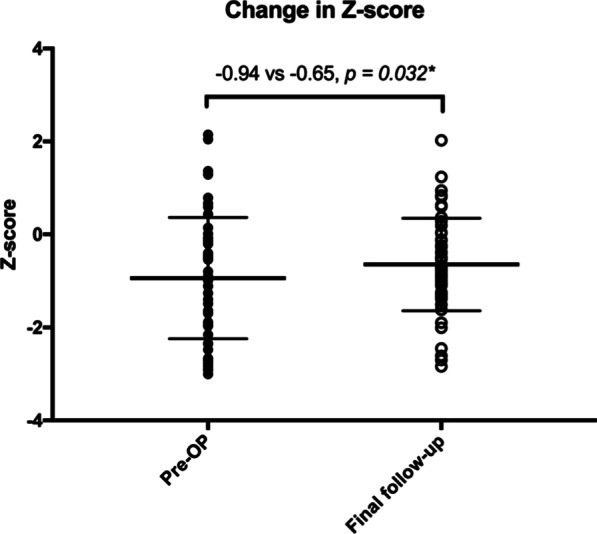
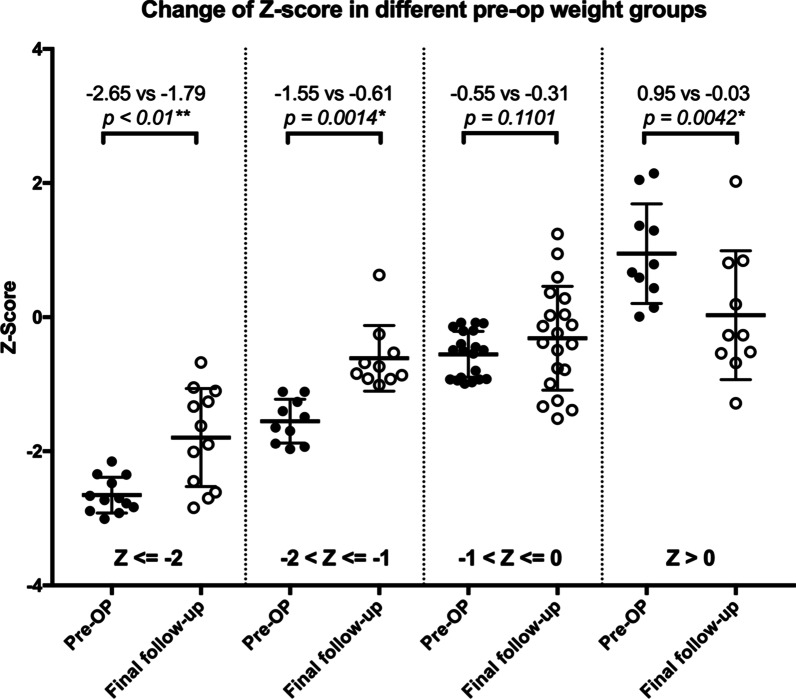
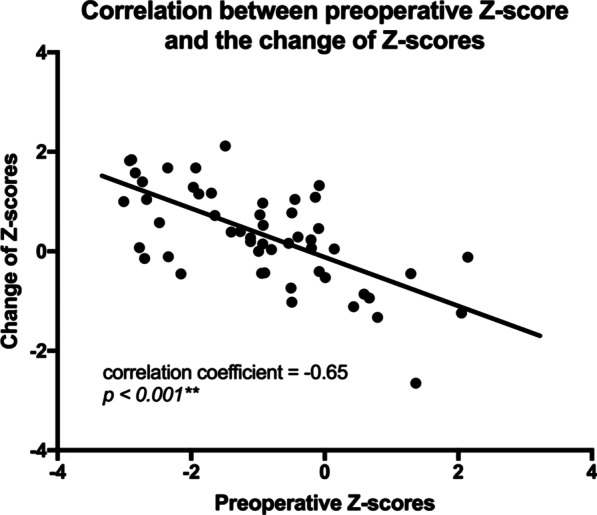
Results: The median follow-up time was 6 years. Preoperatively, the prevalence of malnutrition (Z < - 2) was 21.2%, and reduced to 9.6% at the end of the follow-up. Preoperatively, the average Z-score was - 0.94, and it increased to - 0.65 at the latest follow-up (p < 0.05). Patients with preoperative Z-score below - 1 had more significant increase of Z-scores (- 2.15 vs - 1.26, p < 0.001). A significant negative correlation between the change of Z-score and the preoperative Z-score (correlation coefficient - 0.65, p < 0.001).
Conclusions: The growing rod surgery and lengthening procedures significantly improves the nutrition status of EOS patients. The body weight gains are more significant in patients with lower body weights.
Keywords: Early-onset scoliosis; Growing-rod; Malnutrition.
Conflict of interest statement
All authors declare no competing interests.
Figures

References
-
- Dreimann M, Hoffmann M, Kossow K, Hitzl W, Meier O, Koller H. Scoliosis and chest cage deformity measures predicting impairments in pulmonary function: a cross-sectional study of 492 patients with scoliosis to improve the early identification of patients at risk. Spine (Phila Pa 1976) 2014;39:2024–2033. doi: 10.1097/BRS.0000000000000601. - DOI - PubMed
MeSH terms
LinkOut - more resources
Full Text Sources
Other Literature Sources
Medical
