


Long-term prognostic factors of clinical success after interventional bronchoscopy in patients with scarring central airway stenosis
- PMID: 33648488
- PMCID: PMC7923499
- DOI: 10.1186/s12890-021-01434-5
Long-term prognostic factors of clinical success after interventional bronchoscopy in patients with scarring central airway stenosis
Abstract
Background: Scarring central airway stenosis (SCAS) is a potentially life-threatening condition with debilitating symptoms. Interventional bronchoscopy is increasingly used to relieve symptoms in patients with SCAS, but recurrent stenosis is frequently observed. Little data exist on the long-term prognosis of interventional bronchoscopy for SCAS. We aimed to assess the prognostic factors of bronchoscopic interventions in patients with SCAS to optimize treatment.
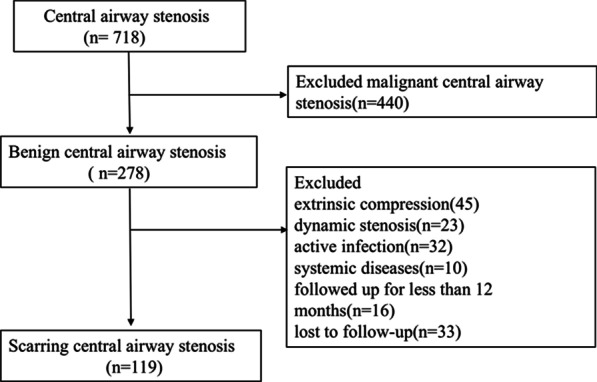
Methods: This was a retrospective study that enrolled 119 consecutive patients with SCAS from January 2010 to April 2019 at our institution. Long-term clinical success was defined as airway stenosis < 50%, no limitation of physical activity, and a stable condition for > 12 months after the last interventional procedure. We compared patients' demographics, airway stenosis characteristics, and interventional procedures between the successful and unsuccessful groups, and identified significant predictors of long-term outcome with univariate and multivariate logistic regression.
Results: A total of 119 patients with 577 therapeutic bronchoscopies were included. Seventy-five (63%) patients were considered to have long-term clinical success. Older age, male gender, smoking, elevated C-reactive protein level, subglottic stenosis, stent or T-tube implantation, previous interventional treatment, and multiple procedures per year were potentially associated with unsuccessful long-term outcomes in the univariate analysis. Current smoker status (odds ratio [OR] 5.70, 95% confidence interval [CI] 1.35-24.17, P = 0.018), subglottic stenosis (OR 4.35, 95% CI 1.31-14.46, P = 0.017), and stent implantation (OR 4.96, 95% CI 1.33-18.48, P = 0.017) were associated with decreased odds of long-term success in the multivariate logistic regression analysis. Of note, there was no significant difference in odds of success between former smokers and nonsmokers.
Conclusions: Current smoker status, subglottic stenosis, and stent implantation are independent factors associated with reduced long-term efficacy of interventional bronchoscopy for SCAS. Smoking cessation should be encouraged to improve the outcome of therapeutic bronchoscopy.
Keywords: Airway obstruction; Bronchoscopy; Outcome; Smoking; Subglottic stenosis.
Conflict of interest statement
The authors declare that they have no competing interests.
Figures
References
MeSH terms
Substances
LinkOut - more resources
Full Text Sources
Other Literature Sources
Medical
Research Materials
Miscellaneous
