


Prevalence of IgM and IgG antibodies to SARS-CoV-2 in health care workers at a tertiary care New York hospital during the Spring COVID-19 surge
- PMID: 33648573
- PMCID: PMC7920632
- DOI: 10.1186/s13741-021-00177-5
Prevalence of IgM and IgG antibodies to SARS-CoV-2 in health care workers at a tertiary care New York hospital during the Spring COVID-19 surge
Abstract
Background: Health care workers (HCW) such as anesthesiologists, surgeons, and intensivists face high rates of exposure to SARS-CoV-2 through direct contact with COVID-19 patients. While there are initial reports of the prevalence of COVID-19 antibodies among the general population, there are few reports comparing the seroprevalence of IgM/IgG COVID-19 antibodies in HCW of different exposure levels as well as different HCW professions.
Methods: A convenience sample of health care workers provided blood for COVID-19 antibody testing and a review of medical history and work exposure for correlative analyses.
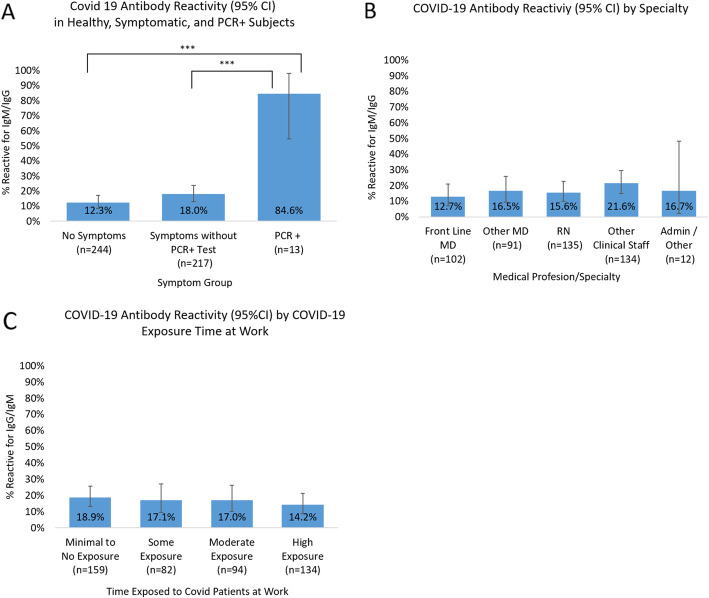
Results: Overall, 474 HCW were enrolled in April 2020 including 102 front-line physicians (e.g., anesthesiologists, surgeons, intensivists, emergency medicine), 91 other physicians, 135 nurses, 134 other clinical staff, and 12 non-clinical HCW. The prevalence of IgM or IgG antibodies to SARS-CoV-2 was 16.9% (95% CI 13.6-20.6) (80/474). The proportion of positive antibodies in the PCR + group was significantly higher than health care workers without symptoms (84.6% [95% CI 54.6-98.1] vs. 12.3% [95% CI 8.5-17.2], p < 0.001). No significant differences in proportions of COVID-19 antibodies were observed among the different exposure groups (e.g., high vs minimal/no exposure) and among the different HCW professionals.
Conclusions: Despite exposure to COVID-19 patients, the prevalence of antibodies in our HCW was similar to what has been reported for the general population of New York State (14%) and for another New York HCW cohort (13.7%). Health care workers with higher exposure rates were not more likely to have been infected with COVID-19. Therefore, these data suggest that infection of HCW may result from exposure in the community rather than at work.
Trial registration: This investigator-initiated study was observational; therefore, no registration was required. Not applicable.
Keywords: COVID-19; Health care worker; Humoral immunity; Intensivist; SARS-CoV-2.
Conflict of interest statement
This investigator-initiated study was sponsored and funded by the Department of Anesthesiology, Stony Brook University. BCF is supported by US Veterans Affairs Merit Review Award 5I01 BX003741 and NIAID R01 AI127704. The contents of this review do not represent the views of VA or the US Government. Chembio Diagnostics Inc. (Chembio) was not involved in the analysis or interpretation of the data, drafting, or revisions of the manuscript. Under a Material Transfer Agreement, Stony Brook provided blood/plasma samples to Chembio for their validation in exchange for the donation of test kits and portable readers (no monies were exchanged). None of the investigators/co-authors are advisors or consultants to Chembio, have an equity interest in Chembio, or have received any financial compensation from Chembio.
Figures

References
-
- FDA. Serology test evaluation report for “DPP COVID-19 IgM/IgG System” from Chembio 2020 [updated June 21, 2020]. Available from: https://www.accessdata.fda.gov/cdrh_docs/presentations/maf/maf3265-a001.pdf
-
- Morosky K. Nearly 17% of Long Island residents could have already had coronavirus, early antibody study shows. Riverhead Local. 2020 April, 23, 2020 12:47 pm.
Grants and funding
LinkOut - more resources
Full Text Sources
Other Literature Sources
Miscellaneous
