Birth weight modifies the relation between adulthood levels of insulin-like growth factor-1 and type 2 diabetes: a prospective cohort study
- PMID: 33648986
- PMCID: PMC7925240
- DOI: 10.1136/bmjdrc-2020-001885
Birth weight modifies the relation between adulthood levels of insulin-like growth factor-1 and type 2 diabetes: a prospective cohort study
Abstract
Introduction: Insulin-like growth factor-1 (IGF-1) has been implicated in fetal and early-life growth and development of type 2 diabetes (T2D). We aimed to examine the interaction between circulating IGF-1 and birth weight in relation to risk of T2D.
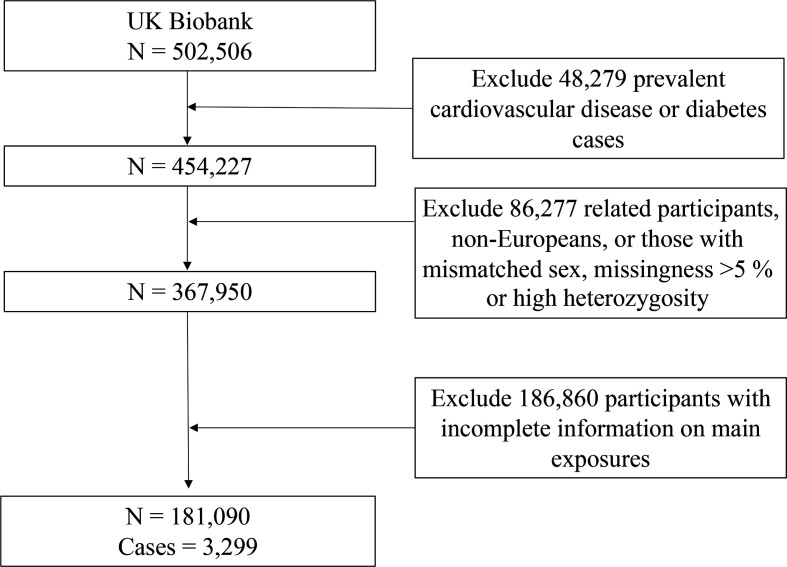
Research design and methods: We included 181 090 adults, aged 39-70 years in the UK Biobank Study, who were free of diabetes or major cardiovascular diseases at baseline. Serum IGF-1 levels were determined using chemiluminescent immunoassay method. Birth weight was self-reported; a Genetic Risk Score (GRS) was calculated to define the genetically determined birth weight. The outcome was the incidence of T2D.
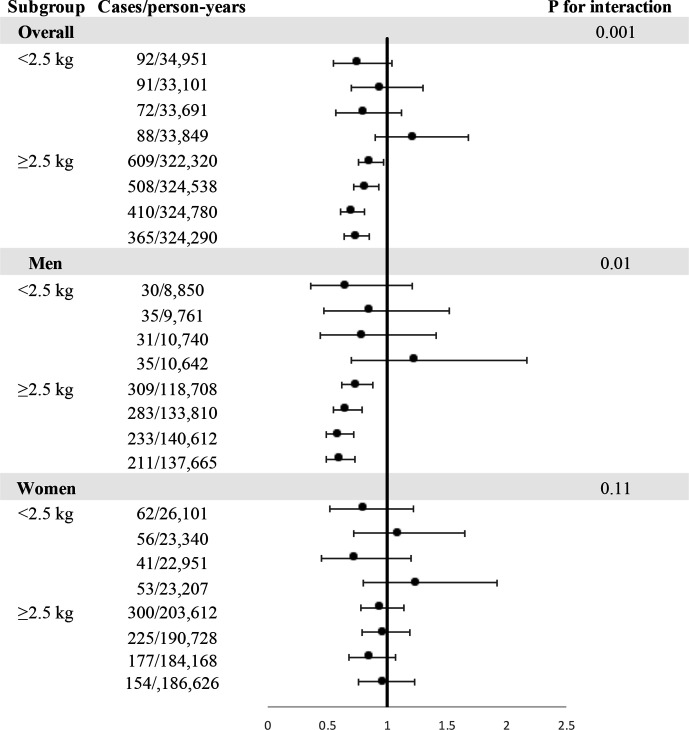
Results: We identified 3299 incident T2D cases over an average of 9.9 years of follow-up. Among the participants with birth weight of ≥2.5 kg, IGF-1 levels were inversely associated with T2D risk in a dose-dependent manner (p-trend<0.001). In contrast, the association was not significant among those with birth weight of <2.5 kg (p-interaction=0.001). The GRS of birth weight did not interact with IGF-1 levels on T2D risk.
Conclusions: Our results indicate that birth weight significantly modifies the relation between adulthood levels of circulating IGF-1 and the risk of T2D. Our findings highlight the importance of early-life risk factors in the development of the lifecourse prevention strategies targeting IGF-1 and T2D.
Keywords: birth weight; epidemiology; gene–environment Interaction; type 2 diabetes mellitus.
© Author(s) (or their employer(s)) 2021. Re-use permitted under CC BY-NC. No commercial re-use. See rights and permissions. Published by BMJ.
Conflict of interest statement
Competing interests: None declared.
Figures
References
Publication types
MeSH terms
Substances
Grants and funding
- R01 DK078616/DK/NIDDK NIH HHS/United States
- R01 DK115679/DK/NIDDK NIH HHS/United States
- MC_QA137853/MRC_/Medical Research Council/United Kingdom
- R01 DK091718/DK/NIDDK NIH HHS/United States
- U54 GM104940/GM/NIGMS NIH HHS/United States
- R21 HL126024/HL/NHLBI NIH HHS/United States
- R01 HL034594/HL/NHLBI NIH HHS/United States
- R01 HL071981/HL/NHLBI NIH HHS/United States
- U01 DK078616/DK/NIDDK NIH HHS/United States
- R01 DK100383/DK/NIDDK NIH HHS/United States
- MC_PC_17228/MRC_/Medical Research Council/United Kingdom
- UM1 DK078616/DK/NIDDK NIH HHS/United States
LinkOut - more resources
Full Text Sources
Other Literature Sources
Medical
Miscellaneous