


Risk of symptomatic COVID-19 due to aircraft transmission: a retrospective cohort study of contact-traced flights during England's containment phase
- PMID: 33650201
- PMCID: PMC8013760
- DOI: 10.1111/irv.12846
Risk of symptomatic COVID-19 due to aircraft transmission: a retrospective cohort study of contact-traced flights during England's containment phase
Abstract
Background: Knowledge gaps remain regarding SARS-CoV-2 transmission on flights. We conducted a retrospective cohort study to estimate risk of acquiring symptomatic SARS-CoV-2 on aircraft, to inform contact tracing and infection control efforts.
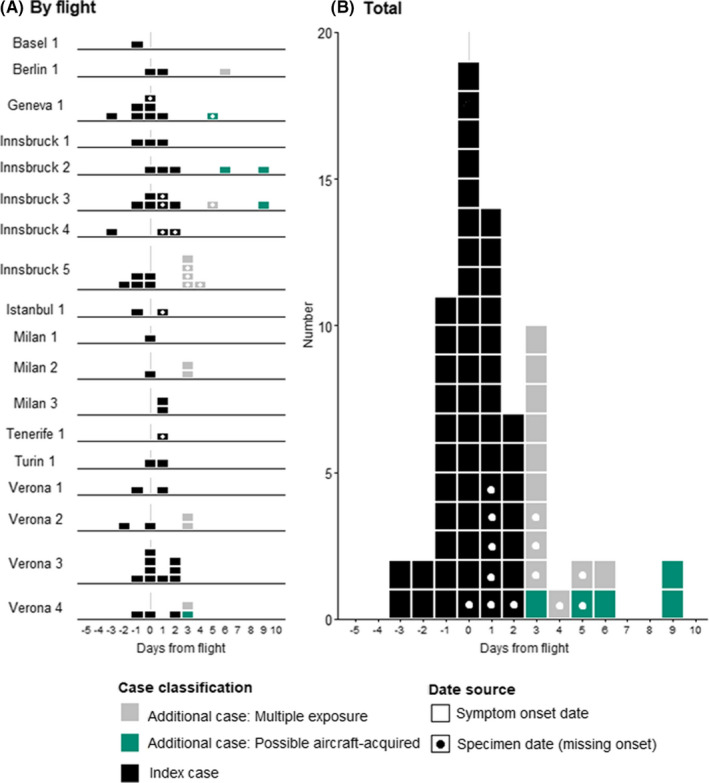
Methods: We identified co-passengers of infectious passengers on 18 England-bound flights from European cities up to 12/03/2020, using manifests received for contact tracing. Infectious passengers were laboratory-confirmed cases with symptom onset from 7 days before to 2 days after the flight. Possible aircraft-acquired cases were laboratory-confirmed with onset 3-14 days post-flight with no known non-flight exposure. Manifests was merged with the national case management dataset (identifying cases, onset dates, contact tracing status) and the national COVID-19 linelist. Contact tracing notes were reviewed to identify non-flight exposures. We calculated attack rates (ARs) among all co-passengers and within subgroups, including by distance from infectious cases and number of infectious cases on-board.
Results: There were 55 infectious passengers and 2313 co-passengers, including 2221 flight-only contacts. Five possible aircraft-acquired cases were identified; ARs of 0.2% (95%CI 0.1-0.5) among all flight-only contacts and 3.8% (95%CI 1.3-10.6) among contact-traced flight-only contacts sat within a two-seat radius. The AR among 92 co-travellers with known non-flight exposure to infectious cases was 13.0% (95%CI 7.6%-21.4%). There were insufficient numbers to assess differences between subgroups.
Conclusion: We conclude that risk of symptomatic COVID-19 due to transmission on short to medium-haul flights is low, and recommend prioritising contact-tracing of close contacts and co-travellers where resources are limited. Further research on risk on aircraft is encouraged.
Keywords: Aircraft; COVID-19; Contact tracing; Epidemiology; SARS-CoV-2; Transmission.
© 2021 The Authors. Influenza and Other Respiratory Viruses Published by John Wiley & Sons Ltd.
Conflict of interest statement
We have no conflicts of interest to declare.
Figures

References
-
- World Health Organisation . Statement on the second meeting of the International Health Regulations. (2005) Emergency Committee regarding the outbreak of novel coronavirus (2019‐nCoV). 30 January 2020. https://www.who.int/news‐room/detail/30‐01‐2020‐statement‐on‐the‐second‐.... Accessed 21 August 2020.
-
- World Health Organisation . WHO Coronavirus Disease (COVID‐19). Dashboard. 5 February 2021. https://covid19.who.int/. Accessed 5 February 2021.
-
- Public Health England . Press release: COVID‐19: government announces moving out of contain phase and into delay. 12 March 2020. https://www.gov.uk/government/news/covid‐19‐government‐announces‐moving‐.... Accessed 22 August 2020.
-
- Public Health England . Public Health Management of Contacts of Possible and Confirmed Human Cases of COVID‐19 (version 3.00). 2020. London.
-
- Airports Council International World and International Air Transport Association . Safely restarting aviation: ACI and IATA joint approach. May 2020. https://www.iata.org/contentassets/5c8786230ff34e2da406c72a52030e95/safe.... Accessed 24 August 2020.
MeSH terms
LinkOut - more resources
Full Text Sources
Other Literature Sources
Medical
Research Materials
Miscellaneous
