


National noncommunicable disease monitoring survey (NNMS) in India: Estimating risk factor prevalence in adult population
- PMID: 33651825
- PMCID: PMC7924800
- DOI: 10.1371/journal.pone.0246712
National noncommunicable disease monitoring survey (NNMS) in India: Estimating risk factor prevalence in adult population
Abstract
Background: The primary objective of National NCD monitoring survey (NNMS) was to generate national-level estimates of key NCD indicators identified in the national NCD monitoring framework. This paper describes survey study protocol and prevalence of risk factors among adults (18-69 years).
Materials and methods: NNMS was a national level cross-sectional survey conducted during 2017-18. The estimated sample size was 12,000 households from 600 primary sampling units. One adult (18-69 years) per household was selected using the World Health Organization-KISH grid. The study tools were adapted from WHO-STEPwise approach to NCD risk factor surveillance, IDSP-NCD risk factor survey and WHO-Global adult tobacco survey. Total of 8/10 indicators of adult NCD risk factors according to national NCD disease monitoring framework was studied. This survey for the first time estimated dietary intake of salt intake of population at a national level from spot urine samples.
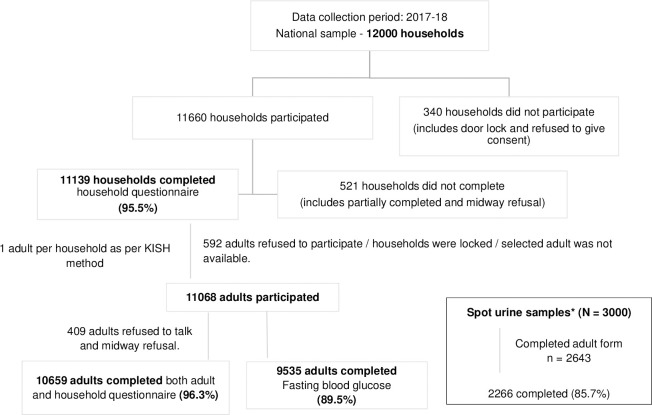
Results: Total of 11139 households and 10659 adults completed the survey. Prevalence of tobacco and alcohol use was 32.8% (95% CI: 30.8-35.0) and 15.9% (95% CI: 14.2-17.7) respectively. More than one-third adults were physically inactive [41.3% (95% CI: 39.4-43.3)], majority [98.4% (95% CI: 97.8-98.8)] consumed less than 5 servings of fruits and / or vegetables per day and mean salt intake was 8 g/day (95% CI: 7.8-8.2). Proportion with raised blood pressure and raised blood glucose were 28.5% (95% CI: 27.0-30.1) and 9.3% (95% CI: 8.3-10.5) respectively. 12.8% (95% CI: 11.2-14.5) of adults (40-69 years) had ten-year CVD risk of ≥30% or with existing CVD.
Conclusion: NNMS was the first comprehensive national survey providing relevant data to assess India's progress towards targets in National NCD monitoring framework and NCD Action Plan. Established methodology and findings from survey would contribute to plan future state-based surveys and also frame policies for prevention and control of NCDs.
Conflict of interest statement
The authors have declared that no competing interests exist.
Figures
References
-
- IHME GHDx, Hub Viz. GBD compare–Viz Hub. Noncommunicable Diseases. Both sexes, all ages, 2019, total percent of deaths. Available from: https://vizhub.healthdata.org/gbd-compare/.
-
- Indian Council of Medical Research, Public Health Foundation of India, and Institute for Health metrics and Evaluation. India: Health of the Nation’s States. The India State-Level Disease Burden Initiative. New Delhi, India: ICMR, PHFI, and IHME;2017.
-
- Choudhury A. and Roy P. Population attributable fraction analysis of leading chronic diseases in India. Human Biology Review 2016;5(3):255–283.
-
- Global status report on alcohol and health 2018. Geneva: World Health Organization; 2018. Available from: https://apps.who.int/iris/bitstream/handle/10665/274603/9789241565639-en...
Publication types
MeSH terms
Substances
LinkOut - more resources
Full Text Sources
Other Literature Sources
